37
Kate Amber and Roderick Dubrow-Marshall |An Investigation into the Efficacy of the PsychoSocial Quicksand Model™
An Investigation into the Efficacy of the
PsychoSocial Quicksand Model™
and Its Utility for Transforming Systems
Kate Amber1 and Roderick Dubrow-Marshall2
Abstract: Research findings point to widespread societal and structural impediments that currently hinder efforts to assist
survivors of coercive control, hold perpetrators accountable, and enable system professionals to develop and implement essential
policies and procedures for bringing about meaningful systemic change (Hill, 2020). To address some of these impediments, a
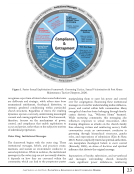
professional and survivor of coercive control designed the PsychoSocial Quicksand Model™ (PSQM), which centers survivors’
experiences, overcomes professionals’ biases and assumptions, and contextualizes coercive control to improve detection and
prevention outcomes. This mixed-methods study on the PSQM aimed to test the model’s reception amongst survivors and
professionals, and its potential ability to efficiently and effectively facilitate the initiation of systemic transformation. For
the purposes of this paper, “professionals” include anyone who works with survivors and/or perpetrators in a professional
capacity, including law enforcement, mental health professionals, court professionals, and advocates.
Study results showed a high appreciation for the PSQM’s ability to educate, validate, motivate, empower, and inspire
participants. Thematic analysis revealed numerous opportunities for systemic change, which a training model (such as the
PSQM) might address more successfully. Quantitative analysis suggests that survivors of more than one form of coercive
control who are also professionals in the field have a particularly high appreciation for the model. This finding indicates that
survivor professionals may be particularly appreciative of the complexity of coercive control to the benefit of clients. Study
results also support the inclusion of survivors’ input during every stage of policy development and implementation to increase
their liberty and autonomy, reduce re-traumatization, improve perpetrator accountability, and fill systemic gaps to reduce
coercive control worldwide.
The PSQM, as a form of psychoeducation, showed promise for survivor healing and empowerment and pointed to potential
directions for future model development and implications for practice. While the PSQM showed potential to fill many gaps, the
study also identified areas where further research and systemic implementation are needed to address unanswered questions
regarding coercive controllers’ intentions and capacity for change.
Keywords: Coercive Control, PsychoSocial, Intimate Partner Violence, Cults, Psychoeducation, The Quicksand Model®
1 Corresponding Author: kate@endccusa.com End Coercive Control USA and University of Salford
2 University of Salford and RETIRN, UK
Introduction
Susan Schecter (1982) coined the concept of coercive
control, which is a pattern of behavior used by one person
or persons to dominate another person or persons,
including tactics of physical and/or non-physical
abuse the concept was later popularized by Evan Stark
(2007). Coercive control is gaining recognition as the
foundation of domestic abuse (Fontes, 2015 Hill, 2020).
Civil and criminal legislation is slowly being proposed
and passed in the United Kingdom, United States,
Canada, and Australia within the context of domestic
abuse. While progress has been made in raising
awareness of coercive control in domestic relationships
and “coercion” has been included in human trafficking
and counter-terrorism laws, unfortunately, legislation
is not adequately addressing other important contexts
where the pattern appears (such as cults, organizations,
and systems). Even within domestic abuse, coercive
control laws (which are available only to a fraction
of the world’s population) are proving to be relatively
ineffective as strategic implementation, appropriate
contextualization, and systemic collaboration are
lacking (Terranova, 2022 Walklate &Fitz-Gibbon,
2021).
Coercive control is often referred to as “invisible
in plain sight” (Weiner, 2017). Antiquated coercive
policies and practices exist throughout the very systems
(e.g., legal, health, etc.) intended to protect survivors
and hold perpetrators accountable (Goldstein, 2014
Hill, 2020 Myhill &Hoyle, 2016), making it even
doi: 10.54208/1000/0009/003
Kate Amber and Roderick Dubrow-Marshall |An Investigation into the Efficacy of the PsychoSocial Quicksand Model™
An Investigation into the Efficacy of the
PsychoSocial Quicksand Model™
and Its Utility for Transforming Systems
Kate Amber1 and Roderick Dubrow-Marshall2
Abstract: Research findings point to widespread societal and structural impediments that currently hinder efforts to assist
survivors of coercive control, hold perpetrators accountable, and enable system professionals to develop and implement essential
policies and procedures for bringing about meaningful systemic change (Hill, 2020). To address some of these impediments, a
professional and survivor of coercive control designed the PsychoSocial Quicksand Model™ (PSQM), which centers survivors’
experiences, overcomes professionals’ biases and assumptions, and contextualizes coercive control to improve detection and
prevention outcomes. This mixed-methods study on the PSQM aimed to test the model’s reception amongst survivors and
professionals, and its potential ability to efficiently and effectively facilitate the initiation of systemic transformation. For
the purposes of this paper, “professionals” include anyone who works with survivors and/or perpetrators in a professional
capacity, including law enforcement, mental health professionals, court professionals, and advocates.
Study results showed a high appreciation for the PSQM’s ability to educate, validate, motivate, empower, and inspire
participants. Thematic analysis revealed numerous opportunities for systemic change, which a training model (such as the
PSQM) might address more successfully. Quantitative analysis suggests that survivors of more than one form of coercive
control who are also professionals in the field have a particularly high appreciation for the model. This finding indicates that
survivor professionals may be particularly appreciative of the complexity of coercive control to the benefit of clients. Study
results also support the inclusion of survivors’ input during every stage of policy development and implementation to increase
their liberty and autonomy, reduce re-traumatization, improve perpetrator accountability, and fill systemic gaps to reduce
coercive control worldwide.
The PSQM, as a form of psychoeducation, showed promise for survivor healing and empowerment and pointed to potential
directions for future model development and implications for practice. While the PSQM showed potential to fill many gaps, the
study also identified areas where further research and systemic implementation are needed to address unanswered questions
regarding coercive controllers’ intentions and capacity for change.
Keywords: Coercive Control, PsychoSocial, Intimate Partner Violence, Cults, Psychoeducation, The Quicksand Model®
1 Corresponding Author: kate@endccusa.com End Coercive Control USA and University of Salford
2 University of Salford and RETIRN, UK
Introduction
Susan Schecter (1982) coined the concept of coercive
control, which is a pattern of behavior used by one person
or persons to dominate another person or persons,
including tactics of physical and/or non-physical
abuse the concept was later popularized by Evan Stark
(2007). Coercive control is gaining recognition as the
foundation of domestic abuse (Fontes, 2015 Hill, 2020).
Civil and criminal legislation is slowly being proposed
and passed in the United Kingdom, United States,
Canada, and Australia within the context of domestic
abuse. While progress has been made in raising
awareness of coercive control in domestic relationships
and “coercion” has been included in human trafficking
and counter-terrorism laws, unfortunately, legislation
is not adequately addressing other important contexts
where the pattern appears (such as cults, organizations,
and systems). Even within domestic abuse, coercive
control laws (which are available only to a fraction
of the world’s population) are proving to be relatively
ineffective as strategic implementation, appropriate
contextualization, and systemic collaboration are
lacking (Terranova, 2022 Walklate &Fitz-Gibbon,
2021).
Coercive control is often referred to as “invisible
in plain sight” (Weiner, 2017). Antiquated coercive
policies and practices exist throughout the very systems
(e.g., legal, health, etc.) intended to protect survivors
and hold perpetrators accountable (Goldstein, 2014
Hill, 2020 Myhill &Hoyle, 2016), making it even
doi: 10.54208/1000/0009/003