iii
| |
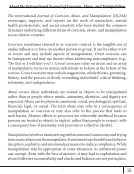
About the International Journal of Coercion, Abuse, and Manipulation
The International Journal of Coercion, Abuse, and Manipulation (IJCAM)
encourages, supports, and reports on the work of researchers, mental
health professionals, and social scientists who have studied the common
dynamics underlying different forms of coercion, abuse, and manipulation
across diverse contexts.
Coercion, sometimes referred to as coercive control, is the tangible use of
undue influence or force on another person or group. It can be either overt
or covert and may include aspects of manipulation. Overt coercion can
be transparent and may use threats when addressing noncompliance (e.g.,
“Do this or I will hurt you”). Covert coercion relies on deceit and an array
of manipulative tactics to induce individuals to behave at the behest of the
coercer. Covert coercion may include suggestions, subtle threats, grooming,
flattery, and the process of slowly overtaking individuals’ critical thinking,
autonomy, and independence.
Abuse occurs when individuals are treated as objects to be manipulated
rather than as people whose minds, autonomy, identities, and dignity are
respected. Abuse can be physical, emotional, social, psychological, spiritual,
financial, legal, or sexual. The term abuse may refer to a consequence of
manipulation or coercion or may also refer to the process that leads to
such harms. Abusive effects or processes are inherently unethical because
persons are treated as objects to exploit, rather than people to respect, with
a consequent loss of autonomy and personal or collective identity.
Manipulation involves maneuvering within someone’s autonomy and trying
to increase reliance on the manipulator. Sometimes it can be subtle and relies on
deception, sophistry, and emotional persuasion to induce compliance. While
manipulation may be appropriate in some situations, its unfettered power
can corrupt. Even with the best of motives, it may lead to exploitation and
abuse if effective accountability and checks and balances are not put in place.
| |
About the International Journal of Coercion, Abuse, and Manipulation
The International Journal of Coercion, Abuse, and Manipulation (IJCAM)
encourages, supports, and reports on the work of researchers, mental
health professionals, and social scientists who have studied the common
dynamics underlying different forms of coercion, abuse, and manipulation
across diverse contexts.
Coercion, sometimes referred to as coercive control, is the tangible use of
undue influence or force on another person or group. It can be either overt
or covert and may include aspects of manipulation. Overt coercion can
be transparent and may use threats when addressing noncompliance (e.g.,
“Do this or I will hurt you”). Covert coercion relies on deceit and an array
of manipulative tactics to induce individuals to behave at the behest of the
coercer. Covert coercion may include suggestions, subtle threats, grooming,
flattery, and the process of slowly overtaking individuals’ critical thinking,
autonomy, and independence.
Abuse occurs when individuals are treated as objects to be manipulated
rather than as people whose minds, autonomy, identities, and dignity are
respected. Abuse can be physical, emotional, social, psychological, spiritual,
financial, legal, or sexual. The term abuse may refer to a consequence of
manipulation or coercion or may also refer to the process that leads to
such harms. Abusive effects or processes are inherently unethical because
persons are treated as objects to exploit, rather than people to respect, with
a consequent loss of autonomy and personal or collective identity.
Manipulation involves maneuvering within someone’s autonomy and trying
to increase reliance on the manipulator. Sometimes it can be subtle and relies on
deception, sophistry, and emotional persuasion to induce compliance. While
manipulation may be appropriate in some situations, its unfettered power
can corrupt. Even with the best of motives, it may lead to exploitation and
abuse if effective accountability and checks and balances are not put in place.