Cultic Studies Journal, Vol. 2 No. 1 1985, Page 58
research--an empirical investigation into the nature and extent of the initial contact stage
between cults and high school students. The utility of our conceptual model will first be
assessed in terms of its predictive value in identifying a subset of adolescents likely to be
contacted or not approached by cult recruiters, and secondly, by predicting those likely to
be receptive, to or rejecting of further affiliation with a cult.
Model of Contact-Indoctrination-Conversion
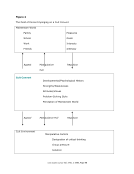
Four distinct phases are identified in the sequence of events and activities that begin prior
to the Initial contact and lead up to a recruited member‘s final conversion into the new
organization. However, there is also feedback of later processes upon those in prior phases,
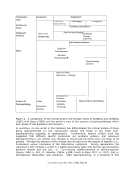
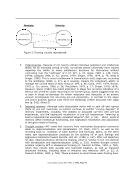
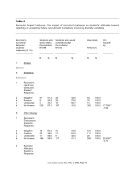
and some reciprocal interaction between these phases. Figure 1.1 provides a schematic
representation of the four phases within the overall sequence, along with the major
subcategories within each phase. [Figure 1.1 not available in this medium]
Our primary focus is on the first three phases, or the pre-conversion structure of the model.
In the final phase, the recruit is converted to the new ideology and becomes a recruiter who
reenters the system by directing contact efforts toward prospective members or by being
selected for contact by them. Group members who decide to ―exit‖ from the organization or
are ―deprogrammed‖ to change their acquired cult belief structure typically come from those
who are somewhere in this last phase. Although the process by which such transformations
into and out of this conversion mentality occur is inherently interesting, for the present we
have limited the scope of our inquiry to the earlier stages of this complex sequence.
Phase I includes the pre-contact variables, or the background characteristics and knowledge
structure of the potential convert and the recruiter. Phase 11 (recruitment) and III
(indoctrination) include the initial and developed contact variables, or situational factors,
mediational processes, and outcome measures of each contact.
The contact may be either selective or directed. Selective contact results when an
individual, perhaps out of curiosity, intellectual interest, personal needs, or ideological
distress, seeks, or makes him/herself available to the group member. Directed, or planned
contact, is initiated by individuals who, on their own or as representatives of a cult group,
intentionally seek to introduce new ideas to another person in order to achieve specific goals
defined for that encounter. However, the selective and directed roles are not exclusive of
one another: a recruit can simultaneously be a seeker and sought after, and so may be the
recruiter.
In Phase II an individual may come into mediated or direct (personal) contact with a group
member. Contact, for example, may be face to face or through exposure to the media‘s
presentation of information about the group. Thus, if the individual chooses to watch a TV
talk show featuring a cult group member or listen to a radio commercial advertising a
particular group‘s literature or meetings, he or she is selecting contact through mediated
channels.
While mediated channels are often more important in creating awareness or knowledge of
representative groups, direct channels are more important in changing attitudes toward
them. If, for whatever reason, the individual talks to a recruitment agent, recruitment can
occur. In such a case, (positive or negative) affective ties are developed between a potential
convert and the recruiter. Following this response, an individual may choose to attend or
may be invited to an introductory meeting, a dinner, or a film. On the other hand, either
actor may terminate the interaction following initial contact.
Accepting the offer for further exposure brings the potential recruit into Phase III. During
this period of indoctrination, more sustained compliance-gaining strategies are directed at
the recruit. In addition, increased efforts are focused on separating him or her from prior