Cultic Studies Journal, Vol. 2 No. 1 1985, Page 109
SELECTED REFERENCES
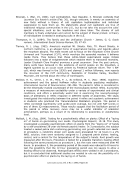
Addis, M., Schulmann-Miller, J., Lightman, M. (1984). The Cult Clinic helps families in crisis.
Social Casework, 65,515-522. Describes a cult clinic offering counseling and
educational services to families with cult-involved children, and teaching techniques
aimed at reducing family dysfunctions. The clinic was started because traditional
therapies did not address the problems experienced by families with children in cults.
The article outlines family issues, including parental and sibling reactions, effect of
cult on family structure, lack of communication. The clinic educates families about
cultic mind control and recruitment techniques, and teaches communication skills
aimed at reestablishing communication with the cult-involved child and the
reevaluation of cult membership. The article also explores family problems
contributing to and exacerbated by a child‘s cult membership. It provides families
with strategies for locating lost children and information pertaining to legal aspects of
a child‘s cult involvement. Also described are intake procedures, specific objectives
and interventions, and effectiveness with clients.
Alfano, S. (1985). The making of a Moonie -Barker, E. (Book review). Psychology Today,
19, 72-73.
Alldridge, P. (Dec. 1984). Brainwashing as a criminal-law defense. Criminal Law Review,
726-737.
Appenzeller, S. N. (1984). Cult and the family – Kaslow, F., Sussman, B. (Book review).
Psychiatric Forum, 12, 77.
Badawi, K., Wallace, R. K., Orme, J. D., &Rouzere, A. M. (May-Jun. 1984).
Electrophysiologic characteristics of respiratory suspension periods occurring during
the practice of the transcendental meditation program. Psychosomatic Medicine,
267-276. The electrophysiologic characteristics of the TM program were investigated
through observation of 52 periods of spontaneous respiratory suspension (RS) in 18
of 54 TM meditators (aged 21-43 years) during meditation. These periods were
correlated with some subjective experiences of pure consciousness. 19 RS periods
involving 11 SS free from any artifact were selected for EEG analysis. The mean total
EEG coherence over all frequencies and over 9 derivations for TM SS showed a
significant increase during the RS periods as compared to pre-and post-RS control
periods. No significant change was noted in mean total EEG coherence in a control
group of 30 SS (mean age 24.8 years) voluntarily holding their breath. Heart rates
showed a significant decrease during the RS periods in both the experimental and
control groups, but there was no significant change in EEG alpha power in either
group. These findings extend those of previous studies and help characterize the
physiological correlates of the state of pure consciousness during the TM program.
(32 ref).
Berman, C. (Apr. 8, 1983). Cults for capitalism. New Statesman, 11. Programmes, Britain‘s
largest telephone sales company, has been criticized for its use of an agressive sales
technique, taught by The Exegesis Programme. Most of Programme‘s staff of 120 are
Exegesis cult members who have attended a controversial self-awareness course.
Elisabeth Gluck, Programme‘s managing director, claims that Exegesis helps
communication and achievement. Liberal Party candidate Judith Kramer, co-founder
of The Exegesis Programme, scored high in the polls in the Deptford local council
election. Programmes has done promotions for the Financial Times, Allen &Unwin,
and several computer companies. Programme‘s workers operate in evangelical-type
groups, and must meet high target quotas. Strong group identity is encouraged at
Exegesis ,meetings.