Cultic Studies Review, Vol. 9, No. 1, 2010, Page 95
Sounding Creativity
Melinda Haas, L.C.S.W.
Jungian Analyst
Abstract
In this paper I present a Neoclassical Jungian perspective on late 20th century
Western culture and the effect of that culture on creativity, and on
vulnerability to cult involvement. Through examples of composers‘
relationships to their own music, I offer an understanding of creativity‘s locus
in the depths of the psyche.
The great problems of humanity were never yet solved by general laws, but
only through regeneration of the attitudes of individuals. If ever there was a
time when self-reflection was the absolutely necessary and only right thing, it
is now, in our present catastrophic epoch. …Individual self-reflection, return
of the individual to the ground of human nature, to his own deepest being
with its individual and social destiny—here is the beginning of a cure for that
blindness which reigns at the present hour. (Jung, 1916, pp. 4–5)
Carl Jung wrote this statement in Europe in the middle of World War I. Perhaps
inconceivable to him was the possibility that the world situation could get worse. And yet,
by the end of the 20th century, his plea for ―self-reflection‖ had gone largely unheeded.
Western culture had devolved into a fast-moving, externally validating, quick-fix, right and
wrong society. The ground, turned over and tilled since the beginning of the century, was,
by its end, fertile for the growth of cults. One end of the spectrum of human values and
concerns had been left outside the popular culture. Cults, extreme versions of the pervasive
one-sidedness that remained, easily took hold. The privileging of the rational and logical had
been developing for hundreds if not several thousand of years, and even more rapidly since
the Age of Enlightenment, with the rejection of religion as ―irrational.‖ The 20th century saw
the culmination of this trajectory. To the Neoclassical Jungian, the over-emphasis on logical
and linear thinking, with its binary by-products either/or, black/white, inclusion/exclusion,
right/wrong, has encapsulated our experience of life. We are caught within directed
thinking, and we have come to define consciousness solely in these terms. Without the rich
energy that lies in intuition, feeling, sensory awareness, causal possibilities, a sense of
timelessness, we are cut off from the source of our own uniqueness and thus from our
creativity.
The seeking that is prerequisite to cult involvement must surely emerge in the individual
who is not finding what s/he needs in the culture. Two needs seem to constellate
simultaneously. One is the need for expansiveness— spiritual, psychological, creative. The
other is the need for containment and belonging. The linear, either/or, inclusive/exclusive
society that Western culture has become offers neither the space nor the safety to those
seekers. By the end of the 20th century, much of life energy had been caught in the demand
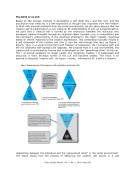
to think in a logical, concretizing, and dichotomizing system. We could call this ―ego‖
thinking.i It is as if a retaining wall had been constructed to insure no escape. Outside this
encapsulation, life energy has the potential to actually be contained, rather than retained,
but in a way that is inclusive, accepting, intuitive, non-linear. To exit the encapsulating ego
is to access psychic energy. In other words, one is able to have a more immediate
experience of ―psyche.‖ii
Sounding Creativity
Melinda Haas, L.C.S.W.
Jungian Analyst
Abstract
In this paper I present a Neoclassical Jungian perspective on late 20th century
Western culture and the effect of that culture on creativity, and on
vulnerability to cult involvement. Through examples of composers‘
relationships to their own music, I offer an understanding of creativity‘s locus
in the depths of the psyche.
The great problems of humanity were never yet solved by general laws, but
only through regeneration of the attitudes of individuals. If ever there was a
time when self-reflection was the absolutely necessary and only right thing, it
is now, in our present catastrophic epoch. …Individual self-reflection, return
of the individual to the ground of human nature, to his own deepest being
with its individual and social destiny—here is the beginning of a cure for that
blindness which reigns at the present hour. (Jung, 1916, pp. 4–5)
Carl Jung wrote this statement in Europe in the middle of World War I. Perhaps
inconceivable to him was the possibility that the world situation could get worse. And yet,
by the end of the 20th century, his plea for ―self-reflection‖ had gone largely unheeded.
Western culture had devolved into a fast-moving, externally validating, quick-fix, right and
wrong society. The ground, turned over and tilled since the beginning of the century, was,
by its end, fertile for the growth of cults. One end of the spectrum of human values and
concerns had been left outside the popular culture. Cults, extreme versions of the pervasive
one-sidedness that remained, easily took hold. The privileging of the rational and logical had
been developing for hundreds if not several thousand of years, and even more rapidly since
the Age of Enlightenment, with the rejection of religion as ―irrational.‖ The 20th century saw
the culmination of this trajectory. To the Neoclassical Jungian, the over-emphasis on logical
and linear thinking, with its binary by-products either/or, black/white, inclusion/exclusion,
right/wrong, has encapsulated our experience of life. We are caught within directed
thinking, and we have come to define consciousness solely in these terms. Without the rich
energy that lies in intuition, feeling, sensory awareness, causal possibilities, a sense of
timelessness, we are cut off from the source of our own uniqueness and thus from our
creativity.
The seeking that is prerequisite to cult involvement must surely emerge in the individual
who is not finding what s/he needs in the culture. Two needs seem to constellate
simultaneously. One is the need for expansiveness— spiritual, psychological, creative. The
other is the need for containment and belonging. The linear, either/or, inclusive/exclusive
society that Western culture has become offers neither the space nor the safety to those
seekers. By the end of the 20th century, much of life energy had been caught in the demand
to think in a logical, concretizing, and dichotomizing system. We could call this ―ego‖
thinking.i It is as if a retaining wall had been constructed to insure no escape. Outside this
encapsulation, life energy has the potential to actually be contained, rather than retained,
but in a way that is inclusive, accepting, intuitive, non-linear. To exit the encapsulating ego
is to access psychic energy. In other words, one is able to have a more immediate
experience of ―psyche.‖ii