Cultic Studies Review, Vol. 9, No. 1, 2010, Page 47
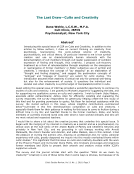
“Just Joking”: Psychoanalytic Treatment of the
Suppression of Creativity in Cults
Dana Wehle, L.C.S.W., M.F.A.
Cult Clinic, JBFCS
Psychoanalyst, New York City
Abstract
This paper presents four psychoanalytically based hypotheses to support
my thesis that the fundamental psychological impact of cults is
dehumanization through the suppression of creativity. My hypotheses
assume symbol formation as characteristically human, intrinsic to
creativity, and impaired in cultic settings.1 I explore four basic criteria of
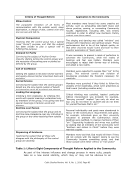
creativity: 1) mourning of loss, 2) tolerance of lack/unfilling of gap, 3)
tolerance of opposition, and 4) tolerance of uncertainty. I then contrast
the fate of these criteria in open versus cultic environments.
Psychoanalysis suggests that suppression of creativity in the individual occurs when there is
a stifling of feelings of loss, opposition, and uncertainty and a disallowance of unfilled
psychic space essential for symbol formation and creation of subjective meaning. Looking
through the lenses of psychoanalyst and painter, and informed by extensive clinical work
with former cult members and second-generation adults (SGAs), I regard suppression of
creativity as primary among the negative impacts of destructive cults. I propose four
hypotheses that build upon Lifton‘s (1961) thought that in cults ―imagination becomes
dissociated from actual life experiences‖ and ―may even tend to atrophy from disuse‖ (p.
430). These four hypotheses contrast the presence or absence of each of four basic criteria
of creativity in open versus cultic environments, and suggest a link between their absence
and the suppression of creativity in cults.
Further, I suggest that two psychoanalytically defined psychic mechanisms, ―trial projective
identification‖ and ―total projective identification‖ (Grotstein, 1994, p. 721), underlie the
hypotheses. As applied to cults and creativity, the two mechanisms can briefly be thought of
as follows: 1) trial projective identification is an unconscious communication in an open
environment, and reflects the encouragement of creativity and 2) total projective
identification is an unconscious communication that underlies cultic functioning, and it
reflects the suppression of creativity. These mechanisms offer an explanation for the ―bait
and switch‖ operation characteristic of cult leaders. When a new recruit is baited by the
leader, the soon-to-be member often flourishes with a sense of aliveness and creativity
based on the charismatic leader‘s use of ―trial projective identification‖ marked by
communication devoid of domination. The switch occurs when the deeply entrenched cult
member has accepted full identification with the leader and thus forfeited both a decision-
making process and creative living. What at first appeared to the member as authentic and
non-dominating communication by the leader and/or disciples insidiously transforms into
“Just Joking”: Psychoanalytic Treatment of the
Suppression of Creativity in Cults
Dana Wehle, L.C.S.W., M.F.A.
Cult Clinic, JBFCS
Psychoanalyst, New York City
Abstract
This paper presents four psychoanalytically based hypotheses to support
my thesis that the fundamental psychological impact of cults is
dehumanization through the suppression of creativity. My hypotheses
assume symbol formation as characteristically human, intrinsic to
creativity, and impaired in cultic settings.1 I explore four basic criteria of
creativity: 1) mourning of loss, 2) tolerance of lack/unfilling of gap, 3)
tolerance of opposition, and 4) tolerance of uncertainty. I then contrast
the fate of these criteria in open versus cultic environments.
Psychoanalysis suggests that suppression of creativity in the individual occurs when there is
a stifling of feelings of loss, opposition, and uncertainty and a disallowance of unfilled
psychic space essential for symbol formation and creation of subjective meaning. Looking
through the lenses of psychoanalyst and painter, and informed by extensive clinical work
with former cult members and second-generation adults (SGAs), I regard suppression of
creativity as primary among the negative impacts of destructive cults. I propose four
hypotheses that build upon Lifton‘s (1961) thought that in cults ―imagination becomes
dissociated from actual life experiences‖ and ―may even tend to atrophy from disuse‖ (p.
430). These four hypotheses contrast the presence or absence of each of four basic criteria
of creativity in open versus cultic environments, and suggest a link between their absence
and the suppression of creativity in cults.
Further, I suggest that two psychoanalytically defined psychic mechanisms, ―trial projective
identification‖ and ―total projective identification‖ (Grotstein, 1994, p. 721), underlie the
hypotheses. As applied to cults and creativity, the two mechanisms can briefly be thought of
as follows: 1) trial projective identification is an unconscious communication in an open
environment, and reflects the encouragement of creativity and 2) total projective
identification is an unconscious communication that underlies cultic functioning, and it
reflects the suppression of creativity. These mechanisms offer an explanation for the ―bait
and switch‖ operation characteristic of cult leaders. When a new recruit is baited by the
leader, the soon-to-be member often flourishes with a sense of aliveness and creativity
based on the charismatic leader‘s use of ―trial projective identification‖ marked by
communication devoid of domination. The switch occurs when the deeply entrenched cult
member has accepted full identification with the leader and thus forfeited both a decision-
making process and creative living. What at first appeared to the member as authentic and
non-dominating communication by the leader and/or disciples insidiously transforms into