Cultic Studies Review, Vol. 9, No. 1, 2010, Page 137
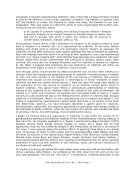
essentially, products of illusion and therefore not worthy of the attention of Krishna‘s
devotees.
************
To make art, to create form from chaos, one must be prepared to launch oneself off into
realms of the unknown and the unfamiliar, to places of mystery and uncertainty. The artist
must be willing to enter the darkness and await new lights from within, to leave the safe
moorings of common perception and routine and see with new and awed eyes. But these
mysterious realms are harshly devalued and made off-limits to those who suckle on the teat
of Truth, feeding on perfect Knowledge.
Religion is often described as an inward journey but often in practice it becomes a tool for
obscuring paths to the inner world of consciousness and personal being, a strategy for
preempting inward journeys—sometimes even defining inwardness itself as a dangerous
path, a deadly detour from religious ―healthy-mindedness.‖ The inner, subjective world is an
impure place, authoritarian religion warns, inhabited by dark spirits and ghostly presences,
a commodious and secure hiding place for Satan or for Maya. If one should happen to fall
into the darkness, and the demons of doubt and confusion begin nipping at one‘s heels, one
is taught, through intensive training, to haul oneself out of the pit by grabbing onto the holy
beads, the purifying mantra, the protective prayer, the saving words of scripture, the
purifying sound of the guru‘s voice, which cleanse the mind and fill it with clarity and
conviction. The way of art, however, is an inner way, a journey through the dark caverns
and illuminated fields of the interior universe, a search not for ―perfection‖ but for authentic
being, guided not by external agents but by inner imperative.
************
If art is about making sense of the world, if it is a seeking of answers to primal, existential
questions, a quest for comprehension and insight into the nature of reality through the
apprehension and inspired molding of the materials of thought and perception—if it is, as
many have said, a path to knowledge—then it is tragically preempted by the tyranny of
authoritarian Truth. Religions, corporate truth systems, have already done the work of
researching and establishing Truth and Meaning. The religious cultist prides himself on his
official affiliation with Absolute Truth, Inc. His group (and none other!) offers a direct line to
God and the infinite mind of God, which encompasses everything. His scripture, being
perfect and complete, answers all questions, resolves all philosophical and theological
matters, settles all controversies, renders unnecessary the sin of ―mental speculation‖ (the
operative term in ISKCON). If one lacks the time to study and memorize the official
religious canon, one is given concordances, keys to the scripture, study guides, boiled down
repeatedly and condensed into easy, digestible catechisms, and finally into aphoristic
slogans.
If all truth is thus condensed and consecrated within one‘s own religious tradition, one‘s own
scripture, one‘s own lineage, and received from the authorized teacher, then further
seeking, further intellectual or artistic experimentation, is rendered unnecessary and
nonsensical. Where ―God‖ has supplied all the answers, uncertainty is a sin.
************
One of my happiest discoveries after leaving ISKCON concerns the beauty and fruitfulness
of not knowing, the serenity that comes from making friends with uncertainty. I found
inspiration in Keats‘s phrase ―Negative Capability‖: that state of being ―when man is capable
of being in uncertainties, Mysteries, doubts, without any irritable reaching after fact and
reason.‖ Such ―irritability‖ denotes the neurotic need to ―know,‖ to possess all the facts, to
be regularly assured that what one thinks is true is indeed true. There‘s a certain smug
intoxication that sweetens the heady conviction that one (or one‘s group) has been
essentially, products of illusion and therefore not worthy of the attention of Krishna‘s
devotees.
************
To make art, to create form from chaos, one must be prepared to launch oneself off into
realms of the unknown and the unfamiliar, to places of mystery and uncertainty. The artist
must be willing to enter the darkness and await new lights from within, to leave the safe
moorings of common perception and routine and see with new and awed eyes. But these
mysterious realms are harshly devalued and made off-limits to those who suckle on the teat
of Truth, feeding on perfect Knowledge.
Religion is often described as an inward journey but often in practice it becomes a tool for
obscuring paths to the inner world of consciousness and personal being, a strategy for
preempting inward journeys—sometimes even defining inwardness itself as a dangerous
path, a deadly detour from religious ―healthy-mindedness.‖ The inner, subjective world is an
impure place, authoritarian religion warns, inhabited by dark spirits and ghostly presences,
a commodious and secure hiding place for Satan or for Maya. If one should happen to fall
into the darkness, and the demons of doubt and confusion begin nipping at one‘s heels, one
is taught, through intensive training, to haul oneself out of the pit by grabbing onto the holy
beads, the purifying mantra, the protective prayer, the saving words of scripture, the
purifying sound of the guru‘s voice, which cleanse the mind and fill it with clarity and
conviction. The way of art, however, is an inner way, a journey through the dark caverns
and illuminated fields of the interior universe, a search not for ―perfection‖ but for authentic
being, guided not by external agents but by inner imperative.
************
If art is about making sense of the world, if it is a seeking of answers to primal, existential
questions, a quest for comprehension and insight into the nature of reality through the
apprehension and inspired molding of the materials of thought and perception—if it is, as
many have said, a path to knowledge—then it is tragically preempted by the tyranny of
authoritarian Truth. Religions, corporate truth systems, have already done the work of
researching and establishing Truth and Meaning. The religious cultist prides himself on his
official affiliation with Absolute Truth, Inc. His group (and none other!) offers a direct line to
God and the infinite mind of God, which encompasses everything. His scripture, being
perfect and complete, answers all questions, resolves all philosophical and theological
matters, settles all controversies, renders unnecessary the sin of ―mental speculation‖ (the
operative term in ISKCON). If one lacks the time to study and memorize the official
religious canon, one is given concordances, keys to the scripture, study guides, boiled down
repeatedly and condensed into easy, digestible catechisms, and finally into aphoristic
slogans.
If all truth is thus condensed and consecrated within one‘s own religious tradition, one‘s own
scripture, one‘s own lineage, and received from the authorized teacher, then further
seeking, further intellectual or artistic experimentation, is rendered unnecessary and
nonsensical. Where ―God‖ has supplied all the answers, uncertainty is a sin.
************
One of my happiest discoveries after leaving ISKCON concerns the beauty and fruitfulness
of not knowing, the serenity that comes from making friends with uncertainty. I found
inspiration in Keats‘s phrase ―Negative Capability‖: that state of being ―when man is capable
of being in uncertainties, Mysteries, doubts, without any irritable reaching after fact and
reason.‖ Such ―irritability‖ denotes the neurotic need to ―know,‖ to possess all the facts, to
be regularly assured that what one thinks is true is indeed true. There‘s a certain smug
intoxication that sweetens the heady conviction that one (or one‘s group) has been