Cultic Studies Review, Vol. 9, No. 1, 2010, Page 63
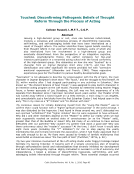
Touched: Disconfirming Pathogenic Beliefs of Thought
Reform Through the Process of Acting
Colleen Russell, L.M.F.T., C.G.P.
Abstract
Leaving a high-demand group or cult, once one becomes indoctrinated,
involves a conscious and unconscious process of disconfirming inaccurate,
self-limiting, and self-sabotaging beliefs that have been internalized as a
result of thought reform. The author identifies these typical beliefs resulting
from thought reform in her work with former members, some of which she
also internalized from her involvement in a high-demand group and
eventually disconfirmed. From the perspective of an integrative cognitive,
relational, psychodynamic theory, the author compares her two-year
intensive participation in a renowned acting school with the forced conformity
of the high-demand group. She elaborates on how she was ―touched‖ by a
character from an Ingmar Bergman short story (1977), and how this
identification and other significant life events provided her with ―corrective
emotional experiences‖ (Alexander and French, 1946). These reparative
experiences gave her the freedom to pursue healthy developmental goals.
―Fascination‖ is not adequate to describe my preoccupation with the life of Karin, the main
character in Ingmar Bergman‘s short story ―The Touch,‖ and her struggle to find herself. At
26, within months after I had stopped participating in any activities in Eckankar,1 then
known as ―The Ancient Science of Soul Travel,‖ I was assigned to play Karin‘s character in
an intensive acting program at the Loft studio. Founded by esteemed acting teacher Peggy
Feury, a former associate of Lee Strasberg, the Loft was my first experience of a life
separate from Eckankar since I had been recruited seven years earlier. Our theater of life
was tucked away behind a bland façade on La Brea Avenue, a main drag in Los Angeles,
and coincidentally just a few blocks from the first Eckankar Center I had helped open in the
early ‗70s in my roles as a ―6th Initiate‖ and ―Co-Worker with God.‖
My conscious reason for initially distancing myself from the ―Living Eck Master‖2 was to
confirm that I could function with a ―higher spiritual consciousness‖ in the world at large. I
was also disturbed by the hypocrisy I had found in those around me, and I distrusted my
own spiritual ―unfoldment‖ that ―higher initiates‖ like me were supposed to have achieved.
Why did I and other members depend on the ―Master‖ to define our reality when we had
each supposedly reached an exalted state of consciousness (or so the ―Master‖ said),
greater than that of the Buddha or Jesus? Why did many of us continue to have serious
difficulties with our partners? Why couldn‘t my partner hold down a good job? Why was
there controversy about the ―master‘s‖ successor? At the time, I didn‘t know it would take
eight more years (including the ―7th Initiation‖) for me to stop paying the yearly
membership fee and formally terminate the association, when I had finally appraised that it
was safe enough to do so. My fears were caused by threats of terrible misfortunes that
would befall us should we leave ―the true path of God‖ (Twitchell,3 1971a, p. 92.)
My two-year intensive involvement at the Loft acting studio under Peggy‘s tutelage helped
facilitate my leaving Eckankar. It became part of a largely unconscious plan of breaking
through self-protective denial and rationalizations that severely inhibited my development
and held me psychologically captive. Highly motivated to succeed in a life of autonomy and
independence, I began a process of disconfirming inaccurate, self-limiting, and self-
sabotaging beliefs internalized through thought reform. These essential changes occurred
Touched: Disconfirming Pathogenic Beliefs of Thought
Reform Through the Process of Acting
Colleen Russell, L.M.F.T., C.G.P.
Abstract
Leaving a high-demand group or cult, once one becomes indoctrinated,
involves a conscious and unconscious process of disconfirming inaccurate,
self-limiting, and self-sabotaging beliefs that have been internalized as a
result of thought reform. The author identifies these typical beliefs resulting
from thought reform in her work with former members, some of which she
also internalized from her involvement in a high-demand group and
eventually disconfirmed. From the perspective of an integrative cognitive,
relational, psychodynamic theory, the author compares her two-year
intensive participation in a renowned acting school with the forced conformity
of the high-demand group. She elaborates on how she was ―touched‖ by a
character from an Ingmar Bergman short story (1977), and how this
identification and other significant life events provided her with ―corrective
emotional experiences‖ (Alexander and French, 1946). These reparative
experiences gave her the freedom to pursue healthy developmental goals.
―Fascination‖ is not adequate to describe my preoccupation with the life of Karin, the main
character in Ingmar Bergman‘s short story ―The Touch,‖ and her struggle to find herself. At
26, within months after I had stopped participating in any activities in Eckankar,1 then
known as ―The Ancient Science of Soul Travel,‖ I was assigned to play Karin‘s character in
an intensive acting program at the Loft studio. Founded by esteemed acting teacher Peggy
Feury, a former associate of Lee Strasberg, the Loft was my first experience of a life
separate from Eckankar since I had been recruited seven years earlier. Our theater of life
was tucked away behind a bland façade on La Brea Avenue, a main drag in Los Angeles,
and coincidentally just a few blocks from the first Eckankar Center I had helped open in the
early ‗70s in my roles as a ―6th Initiate‖ and ―Co-Worker with God.‖
My conscious reason for initially distancing myself from the ―Living Eck Master‖2 was to
confirm that I could function with a ―higher spiritual consciousness‖ in the world at large. I
was also disturbed by the hypocrisy I had found in those around me, and I distrusted my
own spiritual ―unfoldment‖ that ―higher initiates‖ like me were supposed to have achieved.
Why did I and other members depend on the ―Master‖ to define our reality when we had
each supposedly reached an exalted state of consciousness (or so the ―Master‖ said),
greater than that of the Buddha or Jesus? Why did many of us continue to have serious
difficulties with our partners? Why couldn‘t my partner hold down a good job? Why was
there controversy about the ―master‘s‖ successor? At the time, I didn‘t know it would take
eight more years (including the ―7th Initiation‖) for me to stop paying the yearly
membership fee and formally terminate the association, when I had finally appraised that it
was safe enough to do so. My fears were caused by threats of terrible misfortunes that
would befall us should we leave ―the true path of God‖ (Twitchell,3 1971a, p. 92.)
My two-year intensive involvement at the Loft acting studio under Peggy‘s tutelage helped
facilitate my leaving Eckankar. It became part of a largely unconscious plan of breaking
through self-protective denial and rationalizations that severely inhibited my development
and held me psychologically captive. Highly motivated to succeed in a life of autonomy and
independence, I began a process of disconfirming inaccurate, self-limiting, and self-
sabotaging beliefs internalized through thought reform. These essential changes occurred