Cultic Studies Review, Vol. 9, No. 1, 2010, Page 21
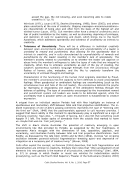
Sawyer (2006) states, that ―of all of the mental processes studied by cognitive
psychologists, the ones thought to be most relevant to creativity are conceptual
combination, metaphor, and analogy‖ (p. 65) in other words, what Guilford identified as
the ―divergent processes‖ (p. 44). It‘s creative to combine two concepts to make a single
new one. … Sawyer notes that ―the generative processes produce ideas, filtering processes
select among these ideas, and exploratory processes expand on the potential of each idea,‖
as well as ―information retrieval, association, and combination…‖ (p. 65).
The ―listening to one‘s inner voice‖ category—particularly relevant to our discussion—
includes ―traits that involve a personal understanding of who you are, a vision of where you
want to go, and a commitment to do whatever it takes to get there‖. This category includes
―awareness of creativeness, … self-direction, internal locus of control, introspective, freedom
from stereotyping, concentration, energy, and work ethic‖ (Treffinger, et al., 2002, p. 8).
The COCO model (Characteristics, Operations, Context, and Outcomes) is similar to the
sociocultural approach of Csikszentmihalyi that looks at individual, domain, and field.
Proposed by Treffinger (1988, 1991), the COCO model suggests that ―creative productivity
arises from the dynamic interactions among the four essential components‖:
1. Characteristics include the personal characteristics of the creative individual.
2. Operations involve the strategies and techniques people employ to generate
and analyze ideas, solve problems, make decisions, and manage their
thinking.
3. Context includes the culture, the climate, the situational dynamics such as
communication and collaboration, and the physical environment in which one
is operating.
4. Outcomes are the products and ideas that result from people's efforts.
Creative productivity is best described as a dynamic, complex system, in
which all four components are interdependent. These components can either
facilitate or inhibit one's expression of creativity in observable ways within
any domain of human effort.‖ (Treffinger, et al., 2002, p. x)
Significant to this model and the NRCG/T model is the incorporation of a person‘s history, as
suggested by researcher Amabile (1983). Because the cult denies the member any
attachment to pre-cult life, the notion of personal history disappears. I suggest therefore
that cult recovery treatment consider pre-cult as well as cult and post-cult experience in
assessing the impact of cults on the creativity of a particular individual.
Neuroscientific
Neuroscience has recently joined psychoanalysis in viewing emotion as central to an
understanding of creativity. Cognitive neuroscientist and neurologist Antonio Damasio, in his
seminal book Descartes‘ Error (1994), writes, ―…the reasoning system evolved as an
extension of the automatic emotional system‖ (p. xi). He came up with a concept called ―the
somatic-marker mechanism‖ that a reviewer of his book The Feeling of What Happens:
Body, Emotion, and the Making of Consciousness (1999), Bruce G. Charlton, M.D., describes
―is the way in which cognitive representations of the external world interact with cognitive
representations of the internal worlds—where perceptions interact with emotions‖ (2000,
pp. 99-101). Charlton continues,
Damasio has suggested that while the senses of vision, hearing, touch, taste
smell function by nerve activation patterns that correspond to the state of the
external world emotions are nerve activations patterns that correspond to
the state of the internal world.
Sawyer (2006) states, that ―of all of the mental processes studied by cognitive
psychologists, the ones thought to be most relevant to creativity are conceptual
combination, metaphor, and analogy‖ (p. 65) in other words, what Guilford identified as
the ―divergent processes‖ (p. 44). It‘s creative to combine two concepts to make a single
new one. … Sawyer notes that ―the generative processes produce ideas, filtering processes
select among these ideas, and exploratory processes expand on the potential of each idea,‖
as well as ―information retrieval, association, and combination…‖ (p. 65).
The ―listening to one‘s inner voice‖ category—particularly relevant to our discussion—
includes ―traits that involve a personal understanding of who you are, a vision of where you
want to go, and a commitment to do whatever it takes to get there‖. This category includes
―awareness of creativeness, … self-direction, internal locus of control, introspective, freedom
from stereotyping, concentration, energy, and work ethic‖ (Treffinger, et al., 2002, p. 8).
The COCO model (Characteristics, Operations, Context, and Outcomes) is similar to the
sociocultural approach of Csikszentmihalyi that looks at individual, domain, and field.
Proposed by Treffinger (1988, 1991), the COCO model suggests that ―creative productivity
arises from the dynamic interactions among the four essential components‖:
1. Characteristics include the personal characteristics of the creative individual.
2. Operations involve the strategies and techniques people employ to generate
and analyze ideas, solve problems, make decisions, and manage their
thinking.
3. Context includes the culture, the climate, the situational dynamics such as
communication and collaboration, and the physical environment in which one
is operating.
4. Outcomes are the products and ideas that result from people's efforts.
Creative productivity is best described as a dynamic, complex system, in
which all four components are interdependent. These components can either
facilitate or inhibit one's expression of creativity in observable ways within
any domain of human effort.‖ (Treffinger, et al., 2002, p. x)
Significant to this model and the NRCG/T model is the incorporation of a person‘s history, as
suggested by researcher Amabile (1983). Because the cult denies the member any
attachment to pre-cult life, the notion of personal history disappears. I suggest therefore
that cult recovery treatment consider pre-cult as well as cult and post-cult experience in
assessing the impact of cults on the creativity of a particular individual.
Neuroscientific
Neuroscience has recently joined psychoanalysis in viewing emotion as central to an
understanding of creativity. Cognitive neuroscientist and neurologist Antonio Damasio, in his
seminal book Descartes‘ Error (1994), writes, ―…the reasoning system evolved as an
extension of the automatic emotional system‖ (p. xi). He came up with a concept called ―the
somatic-marker mechanism‖ that a reviewer of his book The Feeling of What Happens:
Body, Emotion, and the Making of Consciousness (1999), Bruce G. Charlton, M.D., describes
―is the way in which cognitive representations of the external world interact with cognitive
representations of the internal worlds—where perceptions interact with emotions‖ (2000,
pp. 99-101). Charlton continues,
Damasio has suggested that while the senses of vision, hearing, touch, taste
smell function by nerve activation patterns that correspond to the state of the
external world emotions are nerve activations patterns that correspond to
the state of the internal world.