Recovery from Abusive Groups Page 77
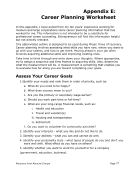
Appendix E:
Career Planning Worksheet
In this appendix, I have pulled from my ten years' experience working for
medium and large corporations some career planning information that has
worked for me. This information is not intended to be a substitute for
professional career counseling. Entrepreneurs will find this information helpful
but not directly relevant.
This abbreviated outline is designed to be used during Phase Three of recovery.
Career planning involves assessing what skills you have now, where you want to
go with your talents, and how to get there. Moving ahead in your job often
involves acquiring additional skills and improving existing ones.
Take time to think through and write down your thoughts. Where appropriate,
try to assign a sequence and time frames to acquiring skills. Also, determine
what the measurement will be. A measurement is something that enables you
to evaluate how far along you are toward completing your goals.
Assess Your Career Goals
1.Identify your needs and rank them in order of priority, such as:
a. What do you need to be happy?
b. What does success mean to you?
c. Are you the primary or secondary wage earner?
d. Should you work part-time or full-time?
e. What are your long-range financial needs, such as:
i. Health and education
ii. Travel and vacation(s)
iii. Housing and transportation
iv. Retirement
f. Do you want to volunteer for community activities?
2. Identify your interests -what you like and do not like to do.
3. Identify your abilities -what you can and cannot do well.
4. Identify your personality style -what types of people do you and don't you
work well with. What effect do you have on others?
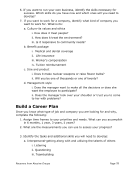
5. Identify whether you want to work for yourself or for a company
(government, education, business).
Appendix E:
Career Planning Worksheet
In this appendix, I have pulled from my ten years' experience working for
medium and large corporations some career planning information that has
worked for me. This information is not intended to be a substitute for
professional career counseling. Entrepreneurs will find this information helpful
but not directly relevant.
This abbreviated outline is designed to be used during Phase Three of recovery.
Career planning involves assessing what skills you have now, where you want to
go with your talents, and how to get there. Moving ahead in your job often
involves acquiring additional skills and improving existing ones.
Take time to think through and write down your thoughts. Where appropriate,
try to assign a sequence and time frames to acquiring skills. Also, determine
what the measurement will be. A measurement is something that enables you
to evaluate how far along you are toward completing your goals.
Assess Your Career Goals
1.Identify your needs and rank them in order of priority, such as:
a. What do you need to be happy?
b. What does success mean to you?
c. Are you the primary or secondary wage earner?
d. Should you work part-time or full-time?
e. What are your long-range financial needs, such as:
i. Health and education
ii. Travel and vacation(s)
iii. Housing and transportation
iv. Retirement
f. Do you want to volunteer for community activities?
2. Identify your interests -what you like and do not like to do.
3. Identify your abilities -what you can and cannot do well.
4. Identify your personality style -what types of people do you and don't you
work well with. What effect do you have on others?
5. Identify whether you want to work for yourself or for a company
(government, education, business).