Recovery from Abusive Groups Page 28
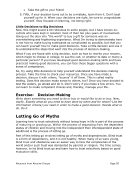
her out for coffee. Remember, let it take time. You don't have to recruit them
into the local chorus group if you don't want to, and you don't have to talk
about the cult experience if you don't want to. Most people love to talk about
themselves. If you ask them a couple of questions that cannot be answered with
a simple yes or no, they may well talk your ear off. Making and developing
friendships can provide healthy support systems and be an interesting way of
exploring what life has to offer by seeing what works for others.
I should warn you that some people prey on others who have been hurt. They
appear friendly and then use you. You know this because you were in a cult, but
these types of people are still around you. When you're first out and fragile, be
wary, especially of situations that may have sexual overtones. I'm sad to say
that some ex-cultists have even trusted other ex-cultists only to find later they
have been used.
Be a wise consumer. Ask other people to help you evaluate someone. This is a
good reality check method to use throughout your life.
Answering Questions
Let me go back to something I just said-you don't have to talk about the cult
experience if you don't want to. I didn't say this to suggest you don't talk about
it. But often ex-cultists feel as if they have to do whatever they are asked to do,
or feel they have to answer any question they are asked. In my cult we used to
say, "don't ask how high, just jump."
Cultists are manipulated into unquestioned obedience. If someone asks a
question, you answer it. If you don't want to, there is something wrong with
you. Either you don't trust the doctrine or you are hiding something evil. Some
ex-cultists continue to face the same dilemma:
I've got to tell all or there's something wrong with me, yet I don't want to tell
all.
Ex-cultists often avoid situations that could help them develop and relearn
assessment skills because on some level they still believe they have to obey any
request of them, even a question. You don't have to do what anyone wants you
to do anymore without thinking it through, assessing its value to you, and
evaluating how to handle the situation.
Assessing the Question
You can start learning this process of assessment with any question someone
asks of you. Ask yourself:
• Do I want to talk about this with this person at this time? If not, would I
be comfortable answering it at a later date or not at all?
• If I decide to answer the question, is this person trustworthy and
intelligent enough to use the information in a responsible manner?
If you're having trouble sorting out how you feel and there is time, try talking it
her out for coffee. Remember, let it take time. You don't have to recruit them
into the local chorus group if you don't want to, and you don't have to talk
about the cult experience if you don't want to. Most people love to talk about
themselves. If you ask them a couple of questions that cannot be answered with
a simple yes or no, they may well talk your ear off. Making and developing
friendships can provide healthy support systems and be an interesting way of
exploring what life has to offer by seeing what works for others.
I should warn you that some people prey on others who have been hurt. They
appear friendly and then use you. You know this because you were in a cult, but
these types of people are still around you. When you're first out and fragile, be
wary, especially of situations that may have sexual overtones. I'm sad to say
that some ex-cultists have even trusted other ex-cultists only to find later they
have been used.
Be a wise consumer. Ask other people to help you evaluate someone. This is a
good reality check method to use throughout your life.
Answering Questions
Let me go back to something I just said-you don't have to talk about the cult
experience if you don't want to. I didn't say this to suggest you don't talk about
it. But often ex-cultists feel as if they have to do whatever they are asked to do,
or feel they have to answer any question they are asked. In my cult we used to
say, "don't ask how high, just jump."
Cultists are manipulated into unquestioned obedience. If someone asks a
question, you answer it. If you don't want to, there is something wrong with
you. Either you don't trust the doctrine or you are hiding something evil. Some
ex-cultists continue to face the same dilemma:
I've got to tell all or there's something wrong with me, yet I don't want to tell
all.
Ex-cultists often avoid situations that could help them develop and relearn
assessment skills because on some level they still believe they have to obey any
request of them, even a question. You don't have to do what anyone wants you
to do anymore without thinking it through, assessing its value to you, and
evaluating how to handle the situation.
Assessing the Question
You can start learning this process of assessment with any question someone
asks of you. Ask yourself:
• Do I want to talk about this with this person at this time? If not, would I
be comfortable answering it at a later date or not at all?
• If I decide to answer the question, is this person trustworthy and
intelligent enough to use the information in a responsible manner?
If you're having trouble sorting out how you feel and there is time, try talking it