Recovery from Abusive Groups Page 67
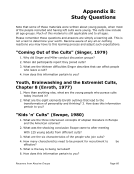
Influence (Ciaidini, 1984)
1. When are we most likely to accept the actions of others as correct?
2. What are the eight weapons of influence? 3. How does this information
pertain to you?
Thought Reform and the Psychology of
Totalism, Chapter 5 (Litton, 1961)
1. What does Lifton call the outstanding psychiatric fact of thought reform?
2. What are the eleven psychological steps to death and rebirth Lifton
outlines?
3. About what did the released prisoners have profound struggles? 4. How
does this information pertain to you?
Thought Reform and the Psychology of
Totalism, Chapter 12 (Litton, 1961)
1. What were the four psychological principles faced when the prisoners
returned home?
2. What does each principle mean?
3. What is the fear and relief of total annihilation?
4. What were the beneficial effects of the prisoners' experience? 5. How does
this information pertain to you?
Thought Reform and the Psychology of
Totalism, Chapter 22 (Litton, 1961)
Answer the following statements TRUE or FALSE. If a question is FALSE, what is
the correct answer?
1. Some potential for extremes exists within everyone. (T/F)
2. Loaded Language is the most basic feature of thought reform. (T/F)
3. Milieu Control seeks to establish control over the individual's
communication with the outside world and with himself. (T/F)
4. The pressure of milieu control causes the individual to close down as he is
deprived of external information and inner reflection. (T/F)
5. The mystique of the group makes manipulating others and oneself, no
matter how bizarre or painful, mandatory. (T/F)
6. The Demand for Purity allows plenty of room for every expression and