Recovery from Abusive Groups Page 70
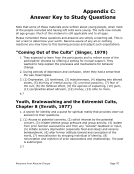
Appendix C:
Answer Key to Study Questions
Note that some of these materials were written about young people, when most
of the people recruited and having left cults were young. The cults now include
all age groups. Much of this material is still applicable and to all ages.
Please remember these questions and answers are simply a learning aid. This is
not a test to determine your worth. Become aware of any all-or-nothing
reactions you may have to this learning process and adjust such expectations.
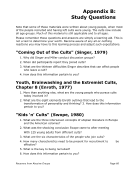
"Coming Out of the Cults" (Singer, 1979)
1. They expected to learn from the participants and to relieve some of the
participants' distress by offering a setting for mutual support. They
wanted to help explain the processes and mechanisms for behavior
change.
2. During periods of depression and confusion, when they had a sense that
life was meaningless.
3. (1) Depression, (2) loneliness, (3) indecisiveness, (4) slipping into altered
states, (5) blurring of mental acuity, (6) uncritical passivity, (7) fear of
the cult, (8) the fishbowl effect, (9) the agonies of explaining, (10) guilt,
(11) perplexities about altruism, (12) money, (13) elite no more.
4.?
Youth, Brainwashing and the Extremist Cults,
Chapter 8 (Enroth, 1977)
1. A search for identity and a quest for spiritual reality that provides clear-cut
answers to their questions.
2. (1) Access to potential converts, (2) solicit interest by the potential
convert, (3) initiate intense group pressure and group activity, (4) isolate
from prior familiar associations and from any "outside" feedback or input,
(5) initiate sensory deprivation (especially food and sleep) and sensory
bombardment, (6) alter former attitude toward and conception of the
world, (7) resocialization by stripping individual of identity, (8)
renunciation and rejection of prior associations and relationships. The past
is submerged.
3.?
Appendix C:
Answer Key to Study Questions
Note that some of these materials were written about young people, when most
of the people recruited and having left cults were young. The cults now include
all age groups. Much of this material is still applicable and to all ages.
Please remember these questions and answers are simply a learning aid. This is
not a test to determine your worth. Become aware of any all-or-nothing
reactions you may have to this learning process and adjust such expectations.
"Coming Out of the Cults" (Singer, 1979)
1. They expected to learn from the participants and to relieve some of the
participants' distress by offering a setting for mutual support. They
wanted to help explain the processes and mechanisms for behavior
change.
2. During periods of depression and confusion, when they had a sense that
life was meaningless.
3. (1) Depression, (2) loneliness, (3) indecisiveness, (4) slipping into altered
states, (5) blurring of mental acuity, (6) uncritical passivity, (7) fear of
the cult, (8) the fishbowl effect, (9) the agonies of explaining, (10) guilt,
(11) perplexities about altruism, (12) money, (13) elite no more.
4.?
Youth, Brainwashing and the Extremist Cults,
Chapter 8 (Enroth, 1977)
1. A search for identity and a quest for spiritual reality that provides clear-cut
answers to their questions.
2. (1) Access to potential converts, (2) solicit interest by the potential
convert, (3) initiate intense group pressure and group activity, (4) isolate
from prior familiar associations and from any "outside" feedback or input,
(5) initiate sensory deprivation (especially food and sleep) and sensory
bombardment, (6) alter former attitude toward and conception of the
world, (7) resocialization by stripping individual of identity, (8)
renunciation and rejection of prior associations and relationships. The past
is submerged.
3.?