Recovery from Abusive Groups Page 71
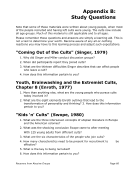
"Kids 'n' Cults" (Swope, 1980)
1. Perfection, harmony, simplicity.
2. Given the right set of circumstances, almost any young adult can be
recruited into a cult.
3. (1) Idealistic, (2) innocent, (3) inquisitive, (4) independent, (5) identity-
seeking, (6) insecure.
4. Three or four need, to be present.
5. Vulnerability at the time of recruitment.
6?
Influence (Cialdini, 1984)
1. When we are unsure of ourselves, when the situation is unclear or
ambiguous, when uncertainty reigns.
2. (1) Contrast principle, (2) rule for reciprocation, (3) rejection-then-retreat,
(4) commitment and consistency, (5) social proof, (6) liking, (7)
authority-directed deference, (8) scarcity.
3.?
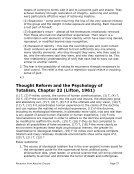
Thought Reform and the Psychology of
Totalism, Chapter 5 (Litton, 1961)
1. The penetration by the psychological forces of the environment into the
inner emotions of the individual.
2. (1) Assault upon identity, (2) establishment of guilt, (3) self-betrayal, (4)
breaking point of total conflict and basic fear, (5) leniency and
opportunity, (6) compulsion to confess, (7) channelling of guilt, (8)
reeducation, (9) progress and harmony, (10) final confession, (11)
rebirth.
3. Their identity, ability to trust, and search for wholeness (integrity).
4.?
Thought Reform and the Psychology of
Totalism,
Chapter 12 (Litton, 1961)
1. (1) Mastery and integrity, (2) separation, (3) expatriate's return, (4)
renewal of identity.
2. (1) Mastery and integrity -subjects relived their thought reform as a
"Kids 'n' Cults" (Swope, 1980)
1. Perfection, harmony, simplicity.
2. Given the right set of circumstances, almost any young adult can be
recruited into a cult.
3. (1) Idealistic, (2) innocent, (3) inquisitive, (4) independent, (5) identity-
seeking, (6) insecure.
4. Three or four need, to be present.
5. Vulnerability at the time of recruitment.
6?
Influence (Cialdini, 1984)
1. When we are unsure of ourselves, when the situation is unclear or
ambiguous, when uncertainty reigns.
2. (1) Contrast principle, (2) rule for reciprocation, (3) rejection-then-retreat,
(4) commitment and consistency, (5) social proof, (6) liking, (7)
authority-directed deference, (8) scarcity.
3.?
Thought Reform and the Psychology of
Totalism, Chapter 5 (Litton, 1961)
1. The penetration by the psychological forces of the environment into the
inner emotions of the individual.
2. (1) Assault upon identity, (2) establishment of guilt, (3) self-betrayal, (4)
breaking point of total conflict and basic fear, (5) leniency and
opportunity, (6) compulsion to confess, (7) channelling of guilt, (8)
reeducation, (9) progress and harmony, (10) final confession, (11)
rebirth.
3. Their identity, ability to trust, and search for wholeness (integrity).
4.?
Thought Reform and the Psychology of
Totalism,
Chapter 12 (Litton, 1961)
1. (1) Mastery and integrity, (2) separation, (3) expatriate's return, (4)
renewal of identity.
2. (1) Mastery and integrity -subjects relived their thought reform as a