Cultic Studies Journal, Vol. 18, 2001, Page 94
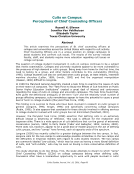
Enemies Within:
Conflict and Control in the Baha’i Community
Karen Bacquet
Abstract
The Baha‘i Faith, best-known for its liberal social teachings and tolerance
towards other religions, has an authoritarian governing structure that has
caused a high level of disillusionment among adherents. Because of the
religion‘s stress on unity, there is considerable insecurity about the
expression of dissent and a fear of internal enemies. Conformity is enforced
by sanctions, excommunication, and shunning, and information is controlled
through a system of censorship. Although the religion is governed by elected
institutions, they are not held accountable to the electorate. Moreover, the
supreme governing institution is believed to be infallible. While the spread of
the Internet in the 1990s has weakened the administration‘s control of
information, the Baha‘i leadership has threatened and sanctioned liberal
intellectuals for the expression of their opinions on e-mail forums.
While other movements that swelled with converts in the 1970s were exposed as cults,
using unethical tactics to recruit and control members, the Baha‘i Faith has maintained a
remarkably positive public image since it was first established in the U.S. in the 1890s. The
religion‘s publicity campaigns have left the impression, even among detractors, that its
beliefs are socially progressive and without a strong doctrinal core, somewhat akin to
Unitarian-Universalists. However, Baha‘i, like other religions in the Abrahamic tradition, is
based on a set of texts that are believed to be divinely revealed. Liberal principles are
contained in these scriptures, but so are authoritarian elements. Baha‘is, then, can be as
fundamentalist as the adherents of any other Western religion.
While these authoritarian elements can perhaps be called ―cult-like‖ it would be wrong to
regard the Baha‘i Faith entirely as a cult. In any case, the line between ―cult‖ and ―non-cult‖
is far from absolute. Many, perhaps most, religious groups have various requirements that
adherents are subject to, and control mechanisms to enforce them. Dennis Tourish and Tim
Wohlforth (2000), in a recent Cultic Studies Journal article, described religions as falling on
a ―continuum‖ rather than simply on one side or another of a ―cult‖ definition:
At one end stand healthy well functioning groups, in which dissent is
respected, people participate in decision making, and members at all times
retain a foot in the real world. At the other end we find totalitarian enclaves
in which conformity is prized above all else and people are frequently
manipulated against their will for the greater good of the cult leader. People
and organizations can move back and forth on this continuum depending on
events. Organizations are not necessarily either cults or non-cults. They can
be both at different times.1
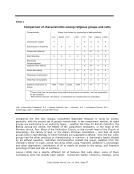
So, on the extreme end one could place a destructive cult such as the Branch
Davidians, which is clearly quite totalitarian compared with the Jehovah‘s Witnesses,
who in turn more strictly control their members than does the Roman Catholic
Church, which has more control mechanisms than the Unitarian-Universalists do.
Even within a single religion, the application of disciplinary measures can vary over
time and circumstances, and individual experience of pressure and manipulation can
differ, with some adherents more vulnerable than others.
Enemies Within:
Conflict and Control in the Baha’i Community
Karen Bacquet
Abstract
The Baha‘i Faith, best-known for its liberal social teachings and tolerance
towards other religions, has an authoritarian governing structure that has
caused a high level of disillusionment among adherents. Because of the
religion‘s stress on unity, there is considerable insecurity about the
expression of dissent and a fear of internal enemies. Conformity is enforced
by sanctions, excommunication, and shunning, and information is controlled
through a system of censorship. Although the religion is governed by elected
institutions, they are not held accountable to the electorate. Moreover, the
supreme governing institution is believed to be infallible. While the spread of
the Internet in the 1990s has weakened the administration‘s control of
information, the Baha‘i leadership has threatened and sanctioned liberal
intellectuals for the expression of their opinions on e-mail forums.
While other movements that swelled with converts in the 1970s were exposed as cults,
using unethical tactics to recruit and control members, the Baha‘i Faith has maintained a
remarkably positive public image since it was first established in the U.S. in the 1890s. The
religion‘s publicity campaigns have left the impression, even among detractors, that its
beliefs are socially progressive and without a strong doctrinal core, somewhat akin to
Unitarian-Universalists. However, Baha‘i, like other religions in the Abrahamic tradition, is
based on a set of texts that are believed to be divinely revealed. Liberal principles are
contained in these scriptures, but so are authoritarian elements. Baha‘is, then, can be as
fundamentalist as the adherents of any other Western religion.
While these authoritarian elements can perhaps be called ―cult-like‖ it would be wrong to
regard the Baha‘i Faith entirely as a cult. In any case, the line between ―cult‖ and ―non-cult‖
is far from absolute. Many, perhaps most, religious groups have various requirements that
adherents are subject to, and control mechanisms to enforce them. Dennis Tourish and Tim
Wohlforth (2000), in a recent Cultic Studies Journal article, described religions as falling on
a ―continuum‖ rather than simply on one side or another of a ―cult‖ definition:
At one end stand healthy well functioning groups, in which dissent is
respected, people participate in decision making, and members at all times
retain a foot in the real world. At the other end we find totalitarian enclaves
in which conformity is prized above all else and people are frequently
manipulated against their will for the greater good of the cult leader. People
and organizations can move back and forth on this continuum depending on
events. Organizations are not necessarily either cults or non-cults. They can
be both at different times.1
So, on the extreme end one could place a destructive cult such as the Branch
Davidians, which is clearly quite totalitarian compared with the Jehovah‘s Witnesses,
who in turn more strictly control their members than does the Roman Catholic
Church, which has more control mechanisms than the Unitarian-Universalists do.
Even within a single religion, the application of disciplinary measures can vary over
time and circumstances, and individual experience of pressure and manipulation can
differ, with some adherents more vulnerable than others.