Cultic Studies Journal, Vol. 18, 2001, Page 3
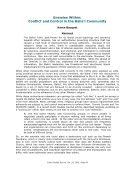
Cults, Psychological Manipulation, and Society:
International Perspectives -An Overview
Michael D. Langone, Ph.D.
Executive Director, AFF
Abstract
This paper provides an overview of salient issues covered in AFF‘s 1999
annual conference. Definitional issues are examined. The proposition
that is central to critical perspectives of cultic groups is: Some groups
may harm some people sometimes, and some groups may be more likely
to harm people than other groups. Four concerns about cults are
discussed: psychological, ethical, social, and theological. Assessments of
particular groups with regard to these areas of concern should be
discerning.
This conference‘s title, ―Cults, Psychological Manipulation, and Society: International
Perspectives,‖ is significant because cults and related groups have aroused significant
concern around the world. I am aware of organizations concerned about cults in the
following countries: U.S.A., Canada, Mexico, Argentina, Brazil, United Kingdom, Norway,
Sweden, Denmark, France, Spain, Italy, Germany, Switzerland, Belgium, Netherlands,
Austria, Poland, Greece, Russia, Malta, Israel, Japan, and Australia. There are probably
some of which I am not aware. The concern tends to focus on, though not be limited to,
issues related to psychological manipulation and its impact on society. Concerns generate
much confusion and disputation, in large part because people define the term ―cult‖ in
different ways.
Analysis of Definitional Issues
According to the Compact Edition of the Oxford English Dictionary (1971) the term, ―cult,‖
originally referred to ―worship reverential homage rendered to a divine being or beings...a
particular form or system of religious worship especially in reference to its external rites
and ceremonies...devotion or homage to a particular person or thing.‖ More recently, the
term has taken on additional connotations: ―3 :A religion regarded as unorthodox or
spurious...4 :A system for the cure of disease based on dogma set forth by its
promulgator...5 a. great devotion to a person, idea, object, movement, or work...b. a
usually small group of people characterized by such devotion.‖ (Merriam-Webster’s
Collegiate Dictionary, Tenth Edition, 1994)
Rutgers University professor Benjamin Zablocki (1997) says that sociologists often
distinguish ―cult‖ from ―church,‖ ―sect,‖ and ―denomination.‖ Cults are innovative, fervent
groups. If they become accepted into the mainstream, cults, in his view, lose their fervor
and become more organized and integrated into the community they become churches.
When people within churches become dissatisfied and break off into fervent splinter groups,
the new groups are called sects. As sects become more stolid and integrated into the
community, they become denominations. Zablocki defines a cult as ―an ideological
organization held together by charismatic relationships and demanding total commitment.‖
According to Zablocki, cults are at high risk of becoming abusive to members, in part
because members‘ adulation of charismatic leaders contributes to their becoming corrupted
by the power they seek and are accorded. The power these corrupt -or corrupted -leaders
come to wield can also result in social harm, such as law-breaking and the undermining of
democratic values.
Cults, Psychological Manipulation, and Society:
International Perspectives -An Overview
Michael D. Langone, Ph.D.
Executive Director, AFF
Abstract
This paper provides an overview of salient issues covered in AFF‘s 1999
annual conference. Definitional issues are examined. The proposition
that is central to critical perspectives of cultic groups is: Some groups
may harm some people sometimes, and some groups may be more likely
to harm people than other groups. Four concerns about cults are
discussed: psychological, ethical, social, and theological. Assessments of
particular groups with regard to these areas of concern should be
discerning.
This conference‘s title, ―Cults, Psychological Manipulation, and Society: International
Perspectives,‖ is significant because cults and related groups have aroused significant
concern around the world. I am aware of organizations concerned about cults in the
following countries: U.S.A., Canada, Mexico, Argentina, Brazil, United Kingdom, Norway,
Sweden, Denmark, France, Spain, Italy, Germany, Switzerland, Belgium, Netherlands,
Austria, Poland, Greece, Russia, Malta, Israel, Japan, and Australia. There are probably
some of which I am not aware. The concern tends to focus on, though not be limited to,
issues related to psychological manipulation and its impact on society. Concerns generate
much confusion and disputation, in large part because people define the term ―cult‖ in
different ways.
Analysis of Definitional Issues
According to the Compact Edition of the Oxford English Dictionary (1971) the term, ―cult,‖
originally referred to ―worship reverential homage rendered to a divine being or beings...a
particular form or system of religious worship especially in reference to its external rites
and ceremonies...devotion or homage to a particular person or thing.‖ More recently, the
term has taken on additional connotations: ―3 :A religion regarded as unorthodox or
spurious...4 :A system for the cure of disease based on dogma set forth by its
promulgator...5 a. great devotion to a person, idea, object, movement, or work...b. a
usually small group of people characterized by such devotion.‖ (Merriam-Webster’s
Collegiate Dictionary, Tenth Edition, 1994)
Rutgers University professor Benjamin Zablocki (1997) says that sociologists often
distinguish ―cult‖ from ―church,‖ ―sect,‖ and ―denomination.‖ Cults are innovative, fervent
groups. If they become accepted into the mainstream, cults, in his view, lose their fervor
and become more organized and integrated into the community they become churches.
When people within churches become dissatisfied and break off into fervent splinter groups,
the new groups are called sects. As sects become more stolid and integrated into the
community, they become denominations. Zablocki defines a cult as ―an ideological
organization held together by charismatic relationships and demanding total commitment.‖
According to Zablocki, cults are at high risk of becoming abusive to members, in part
because members‘ adulation of charismatic leaders contributes to their becoming corrupted
by the power they seek and are accorded. The power these corrupt -or corrupted -leaders
come to wield can also result in social harm, such as law-breaking and the undermining of
democratic values.