Cultic Studies Journal, Vol. 18, 2001, Page 56
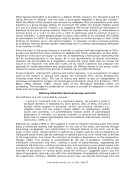
What Lifton calls ―thought reform‖ is also known as ―brainwashing.‖ In a more recent book,
he rephrased his description of a cult to include groups that incorporate ―totalistic or
thought-reform-like practices, a shift from worship of spiritual principles to worship of the
person of the guru or leader, and a combination of spiritual quest from below and
exploitation, usually economic or sexual, from above‖ (Lifton, 1999, p. 11). He has also
described the environment of cults in terms of their psychological characteristics: milieu
control mystical manipulation, which includes purification rites, confession, and self-
criticism a sacred science, the group‘s religious claim to scientific truth loading of
language and dispensing of existence with only true believers being ―saved‖ (Lifton, 1997).
Of course, groups vary considerably along these dimensions and may change substantially
over time.
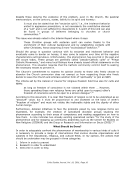
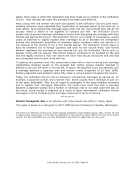
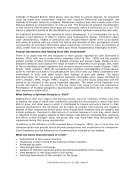
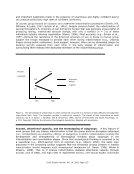
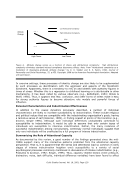
Schwartz &Kaslow (1982) developed a method for comparing the practices of four religions
or sects and four cults (Schwartz &Kaslow, 1982). Their conclusions, expressed below in
Table 1, are of course based on their personal observations and do not reflect quantitative
empirical research.
What Lifton calls ―thought reform‖ is also known as ―brainwashing.‖ In a more recent book,
he rephrased his description of a cult to include groups that incorporate ―totalistic or
thought-reform-like practices, a shift from worship of spiritual principles to worship of the
person of the guru or leader, and a combination of spiritual quest from below and
exploitation, usually economic or sexual, from above‖ (Lifton, 1999, p. 11). He has also
described the environment of cults in terms of their psychological characteristics: milieu
control mystical manipulation, which includes purification rites, confession, and self-
criticism a sacred science, the group‘s religious claim to scientific truth loading of
language and dispensing of existence with only true believers being ―saved‖ (Lifton, 1997).
Of course, groups vary considerably along these dimensions and may change substantially
over time.
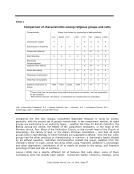
Schwartz &Kaslow (1982) developed a method for comparing the practices of four religions
or sects and four cults (Schwartz &Kaslow, 1982). Their conclusions, expressed below in
Table 1, are of course based on their personal observations and do not reflect quantitative
empirical research.