Cultic Studies Journal, Vol. 18, 2001, Page 12
―New Religious Movement‖ is another term that has been used to designate the
phenomenon under study. For the purposes of this article, the three terms may be treated
as synonyms, although the reader should keep the definitional ambiguity in mind.
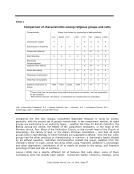
CESNUR 's research published in the Encyclopedia of Religions in Italy2 (May 2001) indicates
that there are at least 616 religious and spiritual groups active in Italy (including the
Catholic Church, Jewish Community, and so on). Among Italian citizens there are about
1.200.000 members of religious minorities, who seem to be evenly distributed throughout
the country. Members of new religious movements number about 700.000. If one includes,
however, those who sympathize with or are curious about these new movements, then one
could estimate that a larger number of persons are involved in major or minor ways with
these new movements. The groups with the highest membership are the Jehovah's
Witnesses (about 400,000 adherents), Scientology (about 80.000 adherents), and Soka
Gakkai (about 21.000 adherents).
Italy has not been affected by tragic episodes involving cults (such as the Aum Shinrikyo
gas attack in the Tokyo subway). But there have been a number of cases involving
homicide, suicide, and various crimes committed by members of various new groups. These
cases have stimulated judicial investigations, a few of which are going on now. Despite
these episodes and the recent tragedy of the Solar Temple in Europe, Italian public opinion
has not shown significant interest in this phenomenon, in part because of the massive and
constant flow of information coming from CESNUR (Center for Studies on New Religions).3
CESNUR tends to minimize these episodes, viewing them as marginal and sociologically and
numerically insignificant.
Given the public apathy about this issue, it was rather extraordinary that on April 29, 1998
the Italian Ministry of Internal Affairs sent to the Commission for Constitutional Affairs of
the Camera dei Deputati (the lower house of the Italian Parliament) a report by the General
Direction of Preventive Police dated February 1998. The report is entitled ―Sette religiose e
nuovi movimenti magici in Italia‖ (―Cults and New Magical Movements in Italy‖)4. In Italy,
The General Direction of Preventive Police coordinates the police intelligence activities. The
Interior Ministry appears to believe that there is a necessity to warn the public about certain
phenomena involving ―violence justified by faith.‖ Police in other countries of Europe,
America, and Japan have been unprepared for certain crimes related to cultic groups. In its
Introduction, this report considers the ―possible dangers and law-enforcement implications
of the activities of some movements‖ and affirms that if a group has a hostile or indifferent
attitude toward the principals on which civil order is founded, then the significance of its
actions for law-enforcement should be considered.
According to the report, such law-enforcement concerns may manifest in many ways:
1. The use of ―subliminal mechanisms of influence and so-called ‗brainwashing‘ or other
methods that limit the liberty and self-determination of the individual.‖ Regarding this
issue, the report affirms that there is much testimony and many investigations
conducted by police departments that attest to the fact that certain movements use
techniques that short-circuit the defenses of individuals, ―leading them into an uncritical
state of blind obedience.‖5 Note 13 of the report describes the process or the various
stages of thought reform. These are: ―isolation, indoctrination, and maintenance.‖
2. ―The interest seems to be more on the material wealth of the leaders than the spiritual
enrichment of the members […] it comes from the aggressive solicitation of
contributions and the sale of goods […] or various services (usually seductive
psychotherapeutic services or ‗self-improvement courses‘).” This section refers to cases
in which someone uses the religious character of his group as a pretext for accumulating
money, taking advantage of financial exemptions. If the profession of faith is ―an
instrument for realizing a profit, abusing the credulity of others,‖ then there are grounds
―New Religious Movement‖ is another term that has been used to designate the
phenomenon under study. For the purposes of this article, the three terms may be treated
as synonyms, although the reader should keep the definitional ambiguity in mind.
CESNUR 's research published in the Encyclopedia of Religions in Italy2 (May 2001) indicates
that there are at least 616 religious and spiritual groups active in Italy (including the
Catholic Church, Jewish Community, and so on). Among Italian citizens there are about
1.200.000 members of religious minorities, who seem to be evenly distributed throughout
the country. Members of new religious movements number about 700.000. If one includes,
however, those who sympathize with or are curious about these new movements, then one
could estimate that a larger number of persons are involved in major or minor ways with
these new movements. The groups with the highest membership are the Jehovah's
Witnesses (about 400,000 adherents), Scientology (about 80.000 adherents), and Soka
Gakkai (about 21.000 adherents).
Italy has not been affected by tragic episodes involving cults (such as the Aum Shinrikyo
gas attack in the Tokyo subway). But there have been a number of cases involving
homicide, suicide, and various crimes committed by members of various new groups. These
cases have stimulated judicial investigations, a few of which are going on now. Despite
these episodes and the recent tragedy of the Solar Temple in Europe, Italian public opinion
has not shown significant interest in this phenomenon, in part because of the massive and
constant flow of information coming from CESNUR (Center for Studies on New Religions).3
CESNUR tends to minimize these episodes, viewing them as marginal and sociologically and
numerically insignificant.
Given the public apathy about this issue, it was rather extraordinary that on April 29, 1998
the Italian Ministry of Internal Affairs sent to the Commission for Constitutional Affairs of
the Camera dei Deputati (the lower house of the Italian Parliament) a report by the General
Direction of Preventive Police dated February 1998. The report is entitled ―Sette religiose e
nuovi movimenti magici in Italia‖ (―Cults and New Magical Movements in Italy‖)4. In Italy,
The General Direction of Preventive Police coordinates the police intelligence activities. The
Interior Ministry appears to believe that there is a necessity to warn the public about certain
phenomena involving ―violence justified by faith.‖ Police in other countries of Europe,
America, and Japan have been unprepared for certain crimes related to cultic groups. In its
Introduction, this report considers the ―possible dangers and law-enforcement implications
of the activities of some movements‖ and affirms that if a group has a hostile or indifferent
attitude toward the principals on which civil order is founded, then the significance of its
actions for law-enforcement should be considered.
According to the report, such law-enforcement concerns may manifest in many ways:
1. The use of ―subliminal mechanisms of influence and so-called ‗brainwashing‘ or other
methods that limit the liberty and self-determination of the individual.‖ Regarding this
issue, the report affirms that there is much testimony and many investigations
conducted by police departments that attest to the fact that certain movements use
techniques that short-circuit the defenses of individuals, ―leading them into an uncritical
state of blind obedience.‖5 Note 13 of the report describes the process or the various
stages of thought reform. These are: ―isolation, indoctrination, and maintenance.‖
2. ―The interest seems to be more on the material wealth of the leaders than the spiritual
enrichment of the members […] it comes from the aggressive solicitation of
contributions and the sale of goods […] or various services (usually seductive
psychotherapeutic services or ‗self-improvement courses‘).” This section refers to cases
in which someone uses the religious character of his group as a pretext for accumulating
money, taking advantage of financial exemptions. If the profession of faith is ―an
instrument for realizing a profit, abusing the credulity of others,‖ then there are grounds