Cultic Studies Journal, Vol. 18, 2001, Page 31
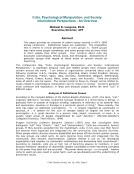
Cults in Japan: Legal Issues
Hiroshi Yamaguchi, Attorney at Law
Tokyo Kyodo Law Office
Abstract
The cult situation is reviewed in Japan. Issues of freedom of religion are
considered in light of specific types of cases, including medical injury,
donations and solicitation practices, and donations and the sale of
merchandise. The legal relevance of mind control theory and the Aum
Shinrikyo problem are explored. Lastly, legal issues involving defamation,
counseling former group members, and problems within the family are
examined.
In Japan, a limited number of groups comprised of lawyers and members of established
religious organizations work on counter measures to cults. Their activities, in terms of
experience and expertise, are at an equal level with those of their counterparts in North
America and Europe. These groups try to integrate the families of cult believers. In contrast,
however, the action taken by the Japanese government, parliament, and religious
organizations on the whole—even in response to such serious issues raised in connection
with the Aum Shinrikyo Cult and the practices of spiritual sales—has been slow and
inadequate, far behind responses seen in the West. Moreover, the general public and the
mass media in Japan have shown only superficial concern exhibited by a type of mass
sensationalism in response to the activities of an unusual cult.
Therefore, to understand cults in Japan, we must examine four points regarding the special
characteristics of religion in Japan.
First, the Japanese government, local public organizations, the police, and criminal justice
organizations have acted overcautiously in dealing with human rights violations and
consumer problems arising from religion. Until the end of World War II, the Shinto religion
(a unique, Shamanistic Japanese religion that saw the Japanese Emperor as the nation‘s
living, absolute god) took priority over all other religions in Japan. Members of other
religions such as Christianity and Buddhism who did not recognize the Shinto religion were
suppressed for a variety of reasons. Therefore, the present Japanese government, which
bears this past of allowing or instigating religious oppression, today adopts a non-
intervention policy with respect to the public‘s religious activities. This basic stance is clearly
exhibited by prosecution offices and consumer centers throughout the country. Likewise,
government administrations and the police have avoided dealing with religious group
problems. As a result, human rights violations suffered by individual victims of new religious
organizations are becoming more serious and widespread.
Second, in the aftermath of World War II, most people in Japan were faced with dire
poverty. These circumstances led to the creation of a number of new religions, many of
which were based on Buddhist ideals. It is estimated that over 10 percent of the Japanese
population followed these new religions. The religions progressed with many new earnest
and active members. Buddhism and Shintoism, with their over one thousand-year histories,
became a part of everyday life in Japan. Accordingly, groups of these religions rarely
propagated their teachings. Their organizational existence is not advertised or well known
by the public. Their ability to unite with other groups is also quite weak. If Japanese are
asked what religion they believe in, over 80 percent respond that they believe in no specific
religion. Traditional Christianity from the West has a following of only one million people in
Japan. In most schools, religion is not taught as a part of the curriculum.
Cults in Japan: Legal Issues
Hiroshi Yamaguchi, Attorney at Law
Tokyo Kyodo Law Office
Abstract
The cult situation is reviewed in Japan. Issues of freedom of religion are
considered in light of specific types of cases, including medical injury,
donations and solicitation practices, and donations and the sale of
merchandise. The legal relevance of mind control theory and the Aum
Shinrikyo problem are explored. Lastly, legal issues involving defamation,
counseling former group members, and problems within the family are
examined.
In Japan, a limited number of groups comprised of lawyers and members of established
religious organizations work on counter measures to cults. Their activities, in terms of
experience and expertise, are at an equal level with those of their counterparts in North
America and Europe. These groups try to integrate the families of cult believers. In contrast,
however, the action taken by the Japanese government, parliament, and religious
organizations on the whole—even in response to such serious issues raised in connection
with the Aum Shinrikyo Cult and the practices of spiritual sales—has been slow and
inadequate, far behind responses seen in the West. Moreover, the general public and the
mass media in Japan have shown only superficial concern exhibited by a type of mass
sensationalism in response to the activities of an unusual cult.
Therefore, to understand cults in Japan, we must examine four points regarding the special
characteristics of religion in Japan.
First, the Japanese government, local public organizations, the police, and criminal justice
organizations have acted overcautiously in dealing with human rights violations and
consumer problems arising from religion. Until the end of World War II, the Shinto religion
(a unique, Shamanistic Japanese religion that saw the Japanese Emperor as the nation‘s
living, absolute god) took priority over all other religions in Japan. Members of other
religions such as Christianity and Buddhism who did not recognize the Shinto religion were
suppressed for a variety of reasons. Therefore, the present Japanese government, which
bears this past of allowing or instigating religious oppression, today adopts a non-
intervention policy with respect to the public‘s religious activities. This basic stance is clearly
exhibited by prosecution offices and consumer centers throughout the country. Likewise,
government administrations and the police have avoided dealing with religious group
problems. As a result, human rights violations suffered by individual victims of new religious
organizations are becoming more serious and widespread.
Second, in the aftermath of World War II, most people in Japan were faced with dire
poverty. These circumstances led to the creation of a number of new religions, many of
which were based on Buddhist ideals. It is estimated that over 10 percent of the Japanese
population followed these new religions. The religions progressed with many new earnest
and active members. Buddhism and Shintoism, with their over one thousand-year histories,
became a part of everyday life in Japan. Accordingly, groups of these religions rarely
propagated their teachings. Their organizational existence is not advertised or well known
by the public. Their ability to unite with other groups is also quite weak. If Japanese are
asked what religion they believe in, over 80 percent respond that they believe in no specific
religion. Traditional Christianity from the West has a following of only one million people in
Japan. In most schools, religion is not taught as a part of the curriculum.