Cultic Studies Journal, Vol. 18, 2001, Page 58
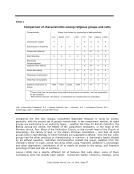
written manifesto or Bible-like book, rules, rituals, neologisms or code words, meetings,
internal code of honor, fairly homogeneous group in terms of age/socio-economic
class/education. Terrorist-type groups, those most likely to attempt to bring on an
Armageddon, like the Aum Shinrikyo, have many of these same characteristics.
A sub-group of the American Academy of Religion, called the New Religious Movements
Group, has fairly recently emerged to study these groups, and has its own journal: Nova
Religio: The Journal of Alternate and Emergent Religions (Niebuhr, 1999). Another group
that studies cults or ―new religious movements‖ – the term preferred by sociologists, is the
Society for the Scientific Study of Religion, which also has a journal.
Popular culture also attends to these groups. Two fairly recent examples are the TV
program, ―Touched by an Angel‖ on August 29, 1999 (a repeat), and mystery writer Faye
Kellerman‘s novel, Jupiter’s Bones, published in 1999. Both demonstrate most of the
characteristics just described to you with respect to group beliefs and behaviors.
A Variety of Perceptions
Recruits and Recruiters
We tend to think of cult recruits as being in their late teens and early twenties, and indeed
many of them have been recruited as they left high school for the more rarefied atmosphere
of dormitory life at college or to live with a friend as they entered the world of work. As
Levine (1999) asserted anew, ―Youths are remarkably susceptible to ideological and
passionate solicitations‖ (p. 342). In addition, some of those recruited, for their money but
not for the almost monastic life of some groups, have been the elderly living at a distance
from family members. He wasn‘t looking at the senior citizens who are recruited, but many
of them were and are also susceptible to heart-wringing appeals, and are particularly
swayed by the idea that they are (supposedly) doing great good for someone else by their
financial contributions. Just briefly, in terms of the senior citizens who are recruited, on the
one side, the cults are after the assets of the elderly on the other side, the elderly welcome
the attention provided by the recruiters. They are once again made to feel important to
someone (Collins &Frantz, 1994). Without family members nearby, and in some cases
feeling that their adult children have rejected or forgotten them, that feeling of importance
is welcome. In other words, many of the factors that make young people vulnerable to cult
recruiting have the same effect on the elderly. These include: ego-weakness, weak or non-
existent family relations and support systems, stress, unmanageable and debilitating crises,
and inadequate resources for survival (Curtis &Curtis, 1993).
It might be mentioned that there are political and racist groups that operate much like cults
in terms of their deceptive recruiting techniques and some of their activities. A former
leader of the Aryan Nation, for example, speaks to high school students about that hate
group, including why he left it. He describes how these groups begin recruiting at the grade
school level, using comic books or finding something in common about which to start a
dialogue. His reason for leaving was that, following his son‘s operation for a cleft palate, an
officer of the Aryan Nation reminded him that when the group gained power the son would
have to be ―euthanized‖ because of his genetic defect (Halper, 2000). This, too, is violence.
The group not only preaches racism and intolerance of defects, but also practices it.
What else is there in the youthful recruit-to-be and in the group that recruits him or her that
creates a match of the two? Some young people as they approach or arrive at significant
crossroads in life may be beset by feelings of low self-esteem, alienation, even
demoralization (Isser &Schwartz, 1988 Levine, 1999). They seek affirmation of their
existence as they seek to belong and to believe. Even the two youths who created the
tragedy at Columbine High School in Colorado sought to belong – to a nebulous association
of ―outsiders‖ since they felt rejected by those who did belong to more acceptable groups in
written manifesto or Bible-like book, rules, rituals, neologisms or code words, meetings,
internal code of honor, fairly homogeneous group in terms of age/socio-economic
class/education. Terrorist-type groups, those most likely to attempt to bring on an
Armageddon, like the Aum Shinrikyo, have many of these same characteristics.
A sub-group of the American Academy of Religion, called the New Religious Movements
Group, has fairly recently emerged to study these groups, and has its own journal: Nova
Religio: The Journal of Alternate and Emergent Religions (Niebuhr, 1999). Another group
that studies cults or ―new religious movements‖ – the term preferred by sociologists, is the
Society for the Scientific Study of Religion, which also has a journal.
Popular culture also attends to these groups. Two fairly recent examples are the TV
program, ―Touched by an Angel‖ on August 29, 1999 (a repeat), and mystery writer Faye
Kellerman‘s novel, Jupiter’s Bones, published in 1999. Both demonstrate most of the
characteristics just described to you with respect to group beliefs and behaviors.
A Variety of Perceptions
Recruits and Recruiters
We tend to think of cult recruits as being in their late teens and early twenties, and indeed
many of them have been recruited as they left high school for the more rarefied atmosphere
of dormitory life at college or to live with a friend as they entered the world of work. As
Levine (1999) asserted anew, ―Youths are remarkably susceptible to ideological and
passionate solicitations‖ (p. 342). In addition, some of those recruited, for their money but
not for the almost monastic life of some groups, have been the elderly living at a distance
from family members. He wasn‘t looking at the senior citizens who are recruited, but many
of them were and are also susceptible to heart-wringing appeals, and are particularly
swayed by the idea that they are (supposedly) doing great good for someone else by their
financial contributions. Just briefly, in terms of the senior citizens who are recruited, on the
one side, the cults are after the assets of the elderly on the other side, the elderly welcome
the attention provided by the recruiters. They are once again made to feel important to
someone (Collins &Frantz, 1994). Without family members nearby, and in some cases
feeling that their adult children have rejected or forgotten them, that feeling of importance
is welcome. In other words, many of the factors that make young people vulnerable to cult
recruiting have the same effect on the elderly. These include: ego-weakness, weak or non-
existent family relations and support systems, stress, unmanageable and debilitating crises,
and inadequate resources for survival (Curtis &Curtis, 1993).
It might be mentioned that there are political and racist groups that operate much like cults
in terms of their deceptive recruiting techniques and some of their activities. A former
leader of the Aryan Nation, for example, speaks to high school students about that hate
group, including why he left it. He describes how these groups begin recruiting at the grade
school level, using comic books or finding something in common about which to start a
dialogue. His reason for leaving was that, following his son‘s operation for a cleft palate, an
officer of the Aryan Nation reminded him that when the group gained power the son would
have to be ―euthanized‖ because of his genetic defect (Halper, 2000). This, too, is violence.
The group not only preaches racism and intolerance of defects, but also practices it.
What else is there in the youthful recruit-to-be and in the group that recruits him or her that
creates a match of the two? Some young people as they approach or arrive at significant
crossroads in life may be beset by feelings of low self-esteem, alienation, even
demoralization (Isser &Schwartz, 1988 Levine, 1999). They seek affirmation of their
existence as they seek to belong and to believe. Even the two youths who created the
tragedy at Columbine High School in Colorado sought to belong – to a nebulous association
of ―outsiders‖ since they felt rejected by those who did belong to more acceptable groups in