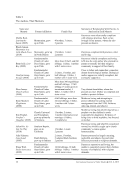
The second worldview the BCW adopted can be
described as consistent with a philosophy of
purity (Casoni, 2000). This worldview goes a
step further in differentiating believers from
nonbelievers by requiring their physical
separation. According to this perspective,
members seek to rid themselves of everything
that might be deemed impure that links them to
society. Hence, contact with nonbelievers is kept
to a minimum for fear of contamination. In such
groups, leaders are venerated as the purest and
wisest of all, and their moral prestige is
extremely high. They most often lead their
group in a solitary fashion, as the incarnation of
the law, the truth, and the sole judge of purity.
In the third worldview held by the BCW, which
is an exacerbation of the philosophies of
separation and of purity, the outer world appears
dangerous to members, who project all goodness
unto the endogroup. This worldview ressembles
what Chouvier and Morhain (2008) have
described as a “cultic position” (p. 27).
Designated as a philosophy of survival, the
followers’ mindset is such that they believe they
must protect themselves from outside enemies,
unto whom all that is bad, malicious, or inpure
has been projected (Casoni, 2000). Such groups
most often seek isolated geographical settings
wherein the leader exercises power in a
plenipotentiary manner, taking on the role of an
earthly god. Total submission to the leader’s
authority is demanded and high standards of
behavior are required of children, whose
immaturity is often interpreted as
malicioussness. Their inability to conform to
these expectations is seen as a sign of evilness,
for which corporal punishment and various
repressive sanctions are used. Some children are
scapegoated and become the object of harsh
treatment that ranges from physical and
psychological abuse to rituals that might take the
form of exorcism aimed at ridding them of evil
forces (Casoni, 2000).
Methodology
This research follows guidelines for single case
studies. Using principles of qualitative
methodology, we gathered data from a variety of
sources, notably through documentary analysis
and interviews with key actors. Info-Cult, an
information center on new religious movements
and cultic groups, archived the data. The
documentary corpus was made up of about a
hundred documents, including 60 legal
transcripts from tribunals of various levels of the
justice system—i.e., criminal, penal, and civil
chambers of the Superior Court and Youth
Court, and the Office of the Prothonotary.
Additonally, we included all the related
newspaper articles published in the province of
Quebec between April 19, 1985, and March 15,
1990, and two television documentaries
produced by Radio-Canada (April 12, 1985, and
October 28, 1986) in the data we analyzed. The
testimonies of several former BCW members
were also part of the material we analyzed. We
conducted interviews with five key actors,
including the police inspector who led the
investigation, a pastor close to the BCW’s
minister, a former member of the church, and a
civil servant from the City of Windsor. Given
the multiple sources of information studied, we
were able to triangulate the data. More precise
information on the modalities of the analyses
and on methods used to limit bias is available in
the Pacheco and Casoni document (2008).
One of us also made a trip to to the region to
better contextualize the environment in which
the events took place. Finally, the Child
Protection Agency consulted the third author
before that service approached members of the
group his knowledge of the group and of the
interventions that occurred were helpful in
validating the results of this research.
Trajectory of The Baptist Church of
Windsor
The BCW was founded in 1978 in the
southeastern part of Quebec. A few years after
he had been participating in and following the
principles of the Evangelical Baptist Church of
Lennoxville, Pastor X began his only training as
a minister, a 1-year program in a close-by city.
Described as a nice and devoted man with a
warm personality, he converted many followers
to the Evangelical Baptist Church of
Lennoxville, which encouraged the congregation
to support him in his project to establish a
church in Windsor. To this end, the Evangelical
Baptist Church of Lennoxville acquired two
International Journal of Cultic Studies ■ Vol. 6, 2015 85
described as consistent with a philosophy of
purity (Casoni, 2000). This worldview goes a
step further in differentiating believers from
nonbelievers by requiring their physical
separation. According to this perspective,
members seek to rid themselves of everything
that might be deemed impure that links them to
society. Hence, contact with nonbelievers is kept
to a minimum for fear of contamination. In such
groups, leaders are venerated as the purest and
wisest of all, and their moral prestige is
extremely high. They most often lead their
group in a solitary fashion, as the incarnation of
the law, the truth, and the sole judge of purity.
In the third worldview held by the BCW, which
is an exacerbation of the philosophies of
separation and of purity, the outer world appears
dangerous to members, who project all goodness
unto the endogroup. This worldview ressembles
what Chouvier and Morhain (2008) have
described as a “cultic position” (p. 27).
Designated as a philosophy of survival, the
followers’ mindset is such that they believe they
must protect themselves from outside enemies,
unto whom all that is bad, malicious, or inpure
has been projected (Casoni, 2000). Such groups
most often seek isolated geographical settings
wherein the leader exercises power in a
plenipotentiary manner, taking on the role of an
earthly god. Total submission to the leader’s
authority is demanded and high standards of
behavior are required of children, whose
immaturity is often interpreted as
malicioussness. Their inability to conform to
these expectations is seen as a sign of evilness,
for which corporal punishment and various
repressive sanctions are used. Some children are
scapegoated and become the object of harsh
treatment that ranges from physical and
psychological abuse to rituals that might take the
form of exorcism aimed at ridding them of evil
forces (Casoni, 2000).
Methodology
This research follows guidelines for single case
studies. Using principles of qualitative
methodology, we gathered data from a variety of
sources, notably through documentary analysis
and interviews with key actors. Info-Cult, an
information center on new religious movements
and cultic groups, archived the data. The
documentary corpus was made up of about a
hundred documents, including 60 legal
transcripts from tribunals of various levels of the
justice system—i.e., criminal, penal, and civil
chambers of the Superior Court and Youth
Court, and the Office of the Prothonotary.
Additonally, we included all the related
newspaper articles published in the province of
Quebec between April 19, 1985, and March 15,
1990, and two television documentaries
produced by Radio-Canada (April 12, 1985, and
October 28, 1986) in the data we analyzed. The
testimonies of several former BCW members
were also part of the material we analyzed. We
conducted interviews with five key actors,
including the police inspector who led the
investigation, a pastor close to the BCW’s
minister, a former member of the church, and a
civil servant from the City of Windsor. Given
the multiple sources of information studied, we
were able to triangulate the data. More precise
information on the modalities of the analyses
and on methods used to limit bias is available in
the Pacheco and Casoni document (2008).
One of us also made a trip to to the region to
better contextualize the environment in which
the events took place. Finally, the Child
Protection Agency consulted the third author
before that service approached members of the
group his knowledge of the group and of the
interventions that occurred were helpful in
validating the results of this research.
Trajectory of The Baptist Church of
Windsor
The BCW was founded in 1978 in the
southeastern part of Quebec. A few years after
he had been participating in and following the
principles of the Evangelical Baptist Church of
Lennoxville, Pastor X began his only training as
a minister, a 1-year program in a close-by city.
Described as a nice and devoted man with a
warm personality, he converted many followers
to the Evangelical Baptist Church of
Lennoxville, which encouraged the congregation
to support him in his project to establish a
church in Windsor. To this end, the Evangelical
Baptist Church of Lennoxville acquired two
International Journal of Cultic Studies ■ Vol. 6, 2015 85