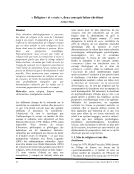
Psychological Manipulation, Hypnosis, and Suggestion
Jose Fernández Aguado
Pehuén Institute of Psychology, Barcelona, Spain
Abstract
A widespread vision links hypnosis to
psychological manipulation. The mass media
favor this image, thus making it popular. Traces
of that point of view can even taint scientific
views at scientific forums. Nevertheless, this
widespread vision is essentially false. In this
paper I deal with some of the possible causes of
that confusion, the main one being that a major
characteristic of hypnosis (namely, an increase
in suggestibility one experiences while under
hypnosis) is also a key characteristic of people
in manipulative and abusive environments. I will
give some well-established and agreed-upon
definitions of hypnosis and explain why one’s
suggestibility is enhanced while hypnotized. My
conclusion is that one’s confidence in the
process and the hypnotizer plays a major role in
any enhanced suggestibility while under
hypnosis. I compare what occurs during
hypnosis to what occurs in the mildly or overly
manipulative contexts of seduction and coercion,
where suggestibility is also enhanced. I conclude
that the main difference in the case of hypnosis
lies in the ease with which one can exit that
enhanced state of suggestibility. I introduce the
concepts of dissociation and integration for the
purpose of increasing readers’ understanding
about the twofold route to higher states of
suggestibility and the way back from them, and
of showing how this way back can be hampered
in manipulative contexts.
Keywords: hypnosis, psychological
manipulation, suggestibility, dissociation,
integration
Introduction
One of the oldest questions in the literature on
hypnosis is whether deeply hypnotized
individuals can be induced to perform antisocial
or self-destructive acts (Orne, 1962), or whether
those individuals can be induced to perform acts
that are against their core principles and that
they would never perform if they were not under
hypnosis.
The answer that many have given to these
questions is “No” (Capafons, 2001 Lynn and
Kirsch, 2006 Orne, 1962). The impossibility of
getting persons to do anything under hypnosis
that they would not do without hypnosis,
therefore, has been widely proven.
Nevertheless, Wells (1941), Rowland (1939),
Young (1948), Estabrooks (1993), Wolberg
(1945 1948), and Weitzenhoffer (1949) have
been leading proponents of the view that,
provided the hypnotist’s technique is adequate,
the subject in hypnosis may be forced to do
anything. But according to Orne (1962), the
evidence shown by all of these authors to
support their view is inconsistent, if not clearly
biased. Orne points out that, before asserting that
by means of hypnosis a person can make
someone act against her will, one must prove
that, without hypnosis, the individual would not
have been predisposed to carry out such an act.
Orne skillfully proves how none of these authors
had controlled the influence the hypnotist may
have had on the subject prior to hypnosis, which
Orne considers a key shortcoming of these
studies.
Therefore, confusion continues to reign. This
confusion has been present since the beginning
of the modern history of hypnosis in the 18th
century, with Mesmer, whose utilization of what
he termed animal magnetism was related to
confusion and deceit. The confusion has
continued to the present day, enhanced by the
popular vision that the mass media have
attributed to hypnosis. More seriously, though,
is the fact that mental-health professionals and
academicians as well often ascribe these
characteristics to hypnosis. For example, Hassan
(1988) states that it is possible to get people who
are under hypnosis to carry out acts that they
would not do if they were not hypnotized.
48 International Journal of Cultic Studies ■ Vol. 6, 2015
Jose Fernández Aguado
Pehuén Institute of Psychology, Barcelona, Spain
Abstract
A widespread vision links hypnosis to
psychological manipulation. The mass media
favor this image, thus making it popular. Traces
of that point of view can even taint scientific
views at scientific forums. Nevertheless, this
widespread vision is essentially false. In this
paper I deal with some of the possible causes of
that confusion, the main one being that a major
characteristic of hypnosis (namely, an increase
in suggestibility one experiences while under
hypnosis) is also a key characteristic of people
in manipulative and abusive environments. I will
give some well-established and agreed-upon
definitions of hypnosis and explain why one’s
suggestibility is enhanced while hypnotized. My
conclusion is that one’s confidence in the
process and the hypnotizer plays a major role in
any enhanced suggestibility while under
hypnosis. I compare what occurs during
hypnosis to what occurs in the mildly or overly
manipulative contexts of seduction and coercion,
where suggestibility is also enhanced. I conclude
that the main difference in the case of hypnosis
lies in the ease with which one can exit that
enhanced state of suggestibility. I introduce the
concepts of dissociation and integration for the
purpose of increasing readers’ understanding
about the twofold route to higher states of
suggestibility and the way back from them, and
of showing how this way back can be hampered
in manipulative contexts.
Keywords: hypnosis, psychological
manipulation, suggestibility, dissociation,
integration
Introduction
One of the oldest questions in the literature on
hypnosis is whether deeply hypnotized
individuals can be induced to perform antisocial
or self-destructive acts (Orne, 1962), or whether
those individuals can be induced to perform acts
that are against their core principles and that
they would never perform if they were not under
hypnosis.
The answer that many have given to these
questions is “No” (Capafons, 2001 Lynn and
Kirsch, 2006 Orne, 1962). The impossibility of
getting persons to do anything under hypnosis
that they would not do without hypnosis,
therefore, has been widely proven.
Nevertheless, Wells (1941), Rowland (1939),
Young (1948), Estabrooks (1993), Wolberg
(1945 1948), and Weitzenhoffer (1949) have
been leading proponents of the view that,
provided the hypnotist’s technique is adequate,
the subject in hypnosis may be forced to do
anything. But according to Orne (1962), the
evidence shown by all of these authors to
support their view is inconsistent, if not clearly
biased. Orne points out that, before asserting that
by means of hypnosis a person can make
someone act against her will, one must prove
that, without hypnosis, the individual would not
have been predisposed to carry out such an act.
Orne skillfully proves how none of these authors
had controlled the influence the hypnotist may
have had on the subject prior to hypnosis, which
Orne considers a key shortcoming of these
studies.
Therefore, confusion continues to reign. This
confusion has been present since the beginning
of the modern history of hypnosis in the 18th
century, with Mesmer, whose utilization of what
he termed animal magnetism was related to
confusion and deceit. The confusion has
continued to the present day, enhanced by the
popular vision that the mass media have
attributed to hypnosis. More seriously, though,
is the fact that mental-health professionals and
academicians as well often ascribe these
characteristics to hypnosis. For example, Hassan
(1988) states that it is possible to get people who
are under hypnosis to carry out acts that they
would not do if they were not hypnotized.
48 International Journal of Cultic Studies ■ Vol. 6, 2015