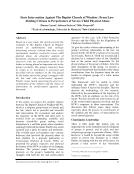
Growing Up With Strictly Religious Parents:
A Narrative Analysis of Second-Generation Memoirs
Terra Anne Manca
University of Alberta, Canada
Abstract
Religious communities often provide some form
of guidance to parents who may understand
religion as beneficial to their families. Some
religions, however, are socially controlling and
can disrupt family practices. Moreover, some
people within religious communities that are not
socially controlling practice religion strictly.
Strict religious practice can impact all members
of a community, but children tend to be among
those most affected. In this article, I discuss how
10 authors of memoirs, whose parents practiced
religion strictly, wrote about being parented. I
focus on how the authors presented their
parents’ compliance and noncompliance with
religious practices and norms that they
portrayed as disruptive to child rearing. In most
cases, authors attributed any perceived
mistreatment to religious demands and wrote
lovingly of their parents. Only three authors
seemed resentful toward one or both parents for
their upbringing. Authors’ understandings of
their parents’ actions and the written emotional
responses to those actions varied greatly
depending on whether the authors represented
their parents’ actions as normal in the given
circumstances.
Keywords: autobiography, narrative analysis,
parent-child relations, religion
Introduction
For many people, family and religion are
mediating structures between individuals and
alienating, large-scale societal forces
(D’Antonio &Aldous, 1983, p. 15). Although
these social institutions can offer various
benefits, they have potential for negative
influences—such as religiously justified social
control and familial abuse. Some religious
communities maintain high levels of social
control through doctrinal insulation or physical
isolation from wider society (Lalich, 2004).
Even in socially controlling environments,
however, adherents and their families are
compliant or noncompliant with specific
religious practices and demands. Moreover,
families in religions with lower levels of social
control can “do religion” in socially controlling
ways or even create religious justifications for
familial abuse.
Parents may differ in the ways in which they
integrate religious norms and practices into their
families. Indeed, the ways in which individuals
“do religion” can relate to how they “do family.”
Religious groups, however, often attempt to
regulate the way parents raise their children
because parents instill values in children, who
form the future of a movement (Bendroth, 1993,
p. 101 Wilcox 2004, p. 106). In many religious
groups, this concern about parenting results in
the socialization and protection of children.
Nonetheless, children are subordinate subjects of
these organizations and families, and, therefore,
extremely vulnerable. Children’s vulnerability is
especially apparent in specific religious groups
that advocate stern parenting demands, such as
extreme uses of corporal punishment geared
toward “breaking children’s self-determination”
to induce obedience (Greven, 1992, p. 65).
In this article, I discuss how 10 authors of
memoirs, whose parents practiced religion
strictly, wrote about the role of religion in how
they were parented. Each of the authors whose
memoirs I analyzed was born into a religious
organization and left either late in childhood or
early in adulthood. (I explain the specific
sampling criteria in the methods section.) These
authors are not representative of children’s
experiences of being parented within their
previous religious communities because I
selected them for this project based on very
specific criteria. Most importantly, most of these
16 International Journal of Cultic Studies ■ Vol. 6, 2015
A Narrative Analysis of Second-Generation Memoirs
Terra Anne Manca
University of Alberta, Canada
Abstract
Religious communities often provide some form
of guidance to parents who may understand
religion as beneficial to their families. Some
religions, however, are socially controlling and
can disrupt family practices. Moreover, some
people within religious communities that are not
socially controlling practice religion strictly.
Strict religious practice can impact all members
of a community, but children tend to be among
those most affected. In this article, I discuss how
10 authors of memoirs, whose parents practiced
religion strictly, wrote about being parented. I
focus on how the authors presented their
parents’ compliance and noncompliance with
religious practices and norms that they
portrayed as disruptive to child rearing. In most
cases, authors attributed any perceived
mistreatment to religious demands and wrote
lovingly of their parents. Only three authors
seemed resentful toward one or both parents for
their upbringing. Authors’ understandings of
their parents’ actions and the written emotional
responses to those actions varied greatly
depending on whether the authors represented
their parents’ actions as normal in the given
circumstances.
Keywords: autobiography, narrative analysis,
parent-child relations, religion
Introduction
For many people, family and religion are
mediating structures between individuals and
alienating, large-scale societal forces
(D’Antonio &Aldous, 1983, p. 15). Although
these social institutions can offer various
benefits, they have potential for negative
influences—such as religiously justified social
control and familial abuse. Some religious
communities maintain high levels of social
control through doctrinal insulation or physical
isolation from wider society (Lalich, 2004).
Even in socially controlling environments,
however, adherents and their families are
compliant or noncompliant with specific
religious practices and demands. Moreover,
families in religions with lower levels of social
control can “do religion” in socially controlling
ways or even create religious justifications for
familial abuse.
Parents may differ in the ways in which they
integrate religious norms and practices into their
families. Indeed, the ways in which individuals
“do religion” can relate to how they “do family.”
Religious groups, however, often attempt to
regulate the way parents raise their children
because parents instill values in children, who
form the future of a movement (Bendroth, 1993,
p. 101 Wilcox 2004, p. 106). In many religious
groups, this concern about parenting results in
the socialization and protection of children.
Nonetheless, children are subordinate subjects of
these organizations and families, and, therefore,
extremely vulnerable. Children’s vulnerability is
especially apparent in specific religious groups
that advocate stern parenting demands, such as
extreme uses of corporal punishment geared
toward “breaking children’s self-determination”
to induce obedience (Greven, 1992, p. 65).
In this article, I discuss how 10 authors of
memoirs, whose parents practiced religion
strictly, wrote about the role of religion in how
they were parented. Each of the authors whose
memoirs I analyzed was born into a religious
organization and left either late in childhood or
early in adulthood. (I explain the specific
sampling criteria in the methods section.) These
authors are not representative of children’s
experiences of being parented within their
previous religious communities because I
selected them for this project based on very
specific criteria. Most importantly, most of these
16 International Journal of Cultic Studies ■ Vol. 6, 2015