Cultic Studies Journal, Vol. 14, No. 1, 1997, page 67
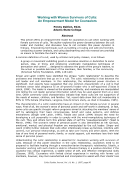
Wifely Subjection: Mental Health Issues
in Jehovah’s Witness Women
Kaynor J. Weishaupt, M.S., M.F.C.C.
San Rafael, California
Michael D. Stensland
Athens, Ohio
Abstract
The Watchtower Society, commonly referred to as Jehovah‟s Witnesses, exerts a
great deal of control over the everyday life of its members. Women, in particular,
suffer from psychological stresses in this high-control environment, as it is also a
culture where patriarchal attitudes limit women‟s personal power and predominate
in their relationships with men. A group of women responded to a questionnaire
about their experiences during membership in the Watchtower Society and after
leaving. The results indicate that while in the Watchtower Society, women
experience a higher degree of mental health problems than they do after they leave
the group. They also report experiencing more egalitarian attitudes in their relation-
ships with men after exiting the group.
Little research has been done focusing on the experience of women in “high-control” or
cultic groups, despite the fact that women make up a large proportion of the membership of
such groups. The type of group referred to here as high-control is defined by the degree of
control and restriction the group exercises over the everyday life of its membership. Such a
group can be focused on religion, politics, militarism, psychotherapy, meditation,
commercialism, or simply a “special” leader (Tobias &Lalich, 1994). A high-control group
differs from other groups in that individual behavior is excessively limited by rules and
regulations, access to information is restricted or managed (especially information critical of
the group), pressure is high to conform in thought and behavior to group norms, and
members must put the group‟s interests before their own. The leadership in this type of
group is absolute and considered infallible outsiders are generally viewed as dangerous or
evil and members leaving the group are generally punished or shunned. While all members
of such groups pay a psychological price (as well as reap certain psychological dividends,
such as a sense of belonging and purpose), women often face particular difficulties in
groups that are patriarchally based.
This article explores the relationship between women and the high-control social climate of
the Watchtower Society (WTS), commonly referred to as Jehovah‟s Witnesses. The article
reviews literature bearing on the Watchtower Society‟s control practices and patriarchal
organizational structure, analyzes psychological implications of WTS‟s social climate, and
reports on the results of a survey of 20 female former members of the Watchtower Society.
The survey explored three areas: (1) the degree of patriarchal versus egalitarian attitudes
subjects felt existed while they were members of WTS compared to what they experienced
after having left the group, (2) subjects‟ perceived psychological distress while in the group
and after exiting, and (3) subjects‟ perceptions of the degree to which the group controlled
everyday life and isolated members from outsiders. The latter area included a comparison
group of women from other religious backgrounds.
The Watchtower Society as a High-Control Group
The Watchtower Society was founded in the late 1800s by Charles Taze Russell, a
charismatic Adventist preacher who predicted that Armageddon would usher in God‟s
Wifely Subjection: Mental Health Issues
in Jehovah’s Witness Women
Kaynor J. Weishaupt, M.S., M.F.C.C.
San Rafael, California
Michael D. Stensland
Athens, Ohio
Abstract
The Watchtower Society, commonly referred to as Jehovah‟s Witnesses, exerts a
great deal of control over the everyday life of its members. Women, in particular,
suffer from psychological stresses in this high-control environment, as it is also a
culture where patriarchal attitudes limit women‟s personal power and predominate
in their relationships with men. A group of women responded to a questionnaire
about their experiences during membership in the Watchtower Society and after
leaving. The results indicate that while in the Watchtower Society, women
experience a higher degree of mental health problems than they do after they leave
the group. They also report experiencing more egalitarian attitudes in their relation-
ships with men after exiting the group.
Little research has been done focusing on the experience of women in “high-control” or
cultic groups, despite the fact that women make up a large proportion of the membership of
such groups. The type of group referred to here as high-control is defined by the degree of
control and restriction the group exercises over the everyday life of its membership. Such a
group can be focused on religion, politics, militarism, psychotherapy, meditation,
commercialism, or simply a “special” leader (Tobias &Lalich, 1994). A high-control group
differs from other groups in that individual behavior is excessively limited by rules and
regulations, access to information is restricted or managed (especially information critical of
the group), pressure is high to conform in thought and behavior to group norms, and
members must put the group‟s interests before their own. The leadership in this type of
group is absolute and considered infallible outsiders are generally viewed as dangerous or
evil and members leaving the group are generally punished or shunned. While all members
of such groups pay a psychological price (as well as reap certain psychological dividends,
such as a sense of belonging and purpose), women often face particular difficulties in
groups that are patriarchally based.
This article explores the relationship between women and the high-control social climate of
the Watchtower Society (WTS), commonly referred to as Jehovah‟s Witnesses. The article
reviews literature bearing on the Watchtower Society‟s control practices and patriarchal
organizational structure, analyzes psychological implications of WTS‟s social climate, and
reports on the results of a survey of 20 female former members of the Watchtower Society.
The survey explored three areas: (1) the degree of patriarchal versus egalitarian attitudes
subjects felt existed while they were members of WTS compared to what they experienced
after having left the group, (2) subjects‟ perceived psychological distress while in the group
and after exiting, and (3) subjects‟ perceptions of the degree to which the group controlled
everyday life and isolated members from outsiders. The latter area included a comparison
group of women from other religious backgrounds.
The Watchtower Society as a High-Control Group
The Watchtower Society was founded in the late 1800s by Charles Taze Russell, a
charismatic Adventist preacher who predicted that Armageddon would usher in God‟s