Cultic Studies Journal, Vol. 14, No. 1, 1997, page 17
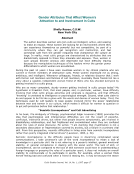
Gender Attributes That Affect Women’s
Attraction to and Involvement in Cults
Shelly Rosen, C.S.W.
New York City
Abstract
The author describes women who join cults as intelligent, active, and seeking
to make an impact. These women are looking for an environment where they
can experience themselves as powerful but not competitive, be part of a
community where they can get recognition and mentorship, and feel
somewhat safe from the gender inequities that characterize the culture at
large. In reality, most cultic groups are characterized by attributes that are
diametrically opposed to those they emanate and espouse. Thus, women in
such groups become anxious and depressed but have difficulty leaving
because the manipulative techniques of the leaders mirror the gender power
differentials to which women are accustomed.
During the past 14 years I have seen countless women in my clinical practice who are
current or former members of destructive cults. These women impressed me as strong,
ambitious, and intelligent. Whenever colleagues, friends, or relatives discover that I work
with former cult members and families of cult members, invariably these friends tell me a
story about a capable, independent woman friend of theirs who has shocked everyone by
getting involved in a cultic group.
Why are so many competent, sturdy women getting involved in cultic groups today? My
hypothesis is threefold. First, that most people, and, in particular, women, have difficulty
knowing that what cultic groups advertise and emanate is deceptive, and that difficulty
“knowing” is unrelated to intelligence or psychological strength. Second, what cults claim to
do and appear to be fits like a glove with the wants and desires of women today. Third, the
techniques used by cult leaders to keep people involved mirror the power relationship
between men and women in our culture, which makes it difficult for women to question or
to put self-protection before that relationship.1
“Semiotic Incompetence” and Cult Advertising
In his book, The Ambiguity of Change, psychoanalyst Edgar Levenson (1983) promotes the
idea that psychological and interpersonal difficulties are not the result of powerful,
conflictual, instinctive drives, but rather that people become symptomatic, get involved in
dissatisfying relationships, and feel frightened and overwhelmed when they are confused
about the rules of social discourse. He writes: “I am claiming that mystification is not a
secondary dissociation or fragmentation covered by anxiety, but a failure in a primary vital
skill. From this perspective, neurotic difficulties in living arise from semiotic incompetence
rather than poorly integrated internal drives” (Levenson, 1983, p. 34).
Semiotic incompetence is the difficulty people have in discerning complicated social
communications. I take Levenson‟s use of the word incompetence to mean a lack of
knowledge in a particular skill. He is not referring to a person‟s intellect, general emotional
stability, or general competence in dealing with the social world. This lack of skill, or
incompetence, can be compared to the lack of skill someone could have in understanding a
foreign language or grasping the rules of a particular sport it does not indicate an overall
inability to communicate or to participate in sports. For example, when a woman finds
herself feeling bad and confused when a friend is teasing her, it may be because the teaser
Gender Attributes That Affect Women’s
Attraction to and Involvement in Cults
Shelly Rosen, C.S.W.
New York City
Abstract
The author describes women who join cults as intelligent, active, and seeking
to make an impact. These women are looking for an environment where they
can experience themselves as powerful but not competitive, be part of a
community where they can get recognition and mentorship, and feel
somewhat safe from the gender inequities that characterize the culture at
large. In reality, most cultic groups are characterized by attributes that are
diametrically opposed to those they emanate and espouse. Thus, women in
such groups become anxious and depressed but have difficulty leaving
because the manipulative techniques of the leaders mirror the gender power
differentials to which women are accustomed.
During the past 14 years I have seen countless women in my clinical practice who are
current or former members of destructive cults. These women impressed me as strong,
ambitious, and intelligent. Whenever colleagues, friends, or relatives discover that I work
with former cult members and families of cult members, invariably these friends tell me a
story about a capable, independent woman friend of theirs who has shocked everyone by
getting involved in a cultic group.
Why are so many competent, sturdy women getting involved in cultic groups today? My
hypothesis is threefold. First, that most people, and, in particular, women, have difficulty
knowing that what cultic groups advertise and emanate is deceptive, and that difficulty
“knowing” is unrelated to intelligence or psychological strength. Second, what cults claim to
do and appear to be fits like a glove with the wants and desires of women today. Third, the
techniques used by cult leaders to keep people involved mirror the power relationship
between men and women in our culture, which makes it difficult for women to question or
to put self-protection before that relationship.1
“Semiotic Incompetence” and Cult Advertising
In his book, The Ambiguity of Change, psychoanalyst Edgar Levenson (1983) promotes the
idea that psychological and interpersonal difficulties are not the result of powerful,
conflictual, instinctive drives, but rather that people become symptomatic, get involved in
dissatisfying relationships, and feel frightened and overwhelmed when they are confused
about the rules of social discourse. He writes: “I am claiming that mystification is not a
secondary dissociation or fragmentation covered by anxiety, but a failure in a primary vital
skill. From this perspective, neurotic difficulties in living arise from semiotic incompetence
rather than poorly integrated internal drives” (Levenson, 1983, p. 34).
Semiotic incompetence is the difficulty people have in discerning complicated social
communications. I take Levenson‟s use of the word incompetence to mean a lack of
knowledge in a particular skill. He is not referring to a person‟s intellect, general emotional
stability, or general competence in dealing with the social world. This lack of skill, or
incompetence, can be compared to the lack of skill someone could have in understanding a
foreign language or grasping the rules of a particular sport it does not indicate an overall
inability to communicate or to participate in sports. For example, when a woman finds
herself feeling bad and confused when a friend is teasing her, it may be because the teaser