Cultic Studies Journal, Vol. 14, No. 1, 1997, page 38
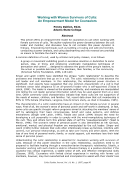
Sex, Lies, and Grand Schemes of Thought
in Closed Groups
A Collective of Women
Abstract
This article explores the invisible dynamics of control and submission in a closed
group with which the authors were affiliated for many years. Relying on Herman‟s
(1992) model of psychological captivity, the article illustrates the psychological
dynamics of the “courtship” of recruits and the covert coercive control through
which individual identity is dismantled and the worldview of the group‟s leader
introduced. Three methods of control are discussed: fear induction, destruction of
autonomy, and breaking of personality. The last part of the article explores how
cultural issues related to sexism enhance the power of high-demand groups.
We write as women who spent an average of 20 years involved in a philosophically oriented,
religious community based on the teachings of George Gurdjieff and Peter Ouspensky. All of
us have now left the group, most within the past 5 years. Yet, we are still dealing with the
aftereffects of what we have come to see was a destructive world permeated with the
dynamics of hidden control.
Some of us are still wondering what happened to our lives. How were we willingly entrapped
in a destructive world for so long? No one forced us to join the group or to stay, or so it
would appear. Rather, we were attracted to the group and its leader. We became
passionately involved, even zealous in our apparent commitment, loyal and dedicated to our
own undoing. Over time, we undermined our capacities for free thought, for hearing our
own conscience, for mutuality in relationship, and for finding our own way in the world. How
did this happen to us?
We write anonymously and disguise the identity of the group because we fear that
harassment may follow exposure. We acknowledge that our perspective on how our group
functioned is personal and that others may disagree with part or all of what we say,
although we are confident that many would agree. Our goal is not to “expose” a particular
group, or to “define” it through the articulation of our personal experience. Our goal is to
alert others to the elements of influence that can unwittingly bind people to what ultimately
harms them, and, especially, to the dangers of involvement with seemingly benevolent,
self-appointed leaders. In addition to mastering our own legacy of confusion, betrayal,
anger, and fear, we hope to shed light on the largely invisible dynamics of control and
submission that sustain such groups and the culture at large. Also we want to offer a view
of what it was like --how silent and unobtrusive the soul-killing can be.
Cults and Auras of Authenticity
Closed, doctrinaire groups with self-appointed leaders are commonly called cults. We prefer
not to use the label cultic, which is so loaded with negative connotations and lack of
understanding that the word itself stops further inquiry. No one ever believes that he or she
is in a cult (or a cultic relationship). Just as battered women rarely recognize themselves as
battered, few followers would ever acknowledge cult membership. Ask anyone you know
who is deeply involved with whatever group, and most likely that person will tell you that
the group is a legitimate organization with a leader, if there is one, who furthers the
members‟ interests (be they philosophical, religious, political). Yet, some of those groups
are probably high-demand, closed environments breeding the psychological chains that
enable manipulation by the leader. Mention “cultic” and the person may walk away,
unwilling to talk further.
Sex, Lies, and Grand Schemes of Thought
in Closed Groups
A Collective of Women
Abstract
This article explores the invisible dynamics of control and submission in a closed
group with which the authors were affiliated for many years. Relying on Herman‟s
(1992) model of psychological captivity, the article illustrates the psychological
dynamics of the “courtship” of recruits and the covert coercive control through
which individual identity is dismantled and the worldview of the group‟s leader
introduced. Three methods of control are discussed: fear induction, destruction of
autonomy, and breaking of personality. The last part of the article explores how
cultural issues related to sexism enhance the power of high-demand groups.
We write as women who spent an average of 20 years involved in a philosophically oriented,
religious community based on the teachings of George Gurdjieff and Peter Ouspensky. All of
us have now left the group, most within the past 5 years. Yet, we are still dealing with the
aftereffects of what we have come to see was a destructive world permeated with the
dynamics of hidden control.
Some of us are still wondering what happened to our lives. How were we willingly entrapped
in a destructive world for so long? No one forced us to join the group or to stay, or so it
would appear. Rather, we were attracted to the group and its leader. We became
passionately involved, even zealous in our apparent commitment, loyal and dedicated to our
own undoing. Over time, we undermined our capacities for free thought, for hearing our
own conscience, for mutuality in relationship, and for finding our own way in the world. How
did this happen to us?
We write anonymously and disguise the identity of the group because we fear that
harassment may follow exposure. We acknowledge that our perspective on how our group
functioned is personal and that others may disagree with part or all of what we say,
although we are confident that many would agree. Our goal is not to “expose” a particular
group, or to “define” it through the articulation of our personal experience. Our goal is to
alert others to the elements of influence that can unwittingly bind people to what ultimately
harms them, and, especially, to the dangers of involvement with seemingly benevolent,
self-appointed leaders. In addition to mastering our own legacy of confusion, betrayal,
anger, and fear, we hope to shed light on the largely invisible dynamics of control and
submission that sustain such groups and the culture at large. Also we want to offer a view
of what it was like --how silent and unobtrusive the soul-killing can be.
Cults and Auras of Authenticity
Closed, doctrinaire groups with self-appointed leaders are commonly called cults. We prefer
not to use the label cultic, which is so loaded with negative connotations and lack of
understanding that the word itself stops further inquiry. No one ever believes that he or she
is in a cult (or a cultic relationship). Just as battered women rarely recognize themselves as
battered, few followers would ever acknowledge cult membership. Ask anyone you know
who is deeply involved with whatever group, and most likely that person will tell you that
the group is a legitimate organization with a leader, if there is one, who furthers the
members‟ interests (be they philosophical, religious, political). Yet, some of those groups
are probably high-demand, closed environments breeding the psychological chains that
enable manipulation by the leader. Mention “cultic” and the person may walk away,
unwilling to talk further.