Cultic Studies Journal, Vol. 14, No. 1, 1997, page 6
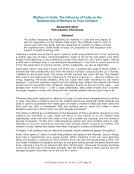
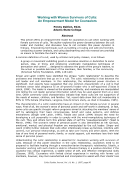
Dominance and Submission: The Psychosexual
Exploitation of Women in Cults1
Janja Lalich
Community Resources on Influence &Control
Alameda, California
Abstract
The author describes the prevalence of the sexual exploitation of women in cults.
This may take the form of daily controls of sexuality and sex lives or more overt
abuses such as arranged marriages, forced sexual activity with the leader, and
rape. Sexual control is seen as the final step in objectification of the cult member
by the authoritarian leader who is able to satisfy his needs through psychological
manipulation leading to sexual exploitation. Key to recovering from cultic sexual
abuse is psychoeducation --that is, aiding the former cult member to understand
the nature of the overall system of deception and manipulation that was used to
exploit her. Through an examination of the social and psychological influence
techniques employed by the cult, former cult members will be able to productively
confront the issues related to their sexual abuse.
With approximately 5,000 cults active in the United States today (Tobias &Lalich, 1994),
and an estimated 185,000 new members being recruited each year (Martin, 1996), public or
professional discussions and analyses of life inside a cult are surprisingly sparse. I define a
cult as a particular type of relationship that not only is based on an enormous power
imbalance between the leader and followers but also includes a hidden agenda. Whether a
group or one-on-one situation, a cult relies on deception, manipulation, and exploitation,
and almost certainly results in abuse. At the head of the cult is a self-proclaimed leader (or
sometimes two or three) who demands all veneration, who makes all decisions, and who
ultimately controls most aspects of the personal lives of those who are cleverly persuaded
that they must follow, obey, and stay in the good graces (i.e., the grips) of the leader.
Despite the common misconception that only crazy, unstable, or weird people are in cults,
research has shown that most cult members are of above-average intelligence, come from
stable backgrounds, and do not have a history of psychological illness (Langone, 1993
Singer with Lalich, 1995 Tobias &Lalich, 1994). Cult leaders and cult recruiters tend to
capture the hearts, minds, and souls of the best and brightest in our society. Cults look for
active, productive, intelligent, energetic individuals who will perform for the cult by fund-
raising, recruiting more followers, and operating cult-owned businesses or leading cult-
related seminars. In the 1960s and 1970s, perhaps, it was more typical for primarily young
people to get involved with a cult this is no longer so. The young and old alike, and
everyone in between, are being recruited into a wide array of cultic groups.
Cults may be formed around almost any topic, and are categorized by nine broad themes:
religious, Eastern-based, New Age, business, political, psychotherapy/human potential,
occult, one-on-one, and miscellaneous (such as lifestyle or personality cults). In general,
cults appeal to that part of ourselves that wants something better. A better world for others
or a better self --these are the genuine, heartfelt desires of decent, honest human beings.
Cult recruiters are trained in how to play on those desires, how to make it look as though
what the cult has to offer is exactly what you‟re interested in.
All cults, no matter their stripe, are a variation on a theme. The common denominator is the
leadership‟s use of a thought-reform program (i.e., behavior control) without the knowledge
or consent of the one who is being manipulated. By attacking a person‟s innermost self, cult
Dominance and Submission: The Psychosexual
Exploitation of Women in Cults1
Janja Lalich
Community Resources on Influence &Control
Alameda, California
Abstract
The author describes the prevalence of the sexual exploitation of women in cults.
This may take the form of daily controls of sexuality and sex lives or more overt
abuses such as arranged marriages, forced sexual activity with the leader, and
rape. Sexual control is seen as the final step in objectification of the cult member
by the authoritarian leader who is able to satisfy his needs through psychological
manipulation leading to sexual exploitation. Key to recovering from cultic sexual
abuse is psychoeducation --that is, aiding the former cult member to understand
the nature of the overall system of deception and manipulation that was used to
exploit her. Through an examination of the social and psychological influence
techniques employed by the cult, former cult members will be able to productively
confront the issues related to their sexual abuse.
With approximately 5,000 cults active in the United States today (Tobias &Lalich, 1994),
and an estimated 185,000 new members being recruited each year (Martin, 1996), public or
professional discussions and analyses of life inside a cult are surprisingly sparse. I define a
cult as a particular type of relationship that not only is based on an enormous power
imbalance between the leader and followers but also includes a hidden agenda. Whether a
group or one-on-one situation, a cult relies on deception, manipulation, and exploitation,
and almost certainly results in abuse. At the head of the cult is a self-proclaimed leader (or
sometimes two or three) who demands all veneration, who makes all decisions, and who
ultimately controls most aspects of the personal lives of those who are cleverly persuaded
that they must follow, obey, and stay in the good graces (i.e., the grips) of the leader.
Despite the common misconception that only crazy, unstable, or weird people are in cults,
research has shown that most cult members are of above-average intelligence, come from
stable backgrounds, and do not have a history of psychological illness (Langone, 1993
Singer with Lalich, 1995 Tobias &Lalich, 1994). Cult leaders and cult recruiters tend to
capture the hearts, minds, and souls of the best and brightest in our society. Cults look for
active, productive, intelligent, energetic individuals who will perform for the cult by fund-
raising, recruiting more followers, and operating cult-owned businesses or leading cult-
related seminars. In the 1960s and 1970s, perhaps, it was more typical for primarily young
people to get involved with a cult this is no longer so. The young and old alike, and
everyone in between, are being recruited into a wide array of cultic groups.
Cults may be formed around almost any topic, and are categorized by nine broad themes:
religious, Eastern-based, New Age, business, political, psychotherapy/human potential,
occult, one-on-one, and miscellaneous (such as lifestyle or personality cults). In general,
cults appeal to that part of ourselves that wants something better. A better world for others
or a better self --these are the genuine, heartfelt desires of decent, honest human beings.
Cult recruiters are trained in how to play on those desires, how to make it look as though
what the cult has to offer is exactly what you‟re interested in.
All cults, no matter their stripe, are a variation on a theme. The common denominator is the
leadership‟s use of a thought-reform program (i.e., behavior control) without the knowledge
or consent of the one who is being manipulated. By attacking a person‟s innermost self, cult