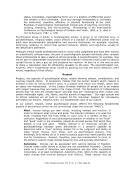
Cultic Studies Journal, Vol. 9, No. 2, 1992, Page 73
Book Reviews
The Gnostic Mystery. Andrea Grace Diem. Mt. San Antonio College Press, Walnut,
CA, 1992, 66 pages.
Over the years many people have tried to “get a handle” on the religious cults by diagnosing
them as, among other things, “gnostic.” That judgment is the result of the perception that (a)
they are elitist and (b) they present themselves as having some special “inside” knowledge
about the meaning and purpose of human existence. This brief book, which will be of interest
to those who can afford the time to explore the subject of gnosticism a little further, appears
to be the fruit of a doctoral dissertation, in which the author weighs two examples of gnostic
religion or spirituality. The first, the Sant tradition, was found in northern India in medieval
times. The second is from the 3rd and 4th centuries in Egypt however, the documentation
has come to light only quite recently, known as the Nag Hammadi Library, for the place of its
discovery in 1945.
Diem shares the common opinion that gnostics, though never an organized religion, were
rather numerous in the infancy of the Christian church and that they saw mankind as being
caught somewhere in the middle of a struggle between the forces of light and darkness, the
contending powers of good and evil. For those who have studied the spiritualities of India, it
will come as no surprise to read that it is knowledge--esoteric and mystical knowledge--that
provides the key for unlocking the doors to union with the All, and that asceticism and
meditation are the chief instruments for promoting mystical insights. Diem does not waste
time over the probably futile effort to date the origins of Indian spirituality. It is sufficient to
acknowledge that it was already highly developed by the time Christianity arose. Although
Indian spirituality was not then “gnostic,” as far as we know, it already saw the fundamental
task for mankind to be the harmonizing or identifying of the human and the transcendent.
When, in 1945, the Nag Hammadi Library was uncovered in upper Egypt, it afforded scholars
a window on the world in which Christianity was establishing itself. A tension between the
gnostics and the orthodox quickly developed, and as a result each expelled or excluded the
other.
James Robinson, editor of the English edition of the Nag Hammadi, remarks that although the
gnostics might see the world as “good in principle,” they actually judge that “evil has been
given a status as the ultimate ruler of the world.” For them, he writes, “a mystical inwardness
undistracted by external factors came to be the only way to attain repose, the overview, the
merger into the All, which is the destiny of one‟s spark of the divine” (1981, The Nag
Hammadi Library, James M. Robinson, Ed. San Francisco: Harper and Row).
The infection--if it be seen as that--persists through the centuries in many forms:
Manichaeism, Jansenism, and Puritanism among others. Now in this century we seem to find
it manifesting itself with added twists that involve manipulation and control.
In her thesis, Diem limits her objective. She wants to make some comparison between these
two examples of gnosticism in India and in Egypt, but she does not attempt to referee the
longstanding opinion that it all originated in Persia long before the Common Era--not even in
the face of the fact that Zoroaster is explicitly mentioned in Nag Hammadi. The subtitle of her
book, “A Connection Between Ancient and Modern Mysticism,” constitutes a promise that is
not too thoroughly fulfilled in the text. It is the opinion of this reviewer that the roots of
gnosticism are older and go deeper than any of the theorists have yet ventured to suggest.
Dare we speculate that they are to be found in the Epic of Gilgamesh? That would be about
two or three millennia before Christ!
Book Reviews
The Gnostic Mystery. Andrea Grace Diem. Mt. San Antonio College Press, Walnut,
CA, 1992, 66 pages.
Over the years many people have tried to “get a handle” on the religious cults by diagnosing
them as, among other things, “gnostic.” That judgment is the result of the perception that (a)
they are elitist and (b) they present themselves as having some special “inside” knowledge
about the meaning and purpose of human existence. This brief book, which will be of interest
to those who can afford the time to explore the subject of gnosticism a little further, appears
to be the fruit of a doctoral dissertation, in which the author weighs two examples of gnostic
religion or spirituality. The first, the Sant tradition, was found in northern India in medieval
times. The second is from the 3rd and 4th centuries in Egypt however, the documentation
has come to light only quite recently, known as the Nag Hammadi Library, for the place of its
discovery in 1945.
Diem shares the common opinion that gnostics, though never an organized religion, were
rather numerous in the infancy of the Christian church and that they saw mankind as being
caught somewhere in the middle of a struggle between the forces of light and darkness, the
contending powers of good and evil. For those who have studied the spiritualities of India, it
will come as no surprise to read that it is knowledge--esoteric and mystical knowledge--that
provides the key for unlocking the doors to union with the All, and that asceticism and
meditation are the chief instruments for promoting mystical insights. Diem does not waste
time over the probably futile effort to date the origins of Indian spirituality. It is sufficient to
acknowledge that it was already highly developed by the time Christianity arose. Although
Indian spirituality was not then “gnostic,” as far as we know, it already saw the fundamental
task for mankind to be the harmonizing or identifying of the human and the transcendent.
When, in 1945, the Nag Hammadi Library was uncovered in upper Egypt, it afforded scholars
a window on the world in which Christianity was establishing itself. A tension between the
gnostics and the orthodox quickly developed, and as a result each expelled or excluded the
other.
James Robinson, editor of the English edition of the Nag Hammadi, remarks that although the
gnostics might see the world as “good in principle,” they actually judge that “evil has been
given a status as the ultimate ruler of the world.” For them, he writes, “a mystical inwardness
undistracted by external factors came to be the only way to attain repose, the overview, the
merger into the All, which is the destiny of one‟s spark of the divine” (1981, The Nag
Hammadi Library, James M. Robinson, Ed. San Francisco: Harper and Row).
The infection--if it be seen as that--persists through the centuries in many forms:
Manichaeism, Jansenism, and Puritanism among others. Now in this century we seem to find
it manifesting itself with added twists that involve manipulation and control.
In her thesis, Diem limits her objective. She wants to make some comparison between these
two examples of gnosticism in India and in Egypt, but she does not attempt to referee the
longstanding opinion that it all originated in Persia long before the Common Era--not even in
the face of the fact that Zoroaster is explicitly mentioned in Nag Hammadi. The subtitle of her
book, “A Connection Between Ancient and Modern Mysticism,” constitutes a promise that is
not too thoroughly fulfilled in the text. It is the opinion of this reviewer that the roots of
gnosticism are older and go deeper than any of the theorists have yet ventured to suggest.
Dare we speculate that they are to be found in the Epic of Gilgamesh? That would be about
two or three millennia before Christ!