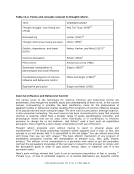
Cultic Studies Journal, Vol. 9, No. 2, 1992, Page 57
correspondence to DSM-III diagnosis. As a result the MCMI-II was revised according to
clinical judgments based on DSM-III-R diagnostic classifications (Millon, 1987). Accordingly,
Wellspring has been using the MCMI-II since shortly after its publication. The results from
the MCMI-II will be presented in another study. Nevertheless, the bulk of studies on the
MCMI-I, which was used in this study, do support it as reliably measuring personality traits
and symptomatology.
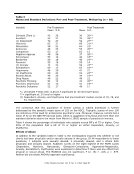
A review of the literature found no study which used the MCMI as a measure of distress
among former sect or cult members, although Weiss and Comrey (1987) reported strong
compulsive traits among members of the Hare Krishna group. Several studies, most done
on psychiatric inpatients, have reported changes on MCMI scores after a treatment
program, including increases in the narcissistic and histrionic scales on the MCMI following
treatment (Libb, Stankovic, Sokol, Freeman, Houck &Switzer, 1990 McMahon, Davidson, &
Flynn, 1986 McMahon, Flynn, &Davidson, 1985 Stankovic, Libb, Freeman, &Roseman,
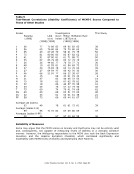
1992). A number of studies have reported on correlations for the MCMI-I prior to treatment
and after treatment (Hyer, Woods, Bruno, &Boudewyns, 1989 Libb, et al., 1990 McMahon
et al., 1985 Millon, 1987 Overholser, 1990 Piersma, 1986). Typically, stability coefficients
for the clinical scales range between r =.60 and r =.70, and for the personality scales
more than r =.70.
Beck Depression Inventory. The Beck Depression Inventory ([BDII Beck, Ward,
Mendelson, Mock, &Erbaugh, 1961) is one of the most commonly used self-report methods
of assessing depression. The BDI is symptom focused. Split-half reliabilities range from .58
to .93 test-retest ranges from .69 to .90. Concurrent validity has been demonstrated with
diverse measures. BDI scores range from 0 to 63, with a score of 10 or more considered to
be beyond the normal range and a score of 17 or more suggestive of depressive disorder.
The BDI has been used with a wide variety of psychiatric and normal populations but has
been criticized for being a measure of a social undesirability response set and for correlating
more closely to an anxiety measure than to another depression measure (Langevin &
Stancer, 1979, cited in Beckham &Leber, 1985).
Hopkins Symptom Checklist. The HSCL is a frequently used, self-administered rating
scale for assessing psychiatric symptomatology (Derogatis, Lipman, Rickels, Uhlenhuth, &
Covi, 1974). Reliability and validity studies have consistently shown the HSCL to be an
instrument possessing high degrees of both reliability and validity. Internal consistency
measures are uniformly high for all five factoral dimensions, that is, .84 to .87. Test-retest
reliability studies show uniform and high consistency (Rickels, Lipman, Park, Covi,
Uhlenhuth, &Mock, 1971). Validity studies demonstrating clinical sensitivity have shown the
USCL to be an efficient and dependable measure of anxiety and other clinical psychiatric
symptoms (Derogatis et al., 1974 Rickels, Lipman, Garcia, &Fisher, 1972). The HSCL is a
58-item inventory with scores ranging from 58 to 232. One hundred is considered a cutoff
score indicating the need for psychiatric treatment.
Staff Burnout Scale. The SBS-HP scale is based on the conceptual framework developed
by Maslach and Pines (1979). However, the SBS-HP also includes behavioral and
physiological indices of burnout. The SBS-HP scale is published by London House
management consultants. It was designed to measure acute stress episodes and was
normed on populations that have been traditionally considered high-stress professions,
namely health professionals. The scale is a self-report measure consisting of 30 questions.
Ten of the questions were designed to detect lying. With the remaining 20 questions a
reliability coefficient of .93 was obtained (Jones, 1980). Three validity studies showed
significant correlations with absenteeism, tardiness, job turnover, physical illness, patient
neglect, employee theft, drug and alcohol abuse, job dissatisfaction, and perceived levels of
stress (Jones 1980, 1981). Martin (1983), found the mean SBS-HP score to be 48.75 (N =
488, SD =18.61) for religious workers in high schools and colleges, for example, Campus
correspondence to DSM-III diagnosis. As a result the MCMI-II was revised according to
clinical judgments based on DSM-III-R diagnostic classifications (Millon, 1987). Accordingly,
Wellspring has been using the MCMI-II since shortly after its publication. The results from
the MCMI-II will be presented in another study. Nevertheless, the bulk of studies on the
MCMI-I, which was used in this study, do support it as reliably measuring personality traits
and symptomatology.
A review of the literature found no study which used the MCMI as a measure of distress
among former sect or cult members, although Weiss and Comrey (1987) reported strong
compulsive traits among members of the Hare Krishna group. Several studies, most done
on psychiatric inpatients, have reported changes on MCMI scores after a treatment
program, including increases in the narcissistic and histrionic scales on the MCMI following
treatment (Libb, Stankovic, Sokol, Freeman, Houck &Switzer, 1990 McMahon, Davidson, &
Flynn, 1986 McMahon, Flynn, &Davidson, 1985 Stankovic, Libb, Freeman, &Roseman,
1992). A number of studies have reported on correlations for the MCMI-I prior to treatment
and after treatment (Hyer, Woods, Bruno, &Boudewyns, 1989 Libb, et al., 1990 McMahon
et al., 1985 Millon, 1987 Overholser, 1990 Piersma, 1986). Typically, stability coefficients
for the clinical scales range between r =.60 and r =.70, and for the personality scales
more than r =.70.
Beck Depression Inventory. The Beck Depression Inventory ([BDII Beck, Ward,
Mendelson, Mock, &Erbaugh, 1961) is one of the most commonly used self-report methods
of assessing depression. The BDI is symptom focused. Split-half reliabilities range from .58
to .93 test-retest ranges from .69 to .90. Concurrent validity has been demonstrated with
diverse measures. BDI scores range from 0 to 63, with a score of 10 or more considered to
be beyond the normal range and a score of 17 or more suggestive of depressive disorder.
The BDI has been used with a wide variety of psychiatric and normal populations but has
been criticized for being a measure of a social undesirability response set and for correlating
more closely to an anxiety measure than to another depression measure (Langevin &
Stancer, 1979, cited in Beckham &Leber, 1985).
Hopkins Symptom Checklist. The HSCL is a frequently used, self-administered rating
scale for assessing psychiatric symptomatology (Derogatis, Lipman, Rickels, Uhlenhuth, &
Covi, 1974). Reliability and validity studies have consistently shown the HSCL to be an
instrument possessing high degrees of both reliability and validity. Internal consistency
measures are uniformly high for all five factoral dimensions, that is, .84 to .87. Test-retest
reliability studies show uniform and high consistency (Rickels, Lipman, Park, Covi,
Uhlenhuth, &Mock, 1971). Validity studies demonstrating clinical sensitivity have shown the
USCL to be an efficient and dependable measure of anxiety and other clinical psychiatric
symptoms (Derogatis et al., 1974 Rickels, Lipman, Garcia, &Fisher, 1972). The HSCL is a
58-item inventory with scores ranging from 58 to 232. One hundred is considered a cutoff
score indicating the need for psychiatric treatment.
Staff Burnout Scale. The SBS-HP scale is based on the conceptual framework developed
by Maslach and Pines (1979). However, the SBS-HP also includes behavioral and
physiological indices of burnout. The SBS-HP scale is published by London House
management consultants. It was designed to measure acute stress episodes and was
normed on populations that have been traditionally considered high-stress professions,
namely health professionals. The scale is a self-report measure consisting of 30 questions.
Ten of the questions were designed to detect lying. With the remaining 20 questions a
reliability coefficient of .93 was obtained (Jones, 1980). Three validity studies showed
significant correlations with absenteeism, tardiness, job turnover, physical illness, patient
neglect, employee theft, drug and alcohol abuse, job dissatisfaction, and perceived levels of
stress (Jones 1980, 1981). Martin (1983), found the mean SBS-HP score to be 48.75 (N =
488, SD =18.61) for religious workers in high schools and colleges, for example, Campus