International Journal of Coercion, Abuse, and Manipulation Volume 6 2023 74
obtain legally valid government identification breaches
his religious beliefs (Windsor v Horner, 2012b).
One-month later then Prothonotary Lafrenière
dismissed Belanger’s application without personal
appearance on the basis Belanger’s financial claims
were nothing more than bald statements, and did
not establish Belanger was unable to pay court filing
fees (Windsor v Horner, 2012c). Belanger’s litigation
incompetence effectively ended this lawsuit before it
even began.
Belanger subsequently published a “Plenary Statement
Of claim Tort of Intimidation,” that probably was
the Federal Court lawsuit he had intended to file for
free (Belanger, n.d.). In this difficult to understand
document, Belanger purported to act as the “proxy” for
Queen Elizabeth II, and demanded $1 million, each,
from a wide variety of government officials, almost every
judge and master of the Alberta trial courts, Crown
prosecutors, and law enforcement and correctional
service officers for their failure to recognize and be
bound by CERI pseudolegal theory. In Meads v Meads
(2012 ABQB 571, para 187), Associate Chief Justice
Rooke comments that CERI materials are “unusually
haphazard, even by [pseudolaw] documentary
materials standards.” Belanger’s “Plenary Statement” is
a model example. If the “Plenary Statement” document
had been successfully filed in Federal Court, that
document would have inevitably been struck out as an
abuse of court processes.
Here Belanger was operating solo. No evidence
implicates Belanger involving others in this lawsuit.
Belanger is obviously targeting those he considers
wrongdoers, and, in an entirely inept manner,
attempted to use court processes to his advantage. In
this instance, Belanger never passed the starting gate.
The persons he intended to sue were never even aware
this litigation occurred.
C. Carol and Roderick Volk Foreclosure Proceedings
-IHSBC Bank Canada v Volk, British Columbia
Supreme Court Docket No. Victoria 13 3743, Minister
Carol Mary Helen v Maia, Federal Court of Canada
Docket No. T-1898-14, Minister Carol Mary Helen v
Maia,FederalCourtofCanadaDocketNo.T-1942-14
The next example of Belanger’s litigation operations
has two phases. In the first, Belanger parachuted into
an existing foreclosure lawsuit, purporting to represent
a married couple, Carol and Roderick Volk. Once
established in that role, Belanger expanded his activity
to include counter-attack litigation in Federal Court.
Prior to adopting CERI strategies, the Volks had already
(on July 13, 2013) deployed “money-for-nothing”
debt elimination concepts promoted by a separate
US-based pseudolaw movement to avoid outstanding
mortgage debts on their Victoria, British Columbia
home. Carol Volk’s illustrative reaction to the bank’s
negative response to this step is recorded in a five-hour
Skype transcript (Riger, 2013) with other members of
her original pseudolaw community, the One People’s
Public Trust (Barrows, 2021 Muniesa, 2022). That
transcript reveals much about the mindsets of these
pseudolaw adherents.
Two months later, the lender applied for foreclosure
in the British Columbia Supreme Court (HSBC Bank
Canada v Volk, 2013a). The Volks initially employed
One People’s Public Trust pseudolegal arguments that
purportedly paid mortgage debts by “courtesy notices”
(HSBC Bank Canada v Volk, 2013b HSBC Bank
Canada v Volk, 2014a). Naturally, that did not work.
As the foreclosure entered its final phases one year
later, the Volks switched pseudolaw gurus. Belanger
physically relocated to Victoria to direct a CERI-
based pseudolaw response to the bank. Belanger was
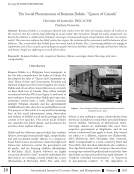
living in a recreational vehicle parked outside the
Volks’ residence, and, in contemporaneous videos,
confronted process servers working for the bank. In July
and August 2014, Belanger followed his usual pattern
of documentary (“Church ministers,” 2014) and video
(Paraclete, 2014c Paraclete, 2014d Paraclete, 2014e
Paraclete, 2014f Paraclete, 2014g Paraclete, 2014h
Paraclete, 2014i) “notices” that purportedly eliminated
any obligation by the two new CERI “ministers” to
the bank, and unilaterally imposed counterattack
sanctions on many targets, included British Columbia
court judges and personnel, the bank and its officers,
the bank’s lawyers, the British Columbia Real Estate
Board, and the British Columbia government and its
officials.
Naturally, these meaningless declarations had no
effect, and, on September 16, 2014, the Court ordered
obtain legally valid government identification breaches
his religious beliefs (Windsor v Horner, 2012b).
One-month later then Prothonotary Lafrenière
dismissed Belanger’s application without personal
appearance on the basis Belanger’s financial claims
were nothing more than bald statements, and did
not establish Belanger was unable to pay court filing
fees (Windsor v Horner, 2012c). Belanger’s litigation
incompetence effectively ended this lawsuit before it
even began.
Belanger subsequently published a “Plenary Statement
Of claim Tort of Intimidation,” that probably was
the Federal Court lawsuit he had intended to file for
free (Belanger, n.d.). In this difficult to understand
document, Belanger purported to act as the “proxy” for
Queen Elizabeth II, and demanded $1 million, each,
from a wide variety of government officials, almost every
judge and master of the Alberta trial courts, Crown
prosecutors, and law enforcement and correctional
service officers for their failure to recognize and be
bound by CERI pseudolegal theory. In Meads v Meads
(2012 ABQB 571, para 187), Associate Chief Justice
Rooke comments that CERI materials are “unusually
haphazard, even by [pseudolaw] documentary
materials standards.” Belanger’s “Plenary Statement” is
a model example. If the “Plenary Statement” document
had been successfully filed in Federal Court, that
document would have inevitably been struck out as an
abuse of court processes.
Here Belanger was operating solo. No evidence
implicates Belanger involving others in this lawsuit.
Belanger is obviously targeting those he considers
wrongdoers, and, in an entirely inept manner,
attempted to use court processes to his advantage. In
this instance, Belanger never passed the starting gate.
The persons he intended to sue were never even aware
this litigation occurred.
C. Carol and Roderick Volk Foreclosure Proceedings
-IHSBC Bank Canada v Volk, British Columbia
Supreme Court Docket No. Victoria 13 3743, Minister
Carol Mary Helen v Maia, Federal Court of Canada
Docket No. T-1898-14, Minister Carol Mary Helen v
Maia,FederalCourtofCanadaDocketNo.T-1942-14
The next example of Belanger’s litigation operations
has two phases. In the first, Belanger parachuted into
an existing foreclosure lawsuit, purporting to represent
a married couple, Carol and Roderick Volk. Once
established in that role, Belanger expanded his activity
to include counter-attack litigation in Federal Court.
Prior to adopting CERI strategies, the Volks had already
(on July 13, 2013) deployed “money-for-nothing”
debt elimination concepts promoted by a separate
US-based pseudolaw movement to avoid outstanding
mortgage debts on their Victoria, British Columbia
home. Carol Volk’s illustrative reaction to the bank’s
negative response to this step is recorded in a five-hour
Skype transcript (Riger, 2013) with other members of
her original pseudolaw community, the One People’s
Public Trust (Barrows, 2021 Muniesa, 2022). That
transcript reveals much about the mindsets of these
pseudolaw adherents.
Two months later, the lender applied for foreclosure
in the British Columbia Supreme Court (HSBC Bank
Canada v Volk, 2013a). The Volks initially employed
One People’s Public Trust pseudolegal arguments that
purportedly paid mortgage debts by “courtesy notices”
(HSBC Bank Canada v Volk, 2013b HSBC Bank
Canada v Volk, 2014a). Naturally, that did not work.
As the foreclosure entered its final phases one year
later, the Volks switched pseudolaw gurus. Belanger
physically relocated to Victoria to direct a CERI-
based pseudolaw response to the bank. Belanger was
living in a recreational vehicle parked outside the
Volks’ residence, and, in contemporaneous videos,
confronted process servers working for the bank. In July
and August 2014, Belanger followed his usual pattern
of documentary (“Church ministers,” 2014) and video
(Paraclete, 2014c Paraclete, 2014d Paraclete, 2014e
Paraclete, 2014f Paraclete, 2014g Paraclete, 2014h
Paraclete, 2014i) “notices” that purportedly eliminated
any obligation by the two new CERI “ministers” to
the bank, and unilaterally imposed counterattack
sanctions on many targets, included British Columbia
court judges and personnel, the bank and its officers,
the bank’s lawyers, the British Columbia Real Estate
Board, and the British Columbia government and its
officials.
Naturally, these meaningless declarations had no
effect, and, on September 16, 2014, the Court ordered