International Journal of Coercion, Abuse, and Manipulation Volume 6 2023 68
residence, what Belanger called the “Heatherdown
Ecclesia” (Canada Trustco Mortgage Company v
Belanger, 2002a). Belanger immediately rejected the
statement of claim, wrote “Refused for Fraud” on it,
and submitted extensive pseudolaw materials and
documents advancing US-style fractional reserve
banking conspiracy “money-for-nothing” theories
(Netolitzky, 2019, p. 1177).
Belanger’s conduct escalated after the property was
subject to a court-ordered sale (Canada Trustco
Mortgage Company v Belanger, 2002c). He demanded
police intervention (“Letter to City of Edmonton,”
2002), and declared “I am intent to defend [the
Heatherdown Ecclesia] with my life if that is what it
takes. Martyrdom is sometimes the only way to prove
a point and I am willing to do that.” (Canada Trustco
Mortgage Company v Belanger, 2002d). “Blood of a
martyr always looks good and I have instructed my
Church members to continue the story after my demise
on the internet and public webservers of news and
events concerning the Coronation Ceremony.” (“Notice
To,” n.d.). When RCMP contacted Belanger in relation
to the foreclosure, Belanger denied the RCMP had any
authority--Belanger is a “minister” (“Notice To,” n.d.).
Belanger’s family was ordered to vacate the property
(Canada Trustco Mortgage Company v Belanger,
2002e). When Belanger and his wife attended court,
Belanger was ejected by security. Belanger’s wife
attempted to facilitate sale of the property. Belanger’s
threats escalated such that the RCMP subsequently
recommended an RCMP escort when anyone attended
the Ecclesia (Canada Trustco Mortgage Company v
Belanger, 2002g). The Court ultimately authorized the
RCMP use force to eject Belanger from the property
(Canada Trustco Mortgage Company v Belanger,
2002f), and in early 2003 the property was sold in a
court-directed sale.
Apparently undeterred, Belanger became a fixture in
Canadian and US pseudolaw circles, promoting his
ideas in forums such as Ecclesia.org (source, 2004)
and Cannabis Culture (Guest_*, 2004). In the latter
discussion, Belanger is debating with Robert Arthur
Menard, the founder of the Freeman-on-the-Land
movement. The scope and scale of CERI activities
during this period is difficult to gauge. A few reported
court judgments are clearly associated with Belanger
and his ideas (e.g., R v Crischuk, 2007 BCPC 470 R
v fidler, 2009 BCSC 1253). Some media reports of
Canadian pseudolaw proceedings are clearly linked to
CERI (Kent &Willey, 2013, pp. 328-329).
Ecclesiastical “notices” and related documents are one
possible method to identify and generally quantify
CERI activity. Many are posted on Belanger’s personal
website, “All Creator’s Gifts,”12 and an associated blog.13
If correct, then those materials confirm that CERI was
a small group. For example, in 2007, only three such
documents were posted on the All Creator’s Gifts blog
(“Letter to Douglas Finley,” 2007 “Manitoba Notary,”
2007 “Private agreements,” 2007). At times Belanger
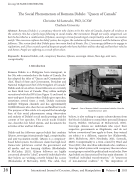
has operated as an itinerant guru, living in a motor
home, and relocating from customer to customer.
Belanger’s recent Internet videos imply he has once
again adopted this nomadic lifestyle (owlmon, 2022b).
Belanger has been repeatedly incarcerated for criminal
activity, despite Belanger teaching followers that
he is outside of, and exempt from, Canadian law.
Most recently, in 2018, Belanger received 2.5-month
sentences for motor vehicle and drug offenses
(R v Belanger (20 September 2018), Edmonton
180222747P1 (Alta PC) R v Belanger (3 April 2019),
Edmonton 180995987P1 (Alta PC)). The degree to
which the Canadian pseudolaw communities are
aware of that criminal activity is unclear. Another
factor that has probably played against Belanger and
CERI is his vocal antisemitism. For example, Belanger
in his video broadcasts has described Jewish practices
of sexual assault of non-Jewish girls, a death penalty
for reading the Talmud, and Jewish conspiratorial
activities (Hilfskreuzer Möwe, 2014 Paraclete, 2014b).
This pattern continues to the present, with Belanger
recently denouncing a lawyer as a “white Zionist jew”
(owlmon, 2022b).
Throughout his pseudolaw guru career, Belanger has
been highly persistent and aggressive, but has exhibited
minimal competence either in court proceedings, or as
a legal advisor. Associate Chief Justice Rooke observed
in Meads v Meads (2012 ABQB 571, para. 187) that
CERI documents and arguments, that are apparently
often prepared personally by Belanger, are unusually
haphazard “cut and paste” assemblages (e.g., Belanger,
12 Website: http://www.allcreatorsgifts.org/.
13 Website: http://allcreatorsgifts.blogspot.com.