International Journal of Coercion, Abuse, and Manipulation Volume 6 2023 46
The “talking” aspect of these items was that each
painting was accompanied by an audio recording
that described and explained the individual painting.
During the Global Announcement, Phoenix played
each recording, and announced her impending death
due to a terminal heart condition. No new MCLR
concepts or directions were announced or described.
While the audience is not visible during this recording,
the limited applause suggests that attendance to this
event was notational.
C. Pseudolegal Theory
Robinson’s Laymans Guide is the centrepiece for MCLR
theory, supplemented by other template and form
documents produced by Robinson and distributed
on MCLR Facebook groups. The Laymans Guide
is a poorly drafted and cryptic document primarily
composed of example and template MCLR documents.
MCLR adherents frequently complain the Laymans
Guide is obscure, and seek other, simpler guidance.
Those complaints are well-founded.
Instead, the best resource to understand MCLR
theory is AVI v MHVB, 2020 ABQB 489, a reported
Alberta Court of Queen’s Bench14 decision where
Justice Graesser reproduced, reviewed, interpreted,
and refuted Robinson’s form documents and their
meaning. Succinctly, Robinson claims that in 2001
the UK collapsed into disorder when the New Rebel
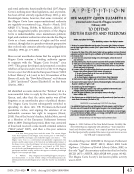
Barons sent their “Petition” to the Queen, and she did
not promptly extract the UK from the European Union.
Robinson’s materials explain that the European Union
was created by the Nazis in 1944 (Robinson, 2017, pp.
35, 116), purport that increased UK integration into
the European Union was treason and sedition, and that
UK politicians knew this (Robinson, 2017, pp. 35-40,
116-120).
Robinson claimed, post-2001, that one can swear
allegiance to and join with the New Rebel Barons
in “lawful rebellion,” pursuant to Article 61 of the
1215 Magna Carta. Allegedly, one is then outside all
“conventional” state and legal authority. For no obvious
reason, Lord Craigmyle of Invernesshire has been
designated the “Baron of choice” for this oath-giving
process. Lord Craigmyle, himself, appears baffled by
the thousands of MCLR documents he has received
14 Now the Alberta Court of King’s Bench.
(Denounce the Deception UK, 2018).
Once aligned with Lord Craigmyle, lawful rebel status
and authority is implemented by two alternative sets
of five form documents. One branch of Robinson’s
documents is sent sequentially to law enforcement and
court actors, and operate as a formal declaration of
status and independence. Robinson claimed that once
that five-document process is complete, the sender is
then outside of state authority, and exclusively under
“common law.”15 The other set of five documents
targets a specific “traitor and quisling,” who is ordered
to comply with MCLR-based demands, or face “the
Gallows.” Both MCLR document processes are “Three/
Five Letters” schemes, a very commonplace pseudolaw
protocol where failure to respond to document-
based demands by a deadline purportedly creates a
binding legal effect (AVI v MHVB, 2020 ABQB 489,
paras. 57-62, 110-113). For example, the “discipline”
MCLR documents claim to impose a death penalty
on government targets who do not comply with the
adherent’s demands, or make impossible replies within
the deadlines set in each of the Three/Five Letters
documents.
Robinson’s “lawful rebellion” scheme, and its reliance
on Article 61, is clearly derived from earlier UK sources,
particularly the Magna Carta Society, Mote, and their
publications. The 1215 Magna Carta allegedly operates
as a supraconstitutional authority that cannot be
modified, revised, repealed, or revoked. The Three/
Five Letters are “foisted unilateral agreements” (Meads
v Meads, 2012 ABQB 571, paras. 379-416) whose
conceptual origin traces to US and Canadian pseudolaw
sources. The foundational “common law” and “person”
ideas found in Robinson’s and Phoenix’s writing are
unoriginal Sovereign Citizen-derived pseudolaw (AVI
v MHVB, 2020 ABQB 489, paras. 11-16, 110-113).
Robinson’s original “theoretical” contributions are
little more than the form documents he created, then
propagated by rote by Phoenix.
AVI v MHVB, 2020 ABQB 489 provides the most
detailed rebuttal of MCLR theory. Beyond pseudolaw’s
usual defects (Kalinowski, 2019 McRoberts, 2019
Meads v Meads, 2012 ABQB 571 Netolitzky, 2021),
Justice Graesser identifies MCLR-specific errors that
15 The term “common law” is incorrectly used in pseudolaw to identify
a fictitious fundamental and immutable historical or God-given law (Meads
v Meads, 2012 ABQB 571, paras. 326-330 Netolitzky, 2018b, pp. 1067-
1071).
The “talking” aspect of these items was that each
painting was accompanied by an audio recording
that described and explained the individual painting.
During the Global Announcement, Phoenix played
each recording, and announced her impending death
due to a terminal heart condition. No new MCLR
concepts or directions were announced or described.
While the audience is not visible during this recording,
the limited applause suggests that attendance to this
event was notational.
C. Pseudolegal Theory
Robinson’s Laymans Guide is the centrepiece for MCLR
theory, supplemented by other template and form
documents produced by Robinson and distributed
on MCLR Facebook groups. The Laymans Guide
is a poorly drafted and cryptic document primarily
composed of example and template MCLR documents.
MCLR adherents frequently complain the Laymans
Guide is obscure, and seek other, simpler guidance.
Those complaints are well-founded.
Instead, the best resource to understand MCLR
theory is AVI v MHVB, 2020 ABQB 489, a reported
Alberta Court of Queen’s Bench14 decision where
Justice Graesser reproduced, reviewed, interpreted,
and refuted Robinson’s form documents and their
meaning. Succinctly, Robinson claims that in 2001
the UK collapsed into disorder when the New Rebel
Barons sent their “Petition” to the Queen, and she did
not promptly extract the UK from the European Union.
Robinson’s materials explain that the European Union
was created by the Nazis in 1944 (Robinson, 2017, pp.
35, 116), purport that increased UK integration into
the European Union was treason and sedition, and that
UK politicians knew this (Robinson, 2017, pp. 35-40,
116-120).
Robinson claimed, post-2001, that one can swear
allegiance to and join with the New Rebel Barons
in “lawful rebellion,” pursuant to Article 61 of the
1215 Magna Carta. Allegedly, one is then outside all
“conventional” state and legal authority. For no obvious
reason, Lord Craigmyle of Invernesshire has been
designated the “Baron of choice” for this oath-giving
process. Lord Craigmyle, himself, appears baffled by
the thousands of MCLR documents he has received
14 Now the Alberta Court of King’s Bench.
(Denounce the Deception UK, 2018).
Once aligned with Lord Craigmyle, lawful rebel status
and authority is implemented by two alternative sets
of five form documents. One branch of Robinson’s
documents is sent sequentially to law enforcement and
court actors, and operate as a formal declaration of
status and independence. Robinson claimed that once
that five-document process is complete, the sender is
then outside of state authority, and exclusively under
“common law.”15 The other set of five documents
targets a specific “traitor and quisling,” who is ordered
to comply with MCLR-based demands, or face “the
Gallows.” Both MCLR document processes are “Three/
Five Letters” schemes, a very commonplace pseudolaw
protocol where failure to respond to document-
based demands by a deadline purportedly creates a
binding legal effect (AVI v MHVB, 2020 ABQB 489,
paras. 57-62, 110-113). For example, the “discipline”
MCLR documents claim to impose a death penalty
on government targets who do not comply with the
adherent’s demands, or make impossible replies within
the deadlines set in each of the Three/Five Letters
documents.
Robinson’s “lawful rebellion” scheme, and its reliance
on Article 61, is clearly derived from earlier UK sources,
particularly the Magna Carta Society, Mote, and their
publications. The 1215 Magna Carta allegedly operates
as a supraconstitutional authority that cannot be
modified, revised, repealed, or revoked. The Three/
Five Letters are “foisted unilateral agreements” (Meads
v Meads, 2012 ABQB 571, paras. 379-416) whose
conceptual origin traces to US and Canadian pseudolaw
sources. The foundational “common law” and “person”
ideas found in Robinson’s and Phoenix’s writing are
unoriginal Sovereign Citizen-derived pseudolaw (AVI
v MHVB, 2020 ABQB 489, paras. 11-16, 110-113).
Robinson’s original “theoretical” contributions are
little more than the form documents he created, then
propagated by rote by Phoenix.
AVI v MHVB, 2020 ABQB 489 provides the most
detailed rebuttal of MCLR theory. Beyond pseudolaw’s
usual defects (Kalinowski, 2019 McRoberts, 2019
Meads v Meads, 2012 ABQB 571 Netolitzky, 2021),
Justice Graesser identifies MCLR-specific errors that
15 The term “common law” is incorrectly used in pseudolaw to identify
a fictitious fundamental and immutable historical or God-given law (Meads
v Meads, 2012 ABQB 571, paras. 326-330 Netolitzky, 2018b, pp. 1067-
1071).