International Journal of Coercion, Abuse, and Manipulation Volume 6 2023 62
social countermeasures.
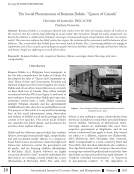
Second, Sarteschi (2023) has recently constructed a
detailed profile and history of a pseudolaw cult centered
on Romana Didulo, the self-proclaimed Queen of
Canada. Starting in 2021, Didulo accumulated tens
of thousands of supporters who fund Didulo’s cross-
Canada caravan of recreational vehicles, and Didulo’s
inner entourage of uniformed facilitators. Didulo’s
cult of personality has persisted, if not thrived, despite
Didulo’s total failure to fulfill her extraordinary
promises and her increasingly absurd claims.
This article focuses on a further example of a pseudolaw
group or movement: the Church of the Ecumenical
Redemption International [CERI], and its central guru
figure, Edward Robin Jay Belanger. Some academic and
legal writing, and case law, already exists that relates to
CERI (e.g., Kent &Willey 2013, pp. 327-329 Meads
v Meads, 2012 ABQB 571, paras. 134-139, 183-188
Netolitzky, 2016, pp. 627-628 Netolitzky, 2021, pp.
177-178 Netolitzky, 2023a, pp. 820-821), however
that limited literature focuses on CERI’s variation
upon Sovereign Citizen pseudolaw, and how CERI and
Belanger have been uniformly unsuccessful in their
attempts to overturn the accepted legal order.
This current article explores CERI’s social structure,
belief system, and activities. Several characteristics
make CERI a highly unusual “legal cult,” so that a
closer investigation of this pseudolaw movement is
potentially useful to broaden our understanding of
pseudolaw groups and their social structures. While
most pseudolaw movements are comparatively short-
lived, CERI has been promoting not-law for almost 25
years, and has antecedents that date back much further.
CERI’s endurance is unusual and surprising, given the
more typical “surge and collapse” pattern observed
world-wide.
CERI has had no successes throughout that timeframe,
but its leader, Belanger, somehow remains active.
In that sense Belanger parallels certain other little
studied long-endurance pseudolaw promoters, such
as David Wynn Miller. Many pseudolaw groups avoid
court proceedings, since pseudolaw ideas always
fail in that forum. CERI, instead, has an extensive
litigation record. Most unusually, CERI is a “legal cult”
that pretends to be a “religious cult.” As such, CERI’s
members proclaim that they are devout King James
Bible literalists. However, that purported belief system
appears to be nothing but a false front to legitimize
claims of religion-based rights and support allegations
of discrimination and human rights abuses. In short,
CERI is a legal cult hiding behind the facade of a fake
church.
II. Source Materials
A reoccurring obstacle to the study of pseudolaw
phenomena is these social groups are usually transient.
For example, the Canadian Freeman-on-the-Land
population was active from 2000 to 2015, and largely
organized around a number of Internet websites and
forums. Almost none of these information resources
survive to the present (Netolitzky, 2023a, pp. 819-820).
This evaporation of information sources is usually
the consequence of neglect, rather than intentional
destruction to conceal what was, and who were,
involved in pseudolaw movements. The Tacit Supreme
in Law /United Sovran Nations (Netolitzky, 2016, pp.
628-629 Netolitzky, 2023a, pp. 828-831) pseudolaw
movement that operated in Calgary, Alberta around
2013 is rare exception to that pattern. That group
appears to have intentionally deleted and destroyed
its records and archived materials, including online
resources, and physical documents that were initially
seized by government investigators.
Belanger and CERI are an exception to this pattern
in four ways. First, Belanger’s primary website, “All
Creator’s Gifts,”3
1
has been in continuous operation
from at least 2006, and, fortuitously, Belanger’s
website design style is “accumulative,” so elements in
the oldest archived version of All Creator’s Gifts4 are
still present in the current website. Second, Belanger
adopted the “talking head” pseudolaw video lecture
format pioneered by Freeman-on-the-Land guru
Robert Arthur Menard (Netolitzky, 2021, p. 184), and
has periodically recorded videos that are archived on
YouTube5 and Bitchute.6
Third, CERI’s members and Belanger have been
involved in numerous Canadian court proceedings that
3 Website: https://www.allcreatorsgifts.org.
4 Archived website: https://web.archive.org/web/20060515193828/
http://www.allcreatorsgifts.org/.
5 Personal website: https://www.youtube.com/user/Owlmon.
6 Personal website: https://www.bitchute.com/channel/owlmon/.
social countermeasures.
Second, Sarteschi (2023) has recently constructed a
detailed profile and history of a pseudolaw cult centered
on Romana Didulo, the self-proclaimed Queen of
Canada. Starting in 2021, Didulo accumulated tens
of thousands of supporters who fund Didulo’s cross-
Canada caravan of recreational vehicles, and Didulo’s
inner entourage of uniformed facilitators. Didulo’s
cult of personality has persisted, if not thrived, despite
Didulo’s total failure to fulfill her extraordinary
promises and her increasingly absurd claims.
This article focuses on a further example of a pseudolaw
group or movement: the Church of the Ecumenical
Redemption International [CERI], and its central guru
figure, Edward Robin Jay Belanger. Some academic and
legal writing, and case law, already exists that relates to
CERI (e.g., Kent &Willey 2013, pp. 327-329 Meads
v Meads, 2012 ABQB 571, paras. 134-139, 183-188
Netolitzky, 2016, pp. 627-628 Netolitzky, 2021, pp.
177-178 Netolitzky, 2023a, pp. 820-821), however
that limited literature focuses on CERI’s variation
upon Sovereign Citizen pseudolaw, and how CERI and
Belanger have been uniformly unsuccessful in their
attempts to overturn the accepted legal order.
This current article explores CERI’s social structure,
belief system, and activities. Several characteristics
make CERI a highly unusual “legal cult,” so that a
closer investigation of this pseudolaw movement is
potentially useful to broaden our understanding of
pseudolaw groups and their social structures. While
most pseudolaw movements are comparatively short-
lived, CERI has been promoting not-law for almost 25
years, and has antecedents that date back much further.
CERI’s endurance is unusual and surprising, given the
more typical “surge and collapse” pattern observed
world-wide.
CERI has had no successes throughout that timeframe,
but its leader, Belanger, somehow remains active.
In that sense Belanger parallels certain other little
studied long-endurance pseudolaw promoters, such
as David Wynn Miller. Many pseudolaw groups avoid
court proceedings, since pseudolaw ideas always
fail in that forum. CERI, instead, has an extensive
litigation record. Most unusually, CERI is a “legal cult”
that pretends to be a “religious cult.” As such, CERI’s
members proclaim that they are devout King James
Bible literalists. However, that purported belief system
appears to be nothing but a false front to legitimize
claims of religion-based rights and support allegations
of discrimination and human rights abuses. In short,
CERI is a legal cult hiding behind the facade of a fake
church.
II. Source Materials
A reoccurring obstacle to the study of pseudolaw
phenomena is these social groups are usually transient.
For example, the Canadian Freeman-on-the-Land
population was active from 2000 to 2015, and largely
organized around a number of Internet websites and
forums. Almost none of these information resources
survive to the present (Netolitzky, 2023a, pp. 819-820).
This evaporation of information sources is usually
the consequence of neglect, rather than intentional
destruction to conceal what was, and who were,
involved in pseudolaw movements. The Tacit Supreme
in Law /United Sovran Nations (Netolitzky, 2016, pp.
628-629 Netolitzky, 2023a, pp. 828-831) pseudolaw
movement that operated in Calgary, Alberta around
2013 is rare exception to that pattern. That group
appears to have intentionally deleted and destroyed
its records and archived materials, including online
resources, and physical documents that were initially
seized by government investigators.
Belanger and CERI are an exception to this pattern
in four ways. First, Belanger’s primary website, “All
Creator’s Gifts,”3
1
has been in continuous operation
from at least 2006, and, fortuitously, Belanger’s
website design style is “accumulative,” so elements in
the oldest archived version of All Creator’s Gifts4 are
still present in the current website. Second, Belanger
adopted the “talking head” pseudolaw video lecture
format pioneered by Freeman-on-the-Land guru
Robert Arthur Menard (Netolitzky, 2021, p. 184), and
has periodically recorded videos that are archived on
YouTube5 and Bitchute.6
Third, CERI’s members and Belanger have been
involved in numerous Canadian court proceedings that
3 Website: https://www.allcreatorsgifts.org.
4 Archived website: https://web.archive.org/web/20060515193828/
http://www.allcreatorsgifts.org/.
5 Personal website: https://www.youtube.com/user/Owlmon.
6 Personal website: https://www.bitchute.com/channel/owlmon/.