ISSN: 2710-4028 DOI: doi.org/10.54208/1000/0006 9
2. that examine social group processes and
cues encountered in association with
pseudolaw
3. that observe how pseudolaw movements
recruit, evolve, and, typically, collapse
and 4. that examine how persons inside
pseudolaw movements frame their
relationships with the opposing,
tyrannical New World Order.
This special issue provides the first detailed
investigations of three pseudolaw movements as social
constructs. First, Donald Netolitzky, “Ten Seconds
to Implosion: The Magna Carta Lawful Rebellion,”
conducts a detailed longitudinal review of the rise and
fall of a UK and Canada pseudolaw group between 2014
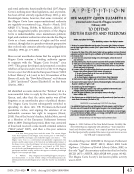
to 2022: the Magna Carta Lawful Rebels [MCLR]. The
MCLR, a predominantly Internet-based phenomenon,
drew from an uneducated and low economic status
population, and originally was organized around a
key guru personality: David Robinson. However,
when Robinson died in late 2020, Canadian “Jacquie
Phoenix” immediately relocated to the UK and seized
the MCLR’s leadership niche. Over the next year
Phoenix conducted numerous in-person gatherings in
the UK in breach of pandemic mitigation regulations,
what Phoenix called the “Redress” process. “Redress”
was to culminate in the seizure of public buildings and
a general revolution to execute existing government
authorities--traitors and seditionists-- by hanging.
Instead, “Redress” fizzled, the MCLR imploded, and
Phoenix largely disappeared.
The MCLR’s dramatic 2019-2021 expansion was likely
supercharged by social stresses resulting from the
COVID-19 pandemic. Up to its sudden dissolution, the
MCLR was a surprisingly cohesive online community,
linked by consistent graphic design, rigorous and
aggressive online forum moderation, and purges of
any non-compliant affiliates, who were denounced as
government “controlled opposition” agents.
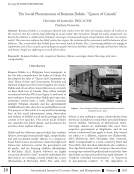
The second study of this type is Christine Sarteschi,
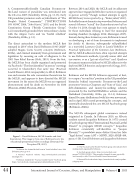
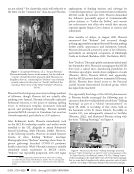
“The Social Phenomenon of Romana Didulo: ‘Queen
of Canada’.” Sarteschi examines the unprecedented
social phenomenon that has developed around
Romana Didulo, a middle-aged Canadian Filipino
immigrant, who claims to exercise sole jurisdiction
in Canada, as Queen of that nation (and sometimes
beyond). Despite providing neither tangible evidence
to support her claims, nor demonstrating any actual
authority, Didulo has accumulated around 60,000-
70,000 followers, and progressed from her initial
status as an online personality, to now travelling
across Canada in a multi-RV convoy, accompanied
by an inner supporter group of uniformed cadres,
conducting in person “meet and greets” with her
followers.
Didulo initially grounded her claims and status in a
QAnon framework, but, subsequently, has developed
her own individual mythology of extraterrestrials
and supernatural entities. Didulo’s success has led to
similar interrelated “monarchs” in other jurisdictions.
Didulo is obtaining substantial funding from her
follower base, who assert Didulo’s authority in
numerous contexts, including refusing to pay debts
and for utilities, and even physical confrontation and
conflict with law enforcement.
Third, Donald Netolitzky, “Jesus Built My Strawman:
The Church of the Ecumenical Redemption
International and “minister” Edward Robin Jay
Belanger,” examines Canada’s longest-standing
pseudolaw movement: the Church of the Ecumenical
Redemption International [CERI]. CERI purports to
be a “religious cult,” a congregation of King James Bible
literalists. However, CERI’s religious identity is a false
front for a “legal cult” directed by artist and criminal
Edward Jay Robin Belanger. Netolitzky reviews 21
legal proceedings that involved CERI to illustrate how
CERI is neither a social, nor a religious community,
but, instead, primarily a vehicle for Belanger to recruit
short-duration personal partners from those already
embedded in pseudolaw circles. Despite CERI having
been in operation for over 20 years, CERI’s scheme
has not undergone any tangible evolution. CERI is not
a social entity, so much as a litigation engine, where
Belanger has repeatedly engaged in hopeless and inept
court activities, in what appears to be a primarily
parasitic arrangement with Belanger’s disposable
followers.
This special issue also includes articles that drill down
to examine certain specific social aspects of pseudolaw
populations, activities, and materials.
2. that examine social group processes and
cues encountered in association with
pseudolaw
3. that observe how pseudolaw movements
recruit, evolve, and, typically, collapse
and 4. that examine how persons inside
pseudolaw movements frame their
relationships with the opposing,
tyrannical New World Order.
This special issue provides the first detailed
investigations of three pseudolaw movements as social
constructs. First, Donald Netolitzky, “Ten Seconds
to Implosion: The Magna Carta Lawful Rebellion,”
conducts a detailed longitudinal review of the rise and
fall of a UK and Canada pseudolaw group between 2014
to 2022: the Magna Carta Lawful Rebels [MCLR]. The
MCLR, a predominantly Internet-based phenomenon,
drew from an uneducated and low economic status
population, and originally was organized around a
key guru personality: David Robinson. However,
when Robinson died in late 2020, Canadian “Jacquie
Phoenix” immediately relocated to the UK and seized
the MCLR’s leadership niche. Over the next year
Phoenix conducted numerous in-person gatherings in
the UK in breach of pandemic mitigation regulations,
what Phoenix called the “Redress” process. “Redress”
was to culminate in the seizure of public buildings and
a general revolution to execute existing government
authorities--traitors and seditionists-- by hanging.
Instead, “Redress” fizzled, the MCLR imploded, and
Phoenix largely disappeared.
The MCLR’s dramatic 2019-2021 expansion was likely
supercharged by social stresses resulting from the
COVID-19 pandemic. Up to its sudden dissolution, the
MCLR was a surprisingly cohesive online community,
linked by consistent graphic design, rigorous and
aggressive online forum moderation, and purges of
any non-compliant affiliates, who were denounced as
government “controlled opposition” agents.
The second study of this type is Christine Sarteschi,
“The Social Phenomenon of Romana Didulo: ‘Queen
of Canada’.” Sarteschi examines the unprecedented
social phenomenon that has developed around
Romana Didulo, a middle-aged Canadian Filipino
immigrant, who claims to exercise sole jurisdiction
in Canada, as Queen of that nation (and sometimes
beyond). Despite providing neither tangible evidence
to support her claims, nor demonstrating any actual
authority, Didulo has accumulated around 60,000-
70,000 followers, and progressed from her initial
status as an online personality, to now travelling
across Canada in a multi-RV convoy, accompanied
by an inner supporter group of uniformed cadres,
conducting in person “meet and greets” with her
followers.
Didulo initially grounded her claims and status in a
QAnon framework, but, subsequently, has developed
her own individual mythology of extraterrestrials
and supernatural entities. Didulo’s success has led to
similar interrelated “monarchs” in other jurisdictions.
Didulo is obtaining substantial funding from her
follower base, who assert Didulo’s authority in
numerous contexts, including refusing to pay debts
and for utilities, and even physical confrontation and
conflict with law enforcement.
Third, Donald Netolitzky, “Jesus Built My Strawman:
The Church of the Ecumenical Redemption
International and “minister” Edward Robin Jay
Belanger,” examines Canada’s longest-standing
pseudolaw movement: the Church of the Ecumenical
Redemption International [CERI]. CERI purports to
be a “religious cult,” a congregation of King James Bible
literalists. However, CERI’s religious identity is a false
front for a “legal cult” directed by artist and criminal
Edward Jay Robin Belanger. Netolitzky reviews 21
legal proceedings that involved CERI to illustrate how
CERI is neither a social, nor a religious community,
but, instead, primarily a vehicle for Belanger to recruit
short-duration personal partners from those already
embedded in pseudolaw circles. Despite CERI having
been in operation for over 20 years, CERI’s scheme
has not undergone any tangible evolution. CERI is not
a social entity, so much as a litigation engine, where
Belanger has repeatedly engaged in hopeless and inept
court activities, in what appears to be a primarily
parasitic arrangement with Belanger’s disposable
followers.
This special issue also includes articles that drill down
to examine certain specific social aspects of pseudolaw
populations, activities, and materials.