Cultic Studies Review, Vol. 2, No. 2, 2003, Page 31
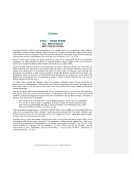
Info-Cult was not formed to promote the forcible removal of individuals from any group and
has not encouraged legislators to pass restrictive laws.
Hexham‘s errors would be more excusable were Info-Cult, the leading cult educational
organization in Canada, incidental to the subject of his article. Since, however, his subject
was ―the anti-cult movement in Canada,‖ he should at least have these basic facts straight.
In the article Hexham writes:
…Josh Freed, who subsequently wrote the best selling book, Moonwebs, and
made the film, Ticket to Heaven based on the book. Before the book was
published, Freed wrote several sensational syndicated articles for The
Montreal Star that ―exposed‖ the Unification Church. (p. 283)
… it is tempting to speculate that this intense anticult activity was the result
of a skillful publicity drive by Freed. As a journalist he was in a position to
promote stories that helped both his book and the subsequent film. (p. 285)
The following comments by Freed challenge the ―scholarship‖ of this article:
This series of ―sensational‖ articles won the 1978 National Newspaper Award
for Feature Writing, the most prestigious award given out in Canadian
journalism…The mainstream ―sensational‖ media regularly fact checks, and I
am often called by fact-checkers when my name is mentioned. You would
think an academic journal would do the same. It‘s bad enough the author
didn‘t call at least the journal should have…This was the worst financial
period of my life and it took me a long time to recover, and I didn‘t do it for
the money, but because I cared about it…If it [his book] did well, it was
because it was well written and well researched. (Personal Communication
June 11, 2002)
I find Hexham‘s choice of words, ―it is tempting to speculate,‖ surprising for an article that
is published in a scholarly journal (i.e., Nova Religio). A simple call to the people about
whom he writes might have eliminated his need to ―speculate.‖
Richard Bergeron
The last example is by Richard Bergeron, founder of the Centre d‘Information sur les
Nouvelles Religions (CINR) in Montreal, now known as the Centre Spiritualités et Religions
de Montréal (Montreal Centre on Spirituality and Religions). In his book, Le Cortege des
Fous de Dieu (1982), Bergeron describes deprogramming as ‗‗une méthode psychiquement
violente qui utilise des moyens coercitifs, comme le kidnappage‖ (p. 458). (English
translation: ―a psychically violent method that uses coercive means, like kidnapping.‖) He
also says: ―Il ne devrait pas favoriser l‘utilisation des techniques de ‗deprogramming,‘
comme Info-culte incline à le faire‖ (p. 456). (English translation: ―One should not favor the
use of ‗deprogramming‘ techniques, as Info-cult is inclined to do.‖)
Once again, such statements are not based on a verification of the primary sources, in this
case, Info-Cult.
Fifteen years later Richard Bergeron (1997) pursues his analysis of Info-Cult:
En 1990, Projet-Culte fermait ses portes comme service de B‘nai B‘rith pour
se constituer en organisme autonome sous le nom d‘Info Cult/Info-Secte. Ce
changement de nom n‘implique aucun changement de perspective ni de
méthode d‘intervention. (p. 33) (English translation: In 1990, the Cult Project
closed their doors as a service of B‘nai B‘rith to form an independent
organization called Info Cult /Info-Secte. This change of name didn‘t involve
any change in their perspective nor their method of intervention.)
Info-Cult was not formed to promote the forcible removal of individuals from any group and
has not encouraged legislators to pass restrictive laws.
Hexham‘s errors would be more excusable were Info-Cult, the leading cult educational
organization in Canada, incidental to the subject of his article. Since, however, his subject
was ―the anti-cult movement in Canada,‖ he should at least have these basic facts straight.
In the article Hexham writes:
…Josh Freed, who subsequently wrote the best selling book, Moonwebs, and
made the film, Ticket to Heaven based on the book. Before the book was
published, Freed wrote several sensational syndicated articles for The
Montreal Star that ―exposed‖ the Unification Church. (p. 283)
… it is tempting to speculate that this intense anticult activity was the result
of a skillful publicity drive by Freed. As a journalist he was in a position to
promote stories that helped both his book and the subsequent film. (p. 285)
The following comments by Freed challenge the ―scholarship‖ of this article:
This series of ―sensational‖ articles won the 1978 National Newspaper Award
for Feature Writing, the most prestigious award given out in Canadian
journalism…The mainstream ―sensational‖ media regularly fact checks, and I
am often called by fact-checkers when my name is mentioned. You would
think an academic journal would do the same. It‘s bad enough the author
didn‘t call at least the journal should have…This was the worst financial
period of my life and it took me a long time to recover, and I didn‘t do it for
the money, but because I cared about it…If it [his book] did well, it was
because it was well written and well researched. (Personal Communication
June 11, 2002)
I find Hexham‘s choice of words, ―it is tempting to speculate,‖ surprising for an article that
is published in a scholarly journal (i.e., Nova Religio). A simple call to the people about
whom he writes might have eliminated his need to ―speculate.‖
Richard Bergeron
The last example is by Richard Bergeron, founder of the Centre d‘Information sur les
Nouvelles Religions (CINR) in Montreal, now known as the Centre Spiritualités et Religions
de Montréal (Montreal Centre on Spirituality and Religions). In his book, Le Cortege des
Fous de Dieu (1982), Bergeron describes deprogramming as ‗‗une méthode psychiquement
violente qui utilise des moyens coercitifs, comme le kidnappage‖ (p. 458). (English
translation: ―a psychically violent method that uses coercive means, like kidnapping.‖) He
also says: ―Il ne devrait pas favoriser l‘utilisation des techniques de ‗deprogramming,‘
comme Info-culte incline à le faire‖ (p. 456). (English translation: ―One should not favor the
use of ‗deprogramming‘ techniques, as Info-cult is inclined to do.‖)
Once again, such statements are not based on a verification of the primary sources, in this
case, Info-Cult.
Fifteen years later Richard Bergeron (1997) pursues his analysis of Info-Cult:
En 1990, Projet-Culte fermait ses portes comme service de B‘nai B‘rith pour
se constituer en organisme autonome sous le nom d‘Info Cult/Info-Secte. Ce
changement de nom n‘implique aucun changement de perspective ni de
méthode d‘intervention. (p. 33) (English translation: In 1990, the Cult Project
closed their doors as a service of B‘nai B‘rith to form an independent
organization called Info Cult /Info-Secte. This change of name didn‘t involve
any change in their perspective nor their method of intervention.)