Cultic Studies Journal, Vol. 15, No. 2, 1998, page 58
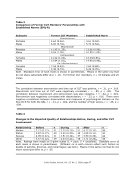
the scoring pattern between the former members of the controversial BCC and their
mainstream comparison groups: BCC scores clearly fell into the abusive range, but none of
the other groups (although different from each other) approached that range.
Personality and Psychiatric Symptomatology
Langone (1996) concluded that cult members‘ personality profiles fall within the normal
range. Walsh et al. (1995) found that although ex-cult members had elevated scores on
the neuroticism scale of the Eysenck Personality Questionnaire, their scores approached
normal as a function of time since leaving the cult. Yeakley (1988) gave the Myers-Briggs
Type Indicator to members of the BCC. He asked them to respond to each item one time as
they would have responded before their conversion, a second time as they perceived
themselves at the time the study was conducted, and a third time as they imagined
themselves answering after five more years of discipling. Nearly all respondents tended to
change their psychological type scores across the three versions. According to Yeakley, the
direction in which these changes occurred was toward the personality of the leader.
A common phenomenon among cult members, which is usually witnessed by their families
and friends but not widely recognized among clinicians, is what West and Martin (1994)
called pseudo-identity or altered persona. It appears to be a dissociative coping response to
extraordinary circumstances such as profound changes in an individual‘s life, prolonged
environmental stress, or both. The pseudo-identity, which is induced, strengthened, and
maintained by the cult environment, becomes superimposed upon the original personality,
which is suppressed while the individual remains in the new stressful environment.
Although a person who is removed from the cult environment may abandon or snap out of
the pseudo-identity and revert back to his or her original personality, this process does not
usually happen without severe psychological problems (Conway &Siegelman, 1995). The
symptoms associated with the pseudo-identity syndrome, which are usually triggered by
environmental cues, are dissociative, trance-like states, depersonalization, derealization,
emotional numbness, and floating, which is a ―switching back and forth between behaviors
characteristic of the two separate personalities‖ (West &Martin, 1994, p. 274). The
restoration of the original identity ―usually requires treatment for the residual post-
traumatic stress disorder (PTSD) which is the legacy of the stress that produced the
pseudo-identity syndrome‖ (West &Martin, 1994, p. 279). Some additional commonly
experienced aftereffects of cult involvement are: (a) depression (b) loneliness and a sense
of alienation (c) low self-esteem and low self-confidence (d) difficulty explaining how they
could have joined such a group (e) phobic-like constriction of social contacts (f) fear of
joining groups or making a commitment (g) apprehension about their own idealism and
altruism (which the cult had manipulated) (h) distrust of professional services and distrust
of self in making good choices (i) problems in reactivating a value system by which to live
(j) guilt, shame, and self-blaming attitudes (k) excessive doubts, fears, and paranoia and
(l) panic attacks (Langone, 1995 Singer, 1979 Singer &Lalich, 1995).
Perceptions of Cult Members and Ex-members
Singer (1978) and Clark (1979) first recognized that dissociative defenses are a mechanism
by which cult members (much like political captives and hostages) adapt to the intense
demands of the environment in which they find themselves. As we have mentioned, the
syndrome associated with this stressful adaptation has since been called pseudo-identity
(West &Martin, 1994). While members are under the group‘s psychological control and are
not in a state of questioning or rebellion, the pseudo-identity can appear to be normal and
well adjusted. However, if an event or outside influence is strong enough to fracture the
pseudo-identity, which until then has enveloped the original self, the underlying pain and
psychological harm become apparent. Langone (1995) insightfully remarked that the
reason why cult members generally do not return to the cult after the floodgates of
the scoring pattern between the former members of the controversial BCC and their
mainstream comparison groups: BCC scores clearly fell into the abusive range, but none of
the other groups (although different from each other) approached that range.
Personality and Psychiatric Symptomatology
Langone (1996) concluded that cult members‘ personality profiles fall within the normal
range. Walsh et al. (1995) found that although ex-cult members had elevated scores on
the neuroticism scale of the Eysenck Personality Questionnaire, their scores approached
normal as a function of time since leaving the cult. Yeakley (1988) gave the Myers-Briggs
Type Indicator to members of the BCC. He asked them to respond to each item one time as
they would have responded before their conversion, a second time as they perceived
themselves at the time the study was conducted, and a third time as they imagined
themselves answering after five more years of discipling. Nearly all respondents tended to
change their psychological type scores across the three versions. According to Yeakley, the
direction in which these changes occurred was toward the personality of the leader.
A common phenomenon among cult members, which is usually witnessed by their families
and friends but not widely recognized among clinicians, is what West and Martin (1994)
called pseudo-identity or altered persona. It appears to be a dissociative coping response to
extraordinary circumstances such as profound changes in an individual‘s life, prolonged
environmental stress, or both. The pseudo-identity, which is induced, strengthened, and
maintained by the cult environment, becomes superimposed upon the original personality,
which is suppressed while the individual remains in the new stressful environment.
Although a person who is removed from the cult environment may abandon or snap out of
the pseudo-identity and revert back to his or her original personality, this process does not
usually happen without severe psychological problems (Conway &Siegelman, 1995). The
symptoms associated with the pseudo-identity syndrome, which are usually triggered by
environmental cues, are dissociative, trance-like states, depersonalization, derealization,
emotional numbness, and floating, which is a ―switching back and forth between behaviors
characteristic of the two separate personalities‖ (West &Martin, 1994, p. 274). The
restoration of the original identity ―usually requires treatment for the residual post-
traumatic stress disorder (PTSD) which is the legacy of the stress that produced the
pseudo-identity syndrome‖ (West &Martin, 1994, p. 279). Some additional commonly
experienced aftereffects of cult involvement are: (a) depression (b) loneliness and a sense
of alienation (c) low self-esteem and low self-confidence (d) difficulty explaining how they
could have joined such a group (e) phobic-like constriction of social contacts (f) fear of
joining groups or making a commitment (g) apprehension about their own idealism and
altruism (which the cult had manipulated) (h) distrust of professional services and distrust
of self in making good choices (i) problems in reactivating a value system by which to live
(j) guilt, shame, and self-blaming attitudes (k) excessive doubts, fears, and paranoia and
(l) panic attacks (Langone, 1995 Singer, 1979 Singer &Lalich, 1995).
Perceptions of Cult Members and Ex-members
Singer (1978) and Clark (1979) first recognized that dissociative defenses are a mechanism
by which cult members (much like political captives and hostages) adapt to the intense
demands of the environment in which they find themselves. As we have mentioned, the
syndrome associated with this stressful adaptation has since been called pseudo-identity
(West &Martin, 1994). While members are under the group‘s psychological control and are
not in a state of questioning or rebellion, the pseudo-identity can appear to be normal and
well adjusted. However, if an event or outside influence is strong enough to fracture the
pseudo-identity, which until then has enveloped the original self, the underlying pain and
psychological harm become apparent. Langone (1995) insightfully remarked that the
reason why cult members generally do not return to the cult after the floodgates of