Cultic Studies Journal, Vol. 15, No. 2, 1998, page 57
observed that being depressed and being between important affiliations are the most
common vulnerability factors predisposing individuals to cult recruitment and that family
dynamics may in some cases contribute to such vulnerability. They also elaborated on the
vast societal, circumstantial, and situational factors impacting individuals‘ receptivity to the
sales pitches of manipulative cult recruiters. Langone (1993) proposed that people join
cults ―because they are duped. The process is a seduction, not a mutually beneficial
agreement or the choice of an informed ‗consumer‘‖ (p. 6). Most experts agree that all
people are potentially vulnerable at different times in their lives, a sobering and alarming
assertion. Lalich (1997) noted an additional argument in support of the view that those
who join cults are not weird, unstable people. She explained that ―cults look for active,
productive, intelligent, energetic individuals who will perform for the cult by fund-raising,
recruiting more followers, and operating cult owned businesses or leading cult-related
seminars‖ (p. 5).
If seeking psychotherapy or counseling is an adequate measure of psychological distress
predating cult involvement, about one-third of those who have been recruited into cults
have had prior psychological problems (Langone, 1995 Martin, 1989 Singer &Lalich,
1995). According to Martin, this rate is only slightly above that of the general population
(which is about one-fourth). However, Singer &Lalich (1995) found that of the one-third of
cultists who sought professional mental health services ―only about five or six percent had
major psychological difficulties prior to joining a cult. The remaining portion of the third had
diagnosable depressions related to personal loss (for example, a death in the family, failure
to be admitted to a preferred university or training program, or a broken romance) or were
struggling with age-related sexual and career dilemmas‖ (p. 17).
Other studies (Goldberg &Goldberg, 1982 Maron, 1989) as well as clinical observations
(Clark, Langone, Schecter, &Daly, 1981 Singer, 1986) indicate that neither family
background nor pre-existing psychological factors adequately predict cult involvement.
When Langone (1995), for example, compared the psychological and family backgrounds of
former Boston Church of Christ (BCC) members to those of former members of two
mainstream groups, he found no significant difference between the groups.
Psychological Abuse
Some theorists (e.g., Langone, 1996 Lifton, 1987, 1991 Singer &Lalich, 1995) have
proposed that cults use a systematic program of psychological manipulation to convince
people to join cults and remain in them. These manipulations may take a severe toll.
Nevertheless, not all cults exercise the same level of abusiveness. If one accepts that cults
use deception in the recruitment and indoctrination process (Andersen, 1985), one cannot
rely on their self-portrayal or any comparisons one may draw from such self-portrayals.
Additionally, comparisons with benign groups are useful, especially for educational
purposes.
The Group Psychological Abuse Scale (Chambers, Langone, Dole, &Grice, 1994) is the first
scientifically developed instrument designed to measure group abuse ascribed to cultic
environments. It is based on research by Dole and Dubrow-Eichel (1985), Langone‘s
(1992) theoretical analysis of psychological abuse, and a review of the clinical literature.
Chambers et al. conducted a factor analysis of 112 descriptive items to identify four distinct
factors associated with cultic environments: Compliance, Exploitation, Mind Control, and
Anxious Dependency.
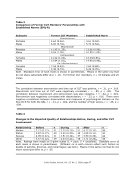
Adams (1993) administered the scale (which she called the cultism scale -the scale had
recently been derived and had not yet been named by Chambers et al., 1994) to former
members of the BCC and former members of a mainstream campus-based Christian
Fellowship. Langone (1995) replicated Adams‘ study, adding a group of former Roman
Catholics to expand the comparison. The results of both studies suggested a definite split in
observed that being depressed and being between important affiliations are the most
common vulnerability factors predisposing individuals to cult recruitment and that family
dynamics may in some cases contribute to such vulnerability. They also elaborated on the
vast societal, circumstantial, and situational factors impacting individuals‘ receptivity to the
sales pitches of manipulative cult recruiters. Langone (1993) proposed that people join
cults ―because they are duped. The process is a seduction, not a mutually beneficial
agreement or the choice of an informed ‗consumer‘‖ (p. 6). Most experts agree that all
people are potentially vulnerable at different times in their lives, a sobering and alarming
assertion. Lalich (1997) noted an additional argument in support of the view that those
who join cults are not weird, unstable people. She explained that ―cults look for active,
productive, intelligent, energetic individuals who will perform for the cult by fund-raising,
recruiting more followers, and operating cult owned businesses or leading cult-related
seminars‖ (p. 5).
If seeking psychotherapy or counseling is an adequate measure of psychological distress
predating cult involvement, about one-third of those who have been recruited into cults
have had prior psychological problems (Langone, 1995 Martin, 1989 Singer &Lalich,
1995). According to Martin, this rate is only slightly above that of the general population
(which is about one-fourth). However, Singer &Lalich (1995) found that of the one-third of
cultists who sought professional mental health services ―only about five or six percent had
major psychological difficulties prior to joining a cult. The remaining portion of the third had
diagnosable depressions related to personal loss (for example, a death in the family, failure
to be admitted to a preferred university or training program, or a broken romance) or were
struggling with age-related sexual and career dilemmas‖ (p. 17).
Other studies (Goldberg &Goldberg, 1982 Maron, 1989) as well as clinical observations
(Clark, Langone, Schecter, &Daly, 1981 Singer, 1986) indicate that neither family
background nor pre-existing psychological factors adequately predict cult involvement.
When Langone (1995), for example, compared the psychological and family backgrounds of
former Boston Church of Christ (BCC) members to those of former members of two
mainstream groups, he found no significant difference between the groups.
Psychological Abuse
Some theorists (e.g., Langone, 1996 Lifton, 1987, 1991 Singer &Lalich, 1995) have
proposed that cults use a systematic program of psychological manipulation to convince
people to join cults and remain in them. These manipulations may take a severe toll.
Nevertheless, not all cults exercise the same level of abusiveness. If one accepts that cults
use deception in the recruitment and indoctrination process (Andersen, 1985), one cannot
rely on their self-portrayal or any comparisons one may draw from such self-portrayals.
Additionally, comparisons with benign groups are useful, especially for educational
purposes.
The Group Psychological Abuse Scale (Chambers, Langone, Dole, &Grice, 1994) is the first
scientifically developed instrument designed to measure group abuse ascribed to cultic
environments. It is based on research by Dole and Dubrow-Eichel (1985), Langone‘s
(1992) theoretical analysis of psychological abuse, and a review of the clinical literature.
Chambers et al. conducted a factor analysis of 112 descriptive items to identify four distinct
factors associated with cultic environments: Compliance, Exploitation, Mind Control, and
Anxious Dependency.
Adams (1993) administered the scale (which she called the cultism scale -the scale had
recently been derived and had not yet been named by Chambers et al., 1994) to former
members of the BCC and former members of a mainstream campus-based Christian
Fellowship. Langone (1995) replicated Adams‘ study, adding a group of former Roman
Catholics to expand the comparison. The results of both studies suggested a definite split in