Cultic Studies Review, Vol. 5, No. 2, 2006, Page 48
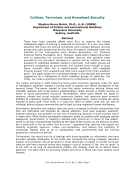
Terrorist Motivations, Extreme Violence, and the Pursuit of
Weapons of Mass Destruction (WMD)
Jaime Gomez, Jr.
Abstract
This essay examines the rationale behind terrorists‘ attempts to use weapons
of mass destruction. The essay explores this theme by comparing Aum
Shinrikyo and al Qaeda in order to assess the extent to which their actions
were the result of strategic choice or the expression of internal group
dynamics. Groups such as al Qaeda, which are motivated by strategic
choice, are more predictable, if their goals are properly understood, and
more likely to respond rationally than are groups such as Aum, which can
reflect the idiosyncratic psychopathology of the leader. However, since both
types of groups can pursue weapons of mass destruction, the most important
goal in counterterrorism should be to make WMD technology and existing
nuclear, biological, and chemical weapons more difficult to obtain.
Succeeding in this goal will reduce the probability of a catastrophe however,
it will not eliminate the lesser but nonetheless horrific destruction achievable
through conventional weapons, especially when creatively used as on 9/11.
To make progress on this front, we must continue to increase our
understanding of how the varieties of terrorist and other destructive groups
operate, psychologically as well as politically and strategically.
Mohammed Hafez cautions that ―Western responses to Islamist violence must be measured
and well thought out. Misconstruing the underlying causes of Islamist rage or overacting to
Islamist violence may only intensify militancy, not temperate it.‖i For policy-makers,
understanding the source or cause of discontent serves as the best hope to remedy the ills
that lie beneath what some refer to as ―sacred‖ terrorism or religious terrorism. Basic
questions arise: What would extremists hope to achieve by resorting to such violent acts?
Is terrorism ever rational? Can terrorism be deterred? All too often, our analysis of
extremist motives begins with our reaction to the terrorist act itself. However, for certain
extremist organizations, successful efforts to identify and isolate the root cause of such
events rests on a deeper understanding of the subtle processes that foment such profound
actions, in particular suicide terrorism and the use of a weapon of mass destruction.
In a recent review of Jessica Stern‘s Terror in the Name of God, Jeff Goodwin stated that
few studies probe deeply into the cause of terrorism and, as a result,
...it remains a mystery. A contributing factor is that social movement
scholars with very few exceptions have said little about terrorism. Nor have
they paid sustained attention to the more general question of how movement
organizations make strategic choices, of which terrorism is one.ii
To resolve group level problems we need to view them from a group level or movement
level perspective. At that point we can craft more tailored solutions to counter the
extremist threat. The central theme of this essay is to examine the rationale behind
terrorists‘ attempts to use weapons of mass destruction. I explore this theme by comparing
Aum Shinrikyo and al Qaeda in order to assess the extent to which their actions were the
result of strategic choice or the expression of internal group dynamics.
In brief, Aum Shinrikyo‘s decision to attack civilians on a Japanese subway reflects an
organization in a desperate fight for survival. According to Martha Crenshaw‘s
organizational perspective, ―terrorist actions often appear inconsistent, erratic, and
Terrorist Motivations, Extreme Violence, and the Pursuit of
Weapons of Mass Destruction (WMD)
Jaime Gomez, Jr.
Abstract
This essay examines the rationale behind terrorists‘ attempts to use weapons
of mass destruction. The essay explores this theme by comparing Aum
Shinrikyo and al Qaeda in order to assess the extent to which their actions
were the result of strategic choice or the expression of internal group
dynamics. Groups such as al Qaeda, which are motivated by strategic
choice, are more predictable, if their goals are properly understood, and
more likely to respond rationally than are groups such as Aum, which can
reflect the idiosyncratic psychopathology of the leader. However, since both
types of groups can pursue weapons of mass destruction, the most important
goal in counterterrorism should be to make WMD technology and existing
nuclear, biological, and chemical weapons more difficult to obtain.
Succeeding in this goal will reduce the probability of a catastrophe however,
it will not eliminate the lesser but nonetheless horrific destruction achievable
through conventional weapons, especially when creatively used as on 9/11.
To make progress on this front, we must continue to increase our
understanding of how the varieties of terrorist and other destructive groups
operate, psychologically as well as politically and strategically.
Mohammed Hafez cautions that ―Western responses to Islamist violence must be measured
and well thought out. Misconstruing the underlying causes of Islamist rage or overacting to
Islamist violence may only intensify militancy, not temperate it.‖i For policy-makers,
understanding the source or cause of discontent serves as the best hope to remedy the ills
that lie beneath what some refer to as ―sacred‖ terrorism or religious terrorism. Basic
questions arise: What would extremists hope to achieve by resorting to such violent acts?
Is terrorism ever rational? Can terrorism be deterred? All too often, our analysis of
extremist motives begins with our reaction to the terrorist act itself. However, for certain
extremist organizations, successful efforts to identify and isolate the root cause of such
events rests on a deeper understanding of the subtle processes that foment such profound
actions, in particular suicide terrorism and the use of a weapon of mass destruction.
In a recent review of Jessica Stern‘s Terror in the Name of God, Jeff Goodwin stated that
few studies probe deeply into the cause of terrorism and, as a result,
...it remains a mystery. A contributing factor is that social movement
scholars with very few exceptions have said little about terrorism. Nor have
they paid sustained attention to the more general question of how movement
organizations make strategic choices, of which terrorism is one.ii
To resolve group level problems we need to view them from a group level or movement
level perspective. At that point we can craft more tailored solutions to counter the
extremist threat. The central theme of this essay is to examine the rationale behind
terrorists‘ attempts to use weapons of mass destruction. I explore this theme by comparing
Aum Shinrikyo and al Qaeda in order to assess the extent to which their actions were the
result of strategic choice or the expression of internal group dynamics.
In brief, Aum Shinrikyo‘s decision to attack civilians on a Japanese subway reflects an
organization in a desperate fight for survival. According to Martha Crenshaw‘s
organizational perspective, ―terrorist actions often appear inconsistent, erratic, and