Cultic Studies Review, Vol. 5, No. 2, 2006, Page 4
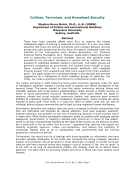
Cultism, Terrorism, and Homeland Security
Stephen Bruce Mutch, Ph.D., LL.B. (UNSW)
Department of Politics and International Relations
Macquarie University
Sydney, Australia
Abstract
There have been renewed efforts since 9/11 to improve the human
intelligence aspect of policing in response to terrorism. It is also now often
observed that there are striking similarities (and overlap) between terrorist
groups and cultic groups that are the focus of research conducted under the
umbrella of the International Cultic Studies Association, Inc. (formerly
American Family Foundation, Inc.). However, public policy makers have been
slow to appreciate the currently available resource and potential asset
provided by the cult-watch movement in general and by scholars who are
prepared to undertake apostate studies in particular. Cult-watch groups are
generally unsupported by government, and scholars brave enough to study
leaver accounts often live a hand-to-mouth existence, with negligible
financial support from academe and little moral support from their academic
peers. This paper argues for a profound change in this attitude and provides
suggestions for a framework in which academic groups (in particular, the
ICSA), can make a significant contribution to contemporary public policy.
The London bombings in 2005 (featuring home-grown terrorists operating under the radar
of intelligence agencies) marked a turning point in popular and official perceptions of the
terrorist threat. The penny started to drop that better community policing (along with
interfaith dialogue and cross-cultural understanding) might provide a fruitful avenue on
which to direct government resources. Nevertheless, while some efforts are made to
reassure, placate and co-opt selected community leaders, real resources seem primarily
directed to expanding empires within intelligence bureaucracies, where recruits are being
enlisted at great pace—most likely in a long term effort to better liaise with (as well as
infiltrate) ethnic/religious communities and to beef up long-neglected human intelligence.
Preventative detention and sedition laws can send a message to Muslim communities that
they are mistrusted and targeted for special attention such laws engender suspicion,
heighten paranoia, and possibly run the risk of amplifying deviance in those pockets where
it might exist. While limited preventative detention might be justified with adequate judicial
safeguards, governments, in treading a delicate path, should err in favour of free speech,
which is not only a fundamental freedom at the heart of the society we are trying to protect,
but a useful ally in the so-called ―war on terror.‖ Legislation that restricts free speech can
certainly engender suspicion, induce non-cooperation, and destroy the credibility of
community leaders seen to be in collaboration with governments that are running
apparently contradictory policies.
Furthermore, the record thus far of dealings with those apostates (or informants) who have
provided valuable intelligence to the police has conveyed the wrong message. Generous
support and protection should be given to those technically in breach of counter-terrorism
laws but who have recanted before they engage in acts of violence. If the ―war on terror‖ is
to be with us as long as governments predict, the strategy must be to attract future
defectors—not deter them by providing lengthy jail terms to those who have already come
forward.
Cultism, Terrorism, and Homeland Security
Stephen Bruce Mutch, Ph.D., LL.B. (UNSW)
Department of Politics and International Relations
Macquarie University
Sydney, Australia
Abstract
There have been renewed efforts since 9/11 to improve the human
intelligence aspect of policing in response to terrorism. It is also now often
observed that there are striking similarities (and overlap) between terrorist
groups and cultic groups that are the focus of research conducted under the
umbrella of the International Cultic Studies Association, Inc. (formerly
American Family Foundation, Inc.). However, public policy makers have been
slow to appreciate the currently available resource and potential asset
provided by the cult-watch movement in general and by scholars who are
prepared to undertake apostate studies in particular. Cult-watch groups are
generally unsupported by government, and scholars brave enough to study
leaver accounts often live a hand-to-mouth existence, with negligible
financial support from academe and little moral support from their academic
peers. This paper argues for a profound change in this attitude and provides
suggestions for a framework in which academic groups (in particular, the
ICSA), can make a significant contribution to contemporary public policy.
The London bombings in 2005 (featuring home-grown terrorists operating under the radar
of intelligence agencies) marked a turning point in popular and official perceptions of the
terrorist threat. The penny started to drop that better community policing (along with
interfaith dialogue and cross-cultural understanding) might provide a fruitful avenue on
which to direct government resources. Nevertheless, while some efforts are made to
reassure, placate and co-opt selected community leaders, real resources seem primarily
directed to expanding empires within intelligence bureaucracies, where recruits are being
enlisted at great pace—most likely in a long term effort to better liaise with (as well as
infiltrate) ethnic/religious communities and to beef up long-neglected human intelligence.
Preventative detention and sedition laws can send a message to Muslim communities that
they are mistrusted and targeted for special attention such laws engender suspicion,
heighten paranoia, and possibly run the risk of amplifying deviance in those pockets where
it might exist. While limited preventative detention might be justified with adequate judicial
safeguards, governments, in treading a delicate path, should err in favour of free speech,
which is not only a fundamental freedom at the heart of the society we are trying to protect,
but a useful ally in the so-called ―war on terror.‖ Legislation that restricts free speech can
certainly engender suspicion, induce non-cooperation, and destroy the credibility of
community leaders seen to be in collaboration with governments that are running
apparently contradictory policies.
Furthermore, the record thus far of dealings with those apostates (or informants) who have
provided valuable intelligence to the police has conveyed the wrong message. Generous
support and protection should be given to those technically in breach of counter-terrorism
laws but who have recanted before they engage in acts of violence. If the ―war on terror‖ is
to be with us as long as governments predict, the strategy must be to attract future
defectors—not deter them by providing lengthy jail terms to those who have already come
forward.