Cultic Studies Review, Vol. 5, No. 2, 2006, Page 10
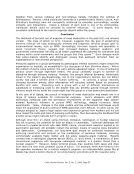
I think that perhaps it might be useful for us to use an alternative model,
and where my thoughts went on this was that really if you think about the
type of behaviour we‘re talking about, it seems to fit all the hallmarks of a
cult, really, and so it might be useful for us, instead of constructing theories
around the idea specifically of Islamic or Islamist extremism, and trying to
deal with that as though it‘s some kind of new animal. It might be better to
think about it in terms of a cult … I think it‘s the same sort of sociological or
human behaviour … cults often play this role in the lives of their members, of
fulfilling some kind of spiritual void, which is of course why they‘re always
linked to some kind of spirituality. Usually it‘s some kind of offshoot of
Christianity, but of course that doesn‘t mean it can‘t happen to other faiths.xiv
This sentiment has recently been reiterated by a Canadian Liberal MP of the Muslim faith,
Wajid Khan, who said,
The onus is on our community to address this problem … We‘re talking about
a cult, a small number of extremists. The majority of us are moderates. But
these are the voices that haven‘t been heard. That has to change. We can‘t
let these people get their roots down here … parents have to stop turning a
blind eye if they notice changes in the behaviour of their teenaged children.xv
What we need, without any doubt, is the establishment of Muslim-based counter-cult
groups. ICSA can provide the blueprint and the guidance. Under present circumstances, we
might even be able to get governments to help—if they can only be helped to understand
the need. I have already written to and spoken with the Australian Attorney-General
recommending the establishment of an ―Islamic cult-watch group along the same lines as
CIFS.‖ The Attorney advised me that he would refer my speech to this conference to his
departmental officers, to see whether there were any ideas worth following up. I think we
should bundle up the entire proceedings for his department to study.
Parliamentary Champions Needed
Politicians in democratic systems, and particularly in lower-house electorates, are in the
game of building alliances, attracting supporters, raising funds, avoiding criticism, and
getting re-elected. When it comes to pursuing the complaints of family members and friends
of people caught up in high-demand cultic groups, or of defectors from such groups, it is
only a very courageous, or some might say stupid, politician who takes up the cause.
I am known to you because as a member of the New South Wales Legislative Council (what
you would call a state senator) I took up the cause of parents and friends of people caught
up in a high-demand group known as Kenja, as well as many defectors from that group who
gave me their written testimonies. Being in the state upper house was efficacious, because
having been elected for two terms and on a party-selected state-wide ticket, I was not
susceptible to the normal concerns of a lower house member, who can be subjected to a
political campaign spearheaded by any interest group, including a religious or quasi-
religious cult, in the member‘s local electorate. Nevertheless, my 1993 call for a select
committee of inquiry to investigate ―the increase in activity of cults in New South Wales,
including deceitful recruitment practices physical and financial exploitation and abuse of
cult members fraudulent fund-raising activities and the misuse of mind-influencing
techniques‖ met with some serious opposition—and from some unexpected quarters.
Indeed, one controversial group, which is generally on the lists of those groups most
complained about (or, to use a euphemism, ―enquired about‖) to ―cult-watch‖ groups,
spearheaded a letter-writing campaign against my private member‘s motion on the grounds
that it was an attack on religions. My proposed motion, on the basis that it might be an
attempt to investigate religious groups, mainstream or otherwise, was characterised as an
I think that perhaps it might be useful for us to use an alternative model,
and where my thoughts went on this was that really if you think about the
type of behaviour we‘re talking about, it seems to fit all the hallmarks of a
cult, really, and so it might be useful for us, instead of constructing theories
around the idea specifically of Islamic or Islamist extremism, and trying to
deal with that as though it‘s some kind of new animal. It might be better to
think about it in terms of a cult … I think it‘s the same sort of sociological or
human behaviour … cults often play this role in the lives of their members, of
fulfilling some kind of spiritual void, which is of course why they‘re always
linked to some kind of spirituality. Usually it‘s some kind of offshoot of
Christianity, but of course that doesn‘t mean it can‘t happen to other faiths.xiv
This sentiment has recently been reiterated by a Canadian Liberal MP of the Muslim faith,
Wajid Khan, who said,
The onus is on our community to address this problem … We‘re talking about
a cult, a small number of extremists. The majority of us are moderates. But
these are the voices that haven‘t been heard. That has to change. We can‘t
let these people get their roots down here … parents have to stop turning a
blind eye if they notice changes in the behaviour of their teenaged children.xv
What we need, without any doubt, is the establishment of Muslim-based counter-cult
groups. ICSA can provide the blueprint and the guidance. Under present circumstances, we
might even be able to get governments to help—if they can only be helped to understand
the need. I have already written to and spoken with the Australian Attorney-General
recommending the establishment of an ―Islamic cult-watch group along the same lines as
CIFS.‖ The Attorney advised me that he would refer my speech to this conference to his
departmental officers, to see whether there were any ideas worth following up. I think we
should bundle up the entire proceedings for his department to study.
Parliamentary Champions Needed
Politicians in democratic systems, and particularly in lower-house electorates, are in the
game of building alliances, attracting supporters, raising funds, avoiding criticism, and
getting re-elected. When it comes to pursuing the complaints of family members and friends
of people caught up in high-demand cultic groups, or of defectors from such groups, it is
only a very courageous, or some might say stupid, politician who takes up the cause.
I am known to you because as a member of the New South Wales Legislative Council (what
you would call a state senator) I took up the cause of parents and friends of people caught
up in a high-demand group known as Kenja, as well as many defectors from that group who
gave me their written testimonies. Being in the state upper house was efficacious, because
having been elected for two terms and on a party-selected state-wide ticket, I was not
susceptible to the normal concerns of a lower house member, who can be subjected to a
political campaign spearheaded by any interest group, including a religious or quasi-
religious cult, in the member‘s local electorate. Nevertheless, my 1993 call for a select
committee of inquiry to investigate ―the increase in activity of cults in New South Wales,
including deceitful recruitment practices physical and financial exploitation and abuse of
cult members fraudulent fund-raising activities and the misuse of mind-influencing
techniques‖ met with some serious opposition—and from some unexpected quarters.
Indeed, one controversial group, which is generally on the lists of those groups most
complained about (or, to use a euphemism, ―enquired about‖) to ―cult-watch‖ groups,
spearheaded a letter-writing campaign against my private member‘s motion on the grounds
that it was an attack on religions. My proposed motion, on the basis that it might be an
attempt to investigate religious groups, mainstream or otherwise, was characterised as an