Cultic Studies Review, Vol. 3, Nos. 2 &3, 2004, Page 89
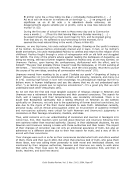
I know who my Older Members, Ti and Do, are. I believe in, cleave to, trust
in, and rely totally upon them. I know my Older Member, Do, is going to his
Older Member, Ti, at this time. Once He is gone, there is nothing left here on
the face of the Earth for me, no reason to stay a moment longer.
Furthermore, I know that my graft to Them would be jeopardized if I linger
here once They have departed. I know my classmates/siblings feel the same
as I do and will be choosing to go when Do goes. I want to stay with my Next
Level family. Choosing to exit this borrowed human vehicle or body and go
home to the Next Level is an opportunity for me to demonstrate my loyalty,
commitment, love, trust, and faith in Ti and Do and the Next Level.
Ultimately, the devoted and enmeshed Heaven‘s Gate students stayed with their leader,
going wherever his decision and course of action would take them. As time wore on, the
formerly unthinkable option of death by their own doing (suicide) became an acceptable act
because it meant they could finally leave. Leaving took precedence over overcoming death.
The final promise of freedom from life on Earth was theirs at last.
To help make some sense of this picture I draw on the works of Anthony Giddens (1979,
1984) Herbert Simon (1955, 1956, 1967, 1979) Edgar Schein (1961, 1992) and Robert
Jay Lifton (1961, 1968, 1986, 1987, 1999). A closed, self-sealing system, as exemplified by
Heaven‘s Gate, holds both positive and negative aspects for its adherents. The positive, or
lure of personal salvation, must be there or no one would ever be attracted to it in the first
place. In cultic groups, this positive and negative dialectic unfolds constantly, as adherents
twist and turn to adapt to the dualistic system. Given that expressing negatives is not
allowed, members focus primarily on their positive interpretations in order to minimize their
feelings of distress as they increase their expressions and acts of faith. If a member wants
to stay with the group—this newfound family—then he or she quickly learns that engaging
the negative is counter to the system. It is through that adaptive (and sometimes coercive)
process that the adherent becomes caught in a self-sealing, cultic system in which she or he
acts, but is also acted upon.
One outcome of this process is a social-psychological state called ―personal closure‖ (Lifton,
1961). The dualistic dimensions of the self-sealing social structure create personal
boundaries around and within the person and constrict the new self, the group-identified
self. The member feels completely separated from his or her pre-group identity and cannot
imagine life outside the group. The state of personal closure is the individualized version of
the larger self-sealing system in which he or she participates and is bound by. The person
turns inward, refusing to look at or consider other ideas, beliefs, or options. The personal
closure that is the culmination of cultic life is profoundly confining because the individual is
closed to both the outside world and her or his own inner life (Lifton 1961). In this instance,
the adherent‘s value structure has been altered, or shifted, by the depth and quality of the
belief change and participation in the social processes (Zablocki 1998). When such a shift
occurs, individual choice is no longer an individual matter.
In this context, human agency (and therefore, free will) is constrained by the duality of
structure—a social-psychological state of being that I have identified as ―bounded choice‖
(Lalich 2001, 2004). The decision-making process is skewed in favor of the collectivity. In
general, organizational choices are made by the leader, for no one else is qualified or has
the authority to do so. Personal choices, if and when they arise, first of all, are formulated
within and constrained by the self-sealing framework and style of consideration, which
always puts the organization first. Second, those choices are limited and bounded by the
constriction of the member‘s thought patterns, which, once more, always put the
organization first. Choice is constrained by both external and internalized sanctions, both
real and imagined. This is the heart of the concept of bounded choice.
I know who my Older Members, Ti and Do, are. I believe in, cleave to, trust
in, and rely totally upon them. I know my Older Member, Do, is going to his
Older Member, Ti, at this time. Once He is gone, there is nothing left here on
the face of the Earth for me, no reason to stay a moment longer.
Furthermore, I know that my graft to Them would be jeopardized if I linger
here once They have departed. I know my classmates/siblings feel the same
as I do and will be choosing to go when Do goes. I want to stay with my Next
Level family. Choosing to exit this borrowed human vehicle or body and go
home to the Next Level is an opportunity for me to demonstrate my loyalty,
commitment, love, trust, and faith in Ti and Do and the Next Level.
Ultimately, the devoted and enmeshed Heaven‘s Gate students stayed with their leader,
going wherever his decision and course of action would take them. As time wore on, the
formerly unthinkable option of death by their own doing (suicide) became an acceptable act
because it meant they could finally leave. Leaving took precedence over overcoming death.
The final promise of freedom from life on Earth was theirs at last.
To help make some sense of this picture I draw on the works of Anthony Giddens (1979,
1984) Herbert Simon (1955, 1956, 1967, 1979) Edgar Schein (1961, 1992) and Robert
Jay Lifton (1961, 1968, 1986, 1987, 1999). A closed, self-sealing system, as exemplified by
Heaven‘s Gate, holds both positive and negative aspects for its adherents. The positive, or
lure of personal salvation, must be there or no one would ever be attracted to it in the first
place. In cultic groups, this positive and negative dialectic unfolds constantly, as adherents
twist and turn to adapt to the dualistic system. Given that expressing negatives is not
allowed, members focus primarily on their positive interpretations in order to minimize their
feelings of distress as they increase their expressions and acts of faith. If a member wants
to stay with the group—this newfound family—then he or she quickly learns that engaging
the negative is counter to the system. It is through that adaptive (and sometimes coercive)
process that the adherent becomes caught in a self-sealing, cultic system in which she or he
acts, but is also acted upon.
One outcome of this process is a social-psychological state called ―personal closure‖ (Lifton,
1961). The dualistic dimensions of the self-sealing social structure create personal
boundaries around and within the person and constrict the new self, the group-identified
self. The member feels completely separated from his or her pre-group identity and cannot
imagine life outside the group. The state of personal closure is the individualized version of
the larger self-sealing system in which he or she participates and is bound by. The person
turns inward, refusing to look at or consider other ideas, beliefs, or options. The personal
closure that is the culmination of cultic life is profoundly confining because the individual is
closed to both the outside world and her or his own inner life (Lifton 1961). In this instance,
the adherent‘s value structure has been altered, or shifted, by the depth and quality of the
belief change and participation in the social processes (Zablocki 1998). When such a shift
occurs, individual choice is no longer an individual matter.
In this context, human agency (and therefore, free will) is constrained by the duality of
structure—a social-psychological state of being that I have identified as ―bounded choice‖
(Lalich 2001, 2004). The decision-making process is skewed in favor of the collectivity. In
general, organizational choices are made by the leader, for no one else is qualified or has
the authority to do so. Personal choices, if and when they arise, first of all, are formulated
within and constrained by the self-sealing framework and style of consideration, which
always puts the organization first. Second, those choices are limited and bounded by the
constriction of the member‘s thought patterns, which, once more, always put the
organization first. Choice is constrained by both external and internalized sanctions, both
real and imagined. This is the heart of the concept of bounded choice.