Cultic Studies Review, Vol. 3, Nos. 2 &3, 2004, Page 32
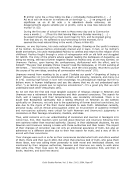
privilege on the basis alone of irrational supernatural belief. The common law of charity,
developed by precedent over centuries, provides us with a common sense and equitable
method of separating the wheat from the chaff. It is important that the public policy
discretions applied under the common law are not lost through the misapplication of
constitutional guarantees applied to the nebulous concept of religion.
Notes
1 This article is based on a paper delivered at the AFF (American Family Foundation) conference in
Edmonton, Alberta, Canada, June 11, 2004.
2 Section 116 of the Australian constitution states, ‗the Commonwealth shall not make any law for
establishing any religion, or for imposing any religious observance, or for prohibiting the free exercise
of any religion, and no religious test shall be required as a qualification for any office or public trust
under the Commonwealth‘, Commonwealth of Australia Constitution Act 1900
3 ‗ ―Charity‖, in its legal sense comprises four principal divisions: trusts for the relief of poverty trusts
for the advancement of education trusts for the advancement of religion and trusts for other
purposes beneficial to the community, not falling under any of the preceeding heads‘, Commissioners
of Income Tax v Pemsel (1891) AC 531. 583 Per Lord Macnaghten.
4 Political purposes are deemed to be non-charitable because it would be difficult to determine whether
a campaign to change government policy would be for the public benefit, and court determinations
would infringe on the sphere of government. However, political purposes ancillary to the main
charitable purpose are acceptable, Gino E Dal Pont, Charity Law in Australia and New Zealand
(Melbourne: Oxford University Press, 2000) 203-7.
5 Religious charities qualify for the full range of benefits available under various Commonwealth
statutes, including income tax exemption, refund of imputation credits, fringe benefits tax (FBT)
rebate, goods and services tax (GST), charity/gift deductible entity concessions and GST religious
organization concessions. However, those organizations that qualify only as a religious institution are
limited to income tax exemption, the FBT rebate and GST religious organization concessions, Hon Ian
Sheppard, Report of the Inquiry into the Definition of Charities and Related Organisations (Canberra,
The Treasury, Commonwealth of Australia: Available online at http://www.cdi.gov.au/html, 2001).
311.
6 ‗Some writers concluded … that the quest for a definition of religion (any definition) is misconceived
and that religious systems, as we know them, have nothing in common that distinguishes them from
all other belief systems: hence ―religion‖ cannot be defined at all‘, Wojciech Sadurski, 'On Legal
Definitions of 'Religion'', ALJ 63 (1989): 840.
7 This test is derived from the joint judgement of Mason ACJ &Brennan J in Church of the New Faith v
Commissioner of Pay-Roll Tax (Victoria) (1983) 154 CLR 120 and has been applied administratively
by the Australian Taxation Office. However, it is arguable that an even more inclusive test might be
derived from the joint judgement of Wilson &Deane JJ and that of Murphy J.
8 Ibid. 136 Per Mason CJ &Brennan J.
9 Francesca Quint and Thomas Spring, 'Religion, Charity Law and Human Rights', The Charity Law and
Practice Review 5, no. 3 (1999): 177-84.
10 See Stephen Kent, 'Lawyer Massimo Introvigne Whines About My Professional Fees' (2004
[Accessed 5 April 2004]) available from
http://www.arts.ualberta.ca/~skent/Linkedfiles/massimo_court.htm.
11 The Commissioner Hindu Religious Endowments Madras v Sri Lakshmindra Thirtha Swamiar of Sri
Shirur Mutt (1954) SCR 1005. 1024 Per Mukherjea J.
12 For example, psychologist Robert Lifton confines ‗the use of cult to groups that display three
characteristics: totalistic or thought-reform-like practices, a shift from worship of spiritual principles to
worship of the guru or leader, and a combination of spiritual quest from below and exploitation,
usually economic or sexual, from above‘, Robert Jay Lifton, Destroying the World to Save It: Aum
privilege on the basis alone of irrational supernatural belief. The common law of charity,
developed by precedent over centuries, provides us with a common sense and equitable
method of separating the wheat from the chaff. It is important that the public policy
discretions applied under the common law are not lost through the misapplication of
constitutional guarantees applied to the nebulous concept of religion.
Notes
1 This article is based on a paper delivered at the AFF (American Family Foundation) conference in
Edmonton, Alberta, Canada, June 11, 2004.
2 Section 116 of the Australian constitution states, ‗the Commonwealth shall not make any law for
establishing any religion, or for imposing any religious observance, or for prohibiting the free exercise
of any religion, and no religious test shall be required as a qualification for any office or public trust
under the Commonwealth‘, Commonwealth of Australia Constitution Act 1900
3 ‗ ―Charity‖, in its legal sense comprises four principal divisions: trusts for the relief of poverty trusts
for the advancement of education trusts for the advancement of religion and trusts for other
purposes beneficial to the community, not falling under any of the preceeding heads‘, Commissioners
of Income Tax v Pemsel (1891) AC 531. 583 Per Lord Macnaghten.
4 Political purposes are deemed to be non-charitable because it would be difficult to determine whether
a campaign to change government policy would be for the public benefit, and court determinations
would infringe on the sphere of government. However, political purposes ancillary to the main
charitable purpose are acceptable, Gino E Dal Pont, Charity Law in Australia and New Zealand
(Melbourne: Oxford University Press, 2000) 203-7.
5 Religious charities qualify for the full range of benefits available under various Commonwealth
statutes, including income tax exemption, refund of imputation credits, fringe benefits tax (FBT)
rebate, goods and services tax (GST), charity/gift deductible entity concessions and GST religious
organization concessions. However, those organizations that qualify only as a religious institution are
limited to income tax exemption, the FBT rebate and GST religious organization concessions, Hon Ian
Sheppard, Report of the Inquiry into the Definition of Charities and Related Organisations (Canberra,
The Treasury, Commonwealth of Australia: Available online at http://www.cdi.gov.au/html, 2001).
311.
6 ‗Some writers concluded … that the quest for a definition of religion (any definition) is misconceived
and that religious systems, as we know them, have nothing in common that distinguishes them from
all other belief systems: hence ―religion‖ cannot be defined at all‘, Wojciech Sadurski, 'On Legal
Definitions of 'Religion'', ALJ 63 (1989): 840.
7 This test is derived from the joint judgement of Mason ACJ &Brennan J in Church of the New Faith v
Commissioner of Pay-Roll Tax (Victoria) (1983) 154 CLR 120 and has been applied administratively
by the Australian Taxation Office. However, it is arguable that an even more inclusive test might be
derived from the joint judgement of Wilson &Deane JJ and that of Murphy J.
8 Ibid. 136 Per Mason CJ &Brennan J.
9 Francesca Quint and Thomas Spring, 'Religion, Charity Law and Human Rights', The Charity Law and
Practice Review 5, no. 3 (1999): 177-84.
10 See Stephen Kent, 'Lawyer Massimo Introvigne Whines About My Professional Fees' (2004
[Accessed 5 April 2004]) available from
http://www.arts.ualberta.ca/~skent/Linkedfiles/massimo_court.htm.
11 The Commissioner Hindu Religious Endowments Madras v Sri Lakshmindra Thirtha Swamiar of Sri
Shirur Mutt (1954) SCR 1005. 1024 Per Mukherjea J.
12 For example, psychologist Robert Lifton confines ‗the use of cult to groups that display three
characteristics: totalistic or thought-reform-like practices, a shift from worship of spiritual principles to
worship of the guru or leader, and a combination of spiritual quest from below and exploitation,
usually economic or sexual, from above‘, Robert Jay Lifton, Destroying the World to Save It: Aum