Cultic Studies Review, Vol. 3, Nos. 2 &3, 2004, Page 39
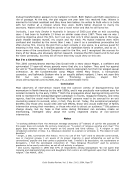
to Anne Mozley, his sister-in-law and editor of his correspondence: ―Of course I cannot
myself be the judge of myself but ...I should say that it is difficult to realize or imagine
the identity of the boy before and after August 1816 ...I can look back at the end of
seventy years as if on another person‖ (Letters and Correspondence 1: 19)
Unamuno, likewise, carefully considers his first spiritual crisis at age 14:
En la época de este cuarto curso, a mis catorce años, cumplióse en mí, en
lecturas de vela y por la obra de la Congregación de San Luis Gonzaga, la
labor de la crisis primera de espíritu, de la entrada del alma en su pubertad. Y
voy a ver si consigo hallar palabras apropiadas y sencillas para contaros
aquella brisa de la maña de mi espíritu. ¡Feliz quien logra resucitar en su
memoria la candorosa expresión de sus años de romanticismo! (Recuerdos
103)
During fourth year, when I was 14, reading late at night and involved with the
Congregation of St. Luis Gonzaga, the work of my first spiritual crisis, my
soul‘s entry into puberty, took place. And I‘ll see if I find appropriate and
simple words to tell of that breeze of the spirit‘s craft. Happy whoever can
bring alive in memory the warm expression of romantic years!1
Unamuno later certainly was not the practicing Catholic, nor was Newman the Evangelical of
their early youth. Both teenagers, before their changes, clung to the upright religion and
morality previously learnt at home. However, some touches of what they later considered to
be superstitions were also present. At the beginning of the Apologia Newman stated how
―even though I had formed no religious conviction ...I used constantly to cross myself on
going into the dark‖ (14).
In Unamuno's case, he remembers his experience of childhood Catholic fervor and piety,
practicing all Holy Mother Church teaches, including praying for indulgences:
Verdad es que recuerdo también cómo habiendo leído en un devocionario una
jaculatoria que proporcionaba cincuenta días de indulgencia a cualquier fiel
por cada vez que devotamente la recitare, nos estuvimos una tarde una
prima mía y yo, sentados sobre la mesa de la cocina, recitándola una y otra
vez durante largo espacio de tiempo y llevando en un papel con raya de un
lápiz la cuenta, no ya de los meses, sino de los años de indulgencia que nos
habíamos ganado. (Recuerdos 22)
It‘s true that I remember as well that having read in a devotional of a prayer
that offered fifty days of indulgence to the faithful every time they devotedly
prayed it, my cousin and I spent an evening seated on the kitchen table,
praying over and over again for a long time and taking note with a pen and
paper, no longer the months, but the years of indulgences which we had won.
At this stage of their lives, Newman and Unamuno evinced an inkling of interest towards a
combination of intellectual philosophy and emotional Christianity. Their teenage study
became a first exposure to the liberal and conservative philosophies characteristic of the
18th and 19th centuries. In the same token, both thinkers began to steer away from
dogmatism towards a personal Christian faith.
The change or conversion took place for Newman when he was 15. John Henry was sent
away to the College at Ealing, where he had to remain after the close of the school term in
June because of the collapse of the bank that Mr. Newman directed. At Ealing, he found a
discreet and dedicated scholar in the Rev. Walter Mayers, a naturally serious man of
character. This shy person was above all dedicated to God, preoccupied with the Gospel
message. Mayers nonetheless always had a yearning for an even more apostolic mission
to Anne Mozley, his sister-in-law and editor of his correspondence: ―Of course I cannot
myself be the judge of myself but ...I should say that it is difficult to realize or imagine
the identity of the boy before and after August 1816 ...I can look back at the end of
seventy years as if on another person‖ (Letters and Correspondence 1: 19)
Unamuno, likewise, carefully considers his first spiritual crisis at age 14:
En la época de este cuarto curso, a mis catorce años, cumplióse en mí, en
lecturas de vela y por la obra de la Congregación de San Luis Gonzaga, la
labor de la crisis primera de espíritu, de la entrada del alma en su pubertad. Y
voy a ver si consigo hallar palabras apropiadas y sencillas para contaros
aquella brisa de la maña de mi espíritu. ¡Feliz quien logra resucitar en su
memoria la candorosa expresión de sus años de romanticismo! (Recuerdos
103)
During fourth year, when I was 14, reading late at night and involved with the
Congregation of St. Luis Gonzaga, the work of my first spiritual crisis, my
soul‘s entry into puberty, took place. And I‘ll see if I find appropriate and
simple words to tell of that breeze of the spirit‘s craft. Happy whoever can
bring alive in memory the warm expression of romantic years!1
Unamuno later certainly was not the practicing Catholic, nor was Newman the Evangelical of
their early youth. Both teenagers, before their changes, clung to the upright religion and
morality previously learnt at home. However, some touches of what they later considered to
be superstitions were also present. At the beginning of the Apologia Newman stated how
―even though I had formed no religious conviction ...I used constantly to cross myself on
going into the dark‖ (14).
In Unamuno's case, he remembers his experience of childhood Catholic fervor and piety,
practicing all Holy Mother Church teaches, including praying for indulgences:
Verdad es que recuerdo también cómo habiendo leído en un devocionario una
jaculatoria que proporcionaba cincuenta días de indulgencia a cualquier fiel
por cada vez que devotamente la recitare, nos estuvimos una tarde una
prima mía y yo, sentados sobre la mesa de la cocina, recitándola una y otra
vez durante largo espacio de tiempo y llevando en un papel con raya de un
lápiz la cuenta, no ya de los meses, sino de los años de indulgencia que nos
habíamos ganado. (Recuerdos 22)
It‘s true that I remember as well that having read in a devotional of a prayer
that offered fifty days of indulgence to the faithful every time they devotedly
prayed it, my cousin and I spent an evening seated on the kitchen table,
praying over and over again for a long time and taking note with a pen and
paper, no longer the months, but the years of indulgences which we had won.
At this stage of their lives, Newman and Unamuno evinced an inkling of interest towards a
combination of intellectual philosophy and emotional Christianity. Their teenage study
became a first exposure to the liberal and conservative philosophies characteristic of the
18th and 19th centuries. In the same token, both thinkers began to steer away from
dogmatism towards a personal Christian faith.
The change or conversion took place for Newman when he was 15. John Henry was sent
away to the College at Ealing, where he had to remain after the close of the school term in
June because of the collapse of the bank that Mr. Newman directed. At Ealing, he found a
discreet and dedicated scholar in the Rev. Walter Mayers, a naturally serious man of
character. This shy person was above all dedicated to God, preoccupied with the Gospel
message. Mayers nonetheless always had a yearning for an even more apostolic mission