Cultic Studies Review, Vol. 3, Nos. 2 &3, 2004, Page 7
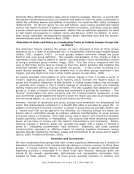
importance of (what he called) intrapsychic factors and their potential contribution to
violence:
...regardless of the biological or psychological system to which one ascribes, it
is clear that a person must end up with a reasonably integrated sense of self
that allows for reasonable goal-directed thinking and acting. Most important,
one must have the intrapsychic mechanisms for resolving anger so that one is
not left with a pool of anger that does not dissipate. If not, the person always
has a pool of anger that can be tapped. This [pool of anger] is the first
favorable condition needed for the development of extremely violent behavior
(Roy 2000:395).
Central to the role that psychiatric and psychosocial dysfunction can contribute to violence
are factors that ―may further compromise an individual‘s ability to have an integrated sense
of self and effective mechanisms for resolving anger‖ (Roy 2000:394).
A. Mental Illnesses
Roy (2000:394) mentioned both ―genetic/biological conditions‖ and ―alcohol and drugs‖ as
culprits, which (separately or in combination) occasionally play crucial roles as either
disinhibiting or catalyzing factors in religious settings of violence. Despite some academic
attempts to minimize the connections between ―organizational outcomes‖ and ―the
personality of a single individual‖ in a leadership position (Melton and Bromley 2002:47),
scholarship has made those connections for several groups (Stark and Bainbridge
1985:174-176).
Sometimes that scholarship has linked theologically sanctioned violence in or by groups to
intrapyschic conditions of leaders, even to some conditions that first appeared in the
leaders‘ childhoods or adolescent periods. Bhagwan Shree Rajneesh, for example,
demonstrated narcissistic characteristics (beginning in childhood) that infused his group‘s
theology and facilitated some of its violence (Clarke 1988 Oakes 1997:53-54). The leader
of Heaven‘s Gate, Marshall Applewhite, demonstrated schizophrenic symptoms in
combination with deep sexual confusion (Hall with Schuyler and Trinh 2000:150 Raine In
Submission). Another leader, David Berg (of the Children of God/The Family), experienced
harsh corporal punishment, oral sex performed by a female adult, and childhood shame
over sex. Together, these experiences translated into group policies during Berg‘s adulthood
that fostered various forms of physical and sexual assaults against women and children
(Kent 1994a 1994b Kent 2001 Kent and Hall 2000). Indeed, Berg‘s adult sexual
behaviour strongly suggests that he was a nonexclusive heterosexual pedophile (American
Psychiatric Association 1994:527-528), as also likely was David Koresh (Breault and King
1993:62-64, 72-73, 78-81, 90-92 Thibodeau and Whiteson 1999:109, 113-114).
Several years before the tragedy at Jonestown, Guyana, a psychiatric examination of Jim
Jones determined that he was ―‗paranoid with delusions of grandeur‘‖ (Reiterman and
Jacobs 1982:262). Speculative diagnoses of Scientology‘s founder, L. Ron Hubbard, include
―anti-social personality‖ (Atack 1990: 371-372) and manic depressive with paranoid
tendencies (Atack 1990:371 Miller 1987:166, 175-176 Oakes 1997:67), but by my
reading he was most likely an individual with a combination of paranoia and narcissism (see
Atack, 1990: 372). Anne Hamilton-Byrne, the Australian leader of a group (called The
Family or the Great White Brotherhood) who brutally trained children whom she believed
―would continue her cult after the earth was consumed by a holocaust‖ (Hamilton-Byrne
1995:1), showed symptoms of psychosis (possibly some form of schizophrenia). According
to a medical doctor who had been the subject (as a child and teenager) of Hamilton-Byrne‘s
training, ―her thoughts skip and derail, she seldom finishes a sentence and she has fantastic
and grandiose delusions‖ (Hamilton-Byrne 1995:110). The doctor noted that her odd speech
importance of (what he called) intrapsychic factors and their potential contribution to
violence:
...regardless of the biological or psychological system to which one ascribes, it
is clear that a person must end up with a reasonably integrated sense of self
that allows for reasonable goal-directed thinking and acting. Most important,
one must have the intrapsychic mechanisms for resolving anger so that one is
not left with a pool of anger that does not dissipate. If not, the person always
has a pool of anger that can be tapped. This [pool of anger] is the first
favorable condition needed for the development of extremely violent behavior
(Roy 2000:395).
Central to the role that psychiatric and psychosocial dysfunction can contribute to violence
are factors that ―may further compromise an individual‘s ability to have an integrated sense
of self and effective mechanisms for resolving anger‖ (Roy 2000:394).
A. Mental Illnesses
Roy (2000:394) mentioned both ―genetic/biological conditions‖ and ―alcohol and drugs‖ as
culprits, which (separately or in combination) occasionally play crucial roles as either
disinhibiting or catalyzing factors in religious settings of violence. Despite some academic
attempts to minimize the connections between ―organizational outcomes‖ and ―the
personality of a single individual‖ in a leadership position (Melton and Bromley 2002:47),
scholarship has made those connections for several groups (Stark and Bainbridge
1985:174-176).
Sometimes that scholarship has linked theologically sanctioned violence in or by groups to
intrapyschic conditions of leaders, even to some conditions that first appeared in the
leaders‘ childhoods or adolescent periods. Bhagwan Shree Rajneesh, for example,
demonstrated narcissistic characteristics (beginning in childhood) that infused his group‘s
theology and facilitated some of its violence (Clarke 1988 Oakes 1997:53-54). The leader
of Heaven‘s Gate, Marshall Applewhite, demonstrated schizophrenic symptoms in
combination with deep sexual confusion (Hall with Schuyler and Trinh 2000:150 Raine In
Submission). Another leader, David Berg (of the Children of God/The Family), experienced
harsh corporal punishment, oral sex performed by a female adult, and childhood shame
over sex. Together, these experiences translated into group policies during Berg‘s adulthood
that fostered various forms of physical and sexual assaults against women and children
(Kent 1994a 1994b Kent 2001 Kent and Hall 2000). Indeed, Berg‘s adult sexual
behaviour strongly suggests that he was a nonexclusive heterosexual pedophile (American
Psychiatric Association 1994:527-528), as also likely was David Koresh (Breault and King
1993:62-64, 72-73, 78-81, 90-92 Thibodeau and Whiteson 1999:109, 113-114).
Several years before the tragedy at Jonestown, Guyana, a psychiatric examination of Jim
Jones determined that he was ―‗paranoid with delusions of grandeur‘‖ (Reiterman and
Jacobs 1982:262). Speculative diagnoses of Scientology‘s founder, L. Ron Hubbard, include
―anti-social personality‖ (Atack 1990: 371-372) and manic depressive with paranoid
tendencies (Atack 1990:371 Miller 1987:166, 175-176 Oakes 1997:67), but by my
reading he was most likely an individual with a combination of paranoia and narcissism (see
Atack, 1990: 372). Anne Hamilton-Byrne, the Australian leader of a group (called The
Family or the Great White Brotherhood) who brutally trained children whom she believed
―would continue her cult after the earth was consumed by a holocaust‖ (Hamilton-Byrne
1995:1), showed symptoms of psychosis (possibly some form of schizophrenia). According
to a medical doctor who had been the subject (as a child and teenager) of Hamilton-Byrne‘s
training, ―her thoughts skip and derail, she seldom finishes a sentence and she has fantastic
and grandiose delusions‖ (Hamilton-Byrne 1995:110). The doctor noted that her odd speech