Cultic Studies Review, Vol. 3, Nos. 2 &3, 2004, Page 80
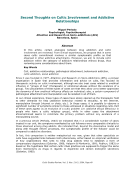
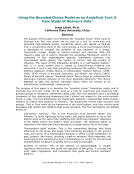
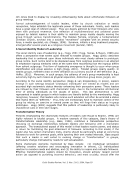
Using the Bounded Choice Model as an Analytical Tool: A
Case Study of Heaven’s Gate1
Janja Lalich, Ph.D.
California State University, Chico
Abstract
The purpose of this paper is to describe the ―bounded choice‖ theory and to
illustrate how this new model can be used as a tool for examining and
analyzing high-demand groups, sometimes called cults. Based on findings
from a comparative study of two cultic groups, a social-psychological theory
is developed to interpret the behavior of true believers in a closed,
charismatic context. Based on textual analysis and interview data, the
Heaven‘s Gate cult is used to illustrate the conceptual framework, which is
comprised of four organizational aspects: charismatic authority, the
transcendent belief system, the system of control, and the system of
influence. The result of this interactive dynamic is a ―self-sealing system,‖
that is, a social system that is closed to disconfirming evidence and
structured in such a way that everything reinforces the system. Drawing on
Anthony Giddens‘s (1984) theory of structuration, Herbert Simon‘s (1955,
1956, 1976) theory of bounded rationality, and Robert Jay Lifton‘s (1961)
theory of personal closure, ―bounded choice‖ theory helps us understand the
seemingly irrational behavior of the most dedicated adherents. The theory
attempts to take into account individual choice within the context of an
authoritarian, transcendent, closed group.
The purpose of this paper is to describe the ―bounded choice‖ theoretical model and to
illustrate how this new model can be used as a tool for examining and analyzing high-
demand groups or situations, sometimes called cults. This new approach uses a conceptual
framework of four interlocking dimensions that I submit are integral to the social dynamic
found in cults. The four dimensions are charismatic authority, transcendent belief system,
systems of control, and systems of influence. The dimensions involve both structure and
process. That is, they make up the framework of the social system, and they include social
processes that uphold and reinforce that social structure. The four dimensions are defined
briefly as:
Charismatic authority: This is the emotional bond between leader and
followers. It lends legitimacy to the leader and grants authority to his or her
actions while at the same time justifying and reinforcing followers‘ responses
to the leader and/or the leader‘s ideas and goals. The relational aspect of
charisma is the hook that links a devotee to a leader and/or his or her ideas.
Transcendent belief system: This is the overarching ideology that binds
adherents to the group and keeps them behaving according to the group‘s
rules and norms. It is transcendent because it offers a total explanation of
past, present, and future, including a path to salvation. Most important, the
leader/group also specifies the exact methodology (or recipe) for the personal
transformation necessary to qualify one to travel on that path.
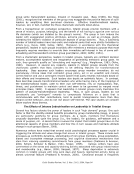
Systems of control: This is the network of acknowledged, or visible,
regulatory mechanisms that guide the operation of the group. It includes the
overt rules, regulations, and procedures that guide and control members‘
behavior.
Using the Bounded Choice Model as an Analytical Tool: A
Case Study of Heaven’s Gate1
Janja Lalich, Ph.D.
California State University, Chico
Abstract
The purpose of this paper is to describe the ―bounded choice‖ theory and to
illustrate how this new model can be used as a tool for examining and
analyzing high-demand groups, sometimes called cults. Based on findings
from a comparative study of two cultic groups, a social-psychological theory
is developed to interpret the behavior of true believers in a closed,
charismatic context. Based on textual analysis and interview data, the
Heaven‘s Gate cult is used to illustrate the conceptual framework, which is
comprised of four organizational aspects: charismatic authority, the
transcendent belief system, the system of control, and the system of
influence. The result of this interactive dynamic is a ―self-sealing system,‖
that is, a social system that is closed to disconfirming evidence and
structured in such a way that everything reinforces the system. Drawing on
Anthony Giddens‘s (1984) theory of structuration, Herbert Simon‘s (1955,
1956, 1976) theory of bounded rationality, and Robert Jay Lifton‘s (1961)
theory of personal closure, ―bounded choice‖ theory helps us understand the
seemingly irrational behavior of the most dedicated adherents. The theory
attempts to take into account individual choice within the context of an
authoritarian, transcendent, closed group.
The purpose of this paper is to describe the ―bounded choice‖ theoretical model and to
illustrate how this new model can be used as a tool for examining and analyzing high-
demand groups or situations, sometimes called cults. This new approach uses a conceptual
framework of four interlocking dimensions that I submit are integral to the social dynamic
found in cults. The four dimensions are charismatic authority, transcendent belief system,
systems of control, and systems of influence. The dimensions involve both structure and
process. That is, they make up the framework of the social system, and they include social
processes that uphold and reinforce that social structure. The four dimensions are defined
briefly as:
Charismatic authority: This is the emotional bond between leader and
followers. It lends legitimacy to the leader and grants authority to his or her
actions while at the same time justifying and reinforcing followers‘ responses
to the leader and/or the leader‘s ideas and goals. The relational aspect of
charisma is the hook that links a devotee to a leader and/or his or her ideas.
Transcendent belief system: This is the overarching ideology that binds
adherents to the group and keeps them behaving according to the group‘s
rules and norms. It is transcendent because it offers a total explanation of
past, present, and future, including a path to salvation. Most important, the
leader/group also specifies the exact methodology (or recipe) for the personal
transformation necessary to qualify one to travel on that path.
Systems of control: This is the network of acknowledged, or visible,
regulatory mechanisms that guide the operation of the group. It includes the
overt rules, regulations, and procedures that guide and control members‘
behavior.