Cultic Studies Review, Vol. 3, Nos. 2 &3, 2004, Page 26
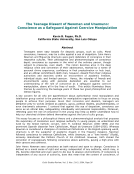
Cults and Religious Privileges in England and Australia:
Can the Wheat be Separated from the Chaff?1
Stephen Bruce Mutch, M.A., LLB.
Solicitor, New South Wales, Australia
Abstract
This paper explores whether it is feasible in Australia to establish an
adjudicative tribunal whereby harmful or deviant religious groups might be
disqualified from receiving fiscal privileges provided to religions generally. The
difficult question of the legal definition of religion, which generally includes
groups pejoratively characterised as cults, is examined. Alternative
approaches of entity disqualification by definition or an inclusive definition
with subsequent policy disqualifications are discussed. It is concluded that
religion is a term best utilized, if at all, as a tool of broad prima facie
classification only, to which transparent public policy parameters might then
be applied in different legislative contexts. Charity law is presented as an
example of a legal context in which public policy criteria are applied to
questions of entitlement. The gate keeping functions of the Charity
Commission for England and Wales are presented as a model for a
prospective adjudicative tribunal in the Australian Commonwealth.
Community protections found in the UK Charities Act 1993 and Article 9 (2) of
the European Convention on Human Rights and Fundamental Freedoms 1950
are noted with approval. The potential impediment of s. 116 of the Australian
Constitution Act 1900, which entrenches notions of free exercise and non-
establishment, is also examined. It is concluded that interpretations of s. 116
requiring a non-discriminatory/neutral aid approach, or a strict separation of
church and state, will be unlikely to prevail. Therefore it would be feasible,
although not without some risk of judicial intervention, for the Commonwealth
to establish a definitions tribunal dealing inter alia with religious applicants for
Commonwealth fiscal dispensations. However, the existence of s. 116 would
make it unlikely for State governments, which are unaffected by the section,
to submit cooperatively to a Commonwealth definitions entitlement tribunal
dealing with third sector entities which include by definition religious groups
The defining word religion and associated terms such as denomination or worship are
commonly used in public policy contexts in the United Kingdom and Australia. The word
religion appears in the Australian constitution, where it invokes free exercise and non-
establishment provisions,1 and it is found often in ordinary statutes. Religious freedom is
also a concept acknowledged and supported generally by the courts.2 The word religion may
relate to individuals or groups and may be used to attract legal protections or confer
privileges, fiscal and otherwise. Public policy contexts involving religion include, inter alia,
rating exemptions for places of worship, marriage celebration, exemptions from military
conscription, denominational schools accreditation, employment and anti-discrimination law
exemptions, deductible donations, religious charitable trusts, exemptions from fundraising
legislation, taxation exemptions and official prayers.
While the concept of religious freedom may be invoked to protect individuals or possibly
groups against actions which might infringe upon that freedom, this paper is focused on
fiscal privileges provided to religious groups or institutions defined by law. For example,
under the law of charity, which developed by precedent under the common law,
Cults and Religious Privileges in England and Australia:
Can the Wheat be Separated from the Chaff?1
Stephen Bruce Mutch, M.A., LLB.
Solicitor, New South Wales, Australia
Abstract
This paper explores whether it is feasible in Australia to establish an
adjudicative tribunal whereby harmful or deviant religious groups might be
disqualified from receiving fiscal privileges provided to religions generally. The
difficult question of the legal definition of religion, which generally includes
groups pejoratively characterised as cults, is examined. Alternative
approaches of entity disqualification by definition or an inclusive definition
with subsequent policy disqualifications are discussed. It is concluded that
religion is a term best utilized, if at all, as a tool of broad prima facie
classification only, to which transparent public policy parameters might then
be applied in different legislative contexts. Charity law is presented as an
example of a legal context in which public policy criteria are applied to
questions of entitlement. The gate keeping functions of the Charity
Commission for England and Wales are presented as a model for a
prospective adjudicative tribunal in the Australian Commonwealth.
Community protections found in the UK Charities Act 1993 and Article 9 (2) of
the European Convention on Human Rights and Fundamental Freedoms 1950
are noted with approval. The potential impediment of s. 116 of the Australian
Constitution Act 1900, which entrenches notions of free exercise and non-
establishment, is also examined. It is concluded that interpretations of s. 116
requiring a non-discriminatory/neutral aid approach, or a strict separation of
church and state, will be unlikely to prevail. Therefore it would be feasible,
although not without some risk of judicial intervention, for the Commonwealth
to establish a definitions tribunal dealing inter alia with religious applicants for
Commonwealth fiscal dispensations. However, the existence of s. 116 would
make it unlikely for State governments, which are unaffected by the section,
to submit cooperatively to a Commonwealth definitions entitlement tribunal
dealing with third sector entities which include by definition religious groups
The defining word religion and associated terms such as denomination or worship are
commonly used in public policy contexts in the United Kingdom and Australia. The word
religion appears in the Australian constitution, where it invokes free exercise and non-
establishment provisions,1 and it is found often in ordinary statutes. Religious freedom is
also a concept acknowledged and supported generally by the courts.2 The word religion may
relate to individuals or groups and may be used to attract legal protections or confer
privileges, fiscal and otherwise. Public policy contexts involving religion include, inter alia,
rating exemptions for places of worship, marriage celebration, exemptions from military
conscription, denominational schools accreditation, employment and anti-discrimination law
exemptions, deductible donations, religious charitable trusts, exemptions from fundraising
legislation, taxation exemptions and official prayers.
While the concept of religious freedom may be invoked to protect individuals or possibly
groups against actions which might infringe upon that freedom, this paper is focused on
fiscal privileges provided to religious groups or institutions defined by law. For example,
under the law of charity, which developed by precedent under the common law,