Cultic Studies Review, Vol. 3, Nos. 2 &3, 2004, Page 158
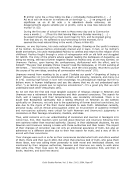
A book about cults becomes all the more fascinating – and useful – when we learn how
these charismatic, and often coercive, groups in our midst are far from ―strange,‖ but
instead have characteristics that interconnect quite deeply with mainstream issues and
concerns. The final chapter, ―The Terrorist Threat,‖ makes such links and brings home once
again the significance of our study of cults. As Doris Lessing writes in the Foreword,
―Terrorists are highly trained ruthless groups waiting in the United States and the countries
of Europe to murder, poison and destroy. Let us catch them, if we can. In order to
understand them we must learn the laws that govern cults and brainwashing‖ (p. xv). This
book is surely one step in that direction. Perhaps you read Deikman‘s The Wrong Way Home
ten years ago or more. Don‘t let that deter you from this new edition. Them and Us is well
worth reading it is incisive, extremely useful, and ultimately forward-looking. Clear and
well-written, it is also a good basic book for high school or college courses in psychology,
social psychology, American history, American culture, and current events.
Janja Lalich, Ph.D.
Department of Sociology, California State University, Chico
The Power of Persuasion: How We’re Bought and Sold
Robert V. Levine
New York: John Wiley &Sons. 2003, Cloth, 278 pages.
The author is a social psychologist and department head whose ―ultimate interest is how
people are manipulated to do things they never thought they‘d do‖ (p. 4). He defines
persuasion as ―psychological dynamics that cause people to be changed in ways they
wouldn‘t if left alone‖ (4). Before writing the book he attended sales training seminars,
―listened to hucksters selling everything from Tupperware and cosmetics to health and
religion‖ and ―took jobs selling cars and hawking cutlery door-to-door‖ (1). He tells us his
research led to three conclusions: (1) we are more susceptible than we would like to
believe (2) the most effective persuaders are the least obvious (3) rules of persuasion are
similar regardless of the source. If the book succeeds it would have the advantage of a
psychology professor who applies objective research to the subjective realities learned
firsthand in the marketplace. As Shakespeare put it, that would be ―a consummation
devoutly to be wished.‖ Let‘s review each of the ten chapters, then evaluate the author‘s
effort to help us ―shift the balance of control to or side‖ (28).
Chapter 1 serves as a wake-up call to how easily we can be manipulated. According to
Levine the ―psychology of persuasion‖ has three ―directions:‖ characteristics of the source
mind-set of the target person the psychological context.
We underestimate susceptibility to death or disease by smoking, drinking, overeating, and
natural disaster and the likelihood of unwanted pregnancy, AIDS, and job satisfaction. This
―fundamental attribution error‖ is well researched and cited. Statistics prove advertising
sells, even by deceptively embedded products in movies and reverse psychology in ads such
as ―if TV is bad for you why is there one in every hospital room?‖ Product placement can
―bounce you through a store like a billiard ball‖ (28). All these are examples of the subject
matter of the new field of consumer anthropology.
Chapter 2 is subtitled ―Supersalesmen who don‘t look like salesmen at all.‖ It describes
seemingly informal in-home product demonstrations and ―parties.‖ Three characteristics
make for sales: perceived authority, honesty, and likability. ―Studies show‖ or ―doctors
prescribe‖ stated forthrightly implies authority. Slanted statistics and technical jargon can
seem convincing but have little relevance. Offering choices or reasons but ―coloring‖ one is
an effective deceptive technique. Propaganda is effective when hidden as education or daily
news. Testimonials by those you admire or like impress and sell but are only one person‘s
opinion. Peer pressure is used in the social pyramid of each-friend-refer-a-friend. Gallup
A book about cults becomes all the more fascinating – and useful – when we learn how
these charismatic, and often coercive, groups in our midst are far from ―strange,‖ but
instead have characteristics that interconnect quite deeply with mainstream issues and
concerns. The final chapter, ―The Terrorist Threat,‖ makes such links and brings home once
again the significance of our study of cults. As Doris Lessing writes in the Foreword,
―Terrorists are highly trained ruthless groups waiting in the United States and the countries
of Europe to murder, poison and destroy. Let us catch them, if we can. In order to
understand them we must learn the laws that govern cults and brainwashing‖ (p. xv). This
book is surely one step in that direction. Perhaps you read Deikman‘s The Wrong Way Home
ten years ago or more. Don‘t let that deter you from this new edition. Them and Us is well
worth reading it is incisive, extremely useful, and ultimately forward-looking. Clear and
well-written, it is also a good basic book for high school or college courses in psychology,
social psychology, American history, American culture, and current events.
Janja Lalich, Ph.D.
Department of Sociology, California State University, Chico
The Power of Persuasion: How We’re Bought and Sold
Robert V. Levine
New York: John Wiley &Sons. 2003, Cloth, 278 pages.
The author is a social psychologist and department head whose ―ultimate interest is how
people are manipulated to do things they never thought they‘d do‖ (p. 4). He defines
persuasion as ―psychological dynamics that cause people to be changed in ways they
wouldn‘t if left alone‖ (4). Before writing the book he attended sales training seminars,
―listened to hucksters selling everything from Tupperware and cosmetics to health and
religion‖ and ―took jobs selling cars and hawking cutlery door-to-door‖ (1). He tells us his
research led to three conclusions: (1) we are more susceptible than we would like to
believe (2) the most effective persuaders are the least obvious (3) rules of persuasion are
similar regardless of the source. If the book succeeds it would have the advantage of a
psychology professor who applies objective research to the subjective realities learned
firsthand in the marketplace. As Shakespeare put it, that would be ―a consummation
devoutly to be wished.‖ Let‘s review each of the ten chapters, then evaluate the author‘s
effort to help us ―shift the balance of control to or side‖ (28).
Chapter 1 serves as a wake-up call to how easily we can be manipulated. According to
Levine the ―psychology of persuasion‖ has three ―directions:‖ characteristics of the source
mind-set of the target person the psychological context.
We underestimate susceptibility to death or disease by smoking, drinking, overeating, and
natural disaster and the likelihood of unwanted pregnancy, AIDS, and job satisfaction. This
―fundamental attribution error‖ is well researched and cited. Statistics prove advertising
sells, even by deceptively embedded products in movies and reverse psychology in ads such
as ―if TV is bad for you why is there one in every hospital room?‖ Product placement can
―bounce you through a store like a billiard ball‖ (28). All these are examples of the subject
matter of the new field of consumer anthropology.
Chapter 2 is subtitled ―Supersalesmen who don‘t look like salesmen at all.‖ It describes
seemingly informal in-home product demonstrations and ―parties.‖ Three characteristics
make for sales: perceived authority, honesty, and likability. ―Studies show‖ or ―doctors
prescribe‖ stated forthrightly implies authority. Slanted statistics and technical jargon can
seem convincing but have little relevance. Offering choices or reasons but ―coloring‖ one is
an effective deceptive technique. Propaganda is effective when hidden as education or daily
news. Testimonials by those you admire or like impress and sell but are only one person‘s
opinion. Peer pressure is used in the social pyramid of each-friend-refer-a-friend. Gallup