Cultic Studies Review, Vol. 3, Nos. 2 &3, 2004, Page 48
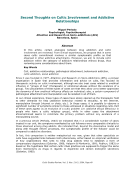
Second Thoughts on Cultic Involvement and Addictive
Relationships
Miguel Perlado
Psychologist, Psychotherapist
Attention and Research on Socio-addictions (AIS)
Barcelona, Spain
Abstract
In this article, certain analogies between drug addiction and cultic
involvement are reviewed. From clinical experiences, we propose that in some
cases cultic commitment involves a similar symptomatic profile as that
observed in other addictive attachments. Moreover, we aim to include cultic
addiction within the category of addictive relationships without drugs, thus
reviewing some considerations about them.
Key Words
Cult, addictive relationships, pathological attachment, behavioural addiction,
cultic addiction, social addiction
Since it was founded in 1977, Attention and Research on Socio-Addictions (AIS), a pioneer
organization in Spain that provides information and advice on cults, has focused its
therapeutic activity on cultic involvement, although we also treat cases related to unethical
influence in ―groups of two‖ (therapeutic or emotional abuses without the existence of a
group). Two peculiarities of these types of cases are that they allow us to better appreciate
the dynamics of how unethical influence affects an individual also, a certain component of
pathological attachment and manipulation can be isolated in all of them.
In our clinical experience, these types of cases have slowly opened up the therapeutic field
to other demands for help (addictive behaviour related to sexuality, to the Internet,
manipulation through Internet or chats, etc.). In these cases, it is possible to observe a
significant number of symptoms similar to those witnessed in situations regarding cults. Part
of these cases appear as an evolution of a cultic problem (i.e. addictive sexual behaviour in
people who leave a cultic religious group), while in other cases the attachment
aforementioned seems to constitute the primary problem without any existence of a
manipulating source.
In a previous article (Perlado, 2003) we indicated that in a considerable number of cases
treated in our unit, the symptoms manifested by cult followers were comparable clinically to
those observed among drug addicts. We indicated that, beyond the dissociative model and
along with thought reform processes, the symptomatic profile of the follower could be
compared to addictive disorders.
In fact, this comparison is neither metaphorical nor new, given that other specialists on
cults have suggested links between both phenomena, either based on empirical verification
of how organizations that seek to help drug addicts tend to establish a form of
compensatory dependence (Galanter, 1980 Halperin &Markowitz, 1991 Rebhun, 1983) or
based on the hypothesis that certain cultic ritual practices are supposed to trigger the same
brain mechanisms as drugs in regards to dopamine and certain endorphin secretions
(Galanter, 1980).
Second Thoughts on Cultic Involvement and Addictive
Relationships
Miguel Perlado
Psychologist, Psychotherapist
Attention and Research on Socio-addictions (AIS)
Barcelona, Spain
Abstract
In this article, certain analogies between drug addiction and cultic
involvement are reviewed. From clinical experiences, we propose that in some
cases cultic commitment involves a similar symptomatic profile as that
observed in other addictive attachments. Moreover, we aim to include cultic
addiction within the category of addictive relationships without drugs, thus
reviewing some considerations about them.
Key Words
Cult, addictive relationships, pathological attachment, behavioural addiction,
cultic addiction, social addiction
Since it was founded in 1977, Attention and Research on Socio-Addictions (AIS), a pioneer
organization in Spain that provides information and advice on cults, has focused its
therapeutic activity on cultic involvement, although we also treat cases related to unethical
influence in ―groups of two‖ (therapeutic or emotional abuses without the existence of a
group). Two peculiarities of these types of cases are that they allow us to better appreciate
the dynamics of how unethical influence affects an individual also, a certain component of
pathological attachment and manipulation can be isolated in all of them.
In our clinical experience, these types of cases have slowly opened up the therapeutic field
to other demands for help (addictive behaviour related to sexuality, to the Internet,
manipulation through Internet or chats, etc.). In these cases, it is possible to observe a
significant number of symptoms similar to those witnessed in situations regarding cults. Part
of these cases appear as an evolution of a cultic problem (i.e. addictive sexual behaviour in
people who leave a cultic religious group), while in other cases the attachment
aforementioned seems to constitute the primary problem without any existence of a
manipulating source.
In a previous article (Perlado, 2003) we indicated that in a considerable number of cases
treated in our unit, the symptoms manifested by cult followers were comparable clinically to
those observed among drug addicts. We indicated that, beyond the dissociative model and
along with thought reform processes, the symptomatic profile of the follower could be
compared to addictive disorders.
In fact, this comparison is neither metaphorical nor new, given that other specialists on
cults have suggested links between both phenomena, either based on empirical verification
of how organizations that seek to help drug addicts tend to establish a form of
compensatory dependence (Galanter, 1980 Halperin &Markowitz, 1991 Rebhun, 1983) or
based on the hypothesis that certain cultic ritual practices are supposed to trigger the same
brain mechanisms as drugs in regards to dopamine and certain endorphin secretions
(Galanter, 1980).