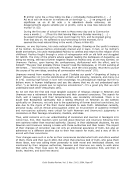
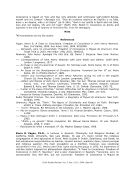
Cultic Studies Review, Vol. 3, Nos. 2 &3, 2004, Page 5
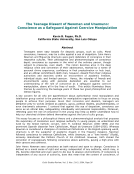
Scientific Evaluation of the Dangers Posed by Religious
Groups: A Partial Model1
Stephen A. Kent, Ph.D.
Department of Sociology,
University of Alberta,
Edmonton, Alberta, Canada
Abstract
This article borrows from family-violence and sociology-of-religion literature
to provide a biopsychosocial model for evaluating religious danger. Taking its
departure from Kenneth G. Roy‘s model of four necessary levels of analysis
concerning the determination of violent behaviour, this article identifies four
interrelated ―domains‖ that contribute to, and help explain, religious violence,
especially within alternative religious groups. These domains include 1)
intrapsychic or biopsychosocial contributors 2) interpersonal contributors 3)
intragroup contributors and 4) intergroup contributors. Each of these
contributors has various subcategories, many of which have parallels in
family-violence literature.
Religiously driven violence fills the pages of history with battles, crusades, martyrs, and
persecution. Yet similar themes recur in our era, as religion continues to motivate
contemporaries around the world to perform heroic acts of courage and dramatic gestures
of rage. Certainly, more religions exist now than ever before in history, as secular tolerance
allows—and some say catalyzes—people‘s claims to have been moved by the word of God.
Consequently, in addition to the world‘s major religions, which themselves often have
violent legacies, we now also face threats from some smaller, newer, but occasionally
dangerous new faiths.
High-profile events involving a few new religions drew attention to the reality of violence by
and, often, against those religions. If we limit our understanding of violence to ―multiple
homicide or suicide,‖ then we can identify (according to the religious scholars Gordon Melton
and David Bromley) some twenty newer religions implicated in violence in the last years of
the twentieth century (Melton and Bromley 2002:44). Although they do not tell us which
ones they identified, and their restricted definition overlooks failed attempts at killing
(including shoot-outs and non-lethal bombings, poisoning, arson, assaults, etc.), certainly
this list includes ones (such as People‘s Temple and Aum Shinrikyo) that we all know (see
Appendix). If, however, we use a broader, more comprehensive definition of violence—the
use of force or its threat, causing harm or abuse—then the list of violent, newer religions is
uncountable. Now we must identify groups that allow or at least facilitate the following:
corporal punishment medical neglect or assault (Asser and Swan 1998 Swan 1998)
spousal violence punitive dietary restrictions exhausting work regimes private,
demanding re-education and punishment programs (Kent 2001) sexual assaults emotional
battering and socio-political terrorism. Significant about the more widely drawn lists of
violence in these religions is how many of the acts of religious aggression resemble, in
varying degrees, what we know goes on within violent family settings.
Several reasons suggest why an examination of family violence literature might provide key
insights into predicting violence among some religions. Both types of organizations—violent
families and abusive religions—tend to be ―somewhat detached from a society with which
they are at tension ...and charismatically led. Intense relations, intimate face-to-face
Scientific Evaluation of the Dangers Posed by Religious
Groups: A Partial Model1
Stephen A. Kent, Ph.D.
Department of Sociology,
University of Alberta,
Edmonton, Alberta, Canada
Abstract
This article borrows from family-violence and sociology-of-religion literature
to provide a biopsychosocial model for evaluating religious danger. Taking its
departure from Kenneth G. Roy‘s model of four necessary levels of analysis
concerning the determination of violent behaviour, this article identifies four
interrelated ―domains‖ that contribute to, and help explain, religious violence,
especially within alternative religious groups. These domains include 1)
intrapsychic or biopsychosocial contributors 2) interpersonal contributors 3)
intragroup contributors and 4) intergroup contributors. Each of these
contributors has various subcategories, many of which have parallels in
family-violence literature.
Religiously driven violence fills the pages of history with battles, crusades, martyrs, and
persecution. Yet similar themes recur in our era, as religion continues to motivate
contemporaries around the world to perform heroic acts of courage and dramatic gestures
of rage. Certainly, more religions exist now than ever before in history, as secular tolerance
allows—and some say catalyzes—people‘s claims to have been moved by the word of God.
Consequently, in addition to the world‘s major religions, which themselves often have
violent legacies, we now also face threats from some smaller, newer, but occasionally
dangerous new faiths.
High-profile events involving a few new religions drew attention to the reality of violence by
and, often, against those religions. If we limit our understanding of violence to ―multiple
homicide or suicide,‖ then we can identify (according to the religious scholars Gordon Melton
and David Bromley) some twenty newer religions implicated in violence in the last years of
the twentieth century (Melton and Bromley 2002:44). Although they do not tell us which
ones they identified, and their restricted definition overlooks failed attempts at killing
(including shoot-outs and non-lethal bombings, poisoning, arson, assaults, etc.), certainly
this list includes ones (such as People‘s Temple and Aum Shinrikyo) that we all know (see
Appendix). If, however, we use a broader, more comprehensive definition of violence—the
use of force or its threat, causing harm or abuse—then the list of violent, newer religions is
uncountable. Now we must identify groups that allow or at least facilitate the following:
corporal punishment medical neglect or assault (Asser and Swan 1998 Swan 1998)
spousal violence punitive dietary restrictions exhausting work regimes private,
demanding re-education and punishment programs (Kent 2001) sexual assaults emotional
battering and socio-political terrorism. Significant about the more widely drawn lists of
violence in these religions is how many of the acts of religious aggression resemble, in
varying degrees, what we know goes on within violent family settings.
Several reasons suggest why an examination of family violence literature might provide key
insights into predicting violence among some religions. Both types of organizations—violent
families and abusive religions—tend to be ―somewhat detached from a society with which
they are at tension ...and charismatically led. Intense relations, intimate face-to-face