Cultic Studies Journal, Vol. 12, No. 1, 1995, page 72
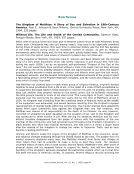
The New Satanists. Linda Blood. Warner Books, New York, NY, 1994, 244 pages.
Death and the sun! Who can outstare them?
--Duc de la Rochefoucauld, Maxims.
To those who, like this reader, bring unprejudiced minds to the subject of Satanism, having
no personal experience of it, Linda Blood‟s excellent new book comes as a revelation. She
has woven her own unhappy history of involvement with the Temple of Set and its
charismatic occultist leader into a larger tapestry, from the Middle Ages to today‟s news, of
a phenomenon so unrelievedly ugly that it is easier to ignore or belittle than to try to
comprehend it.
From history, she cites the case of Baron Gilles de Rais, Joan of Arc‟s heroic champion, in
his later years unmasked as a sadistic pedophile obsessed with alchemy and its associated
black arts that required the sacrifice of young children‟s flesh and blood, crimes for which he
was hanged and burned. In the reign of Louis XIV, two centuries later, the Paris police
uncovered a large network of sorcerers, midwives, and abortionists trafficking in Black
Masses and poisons (some meant as “love potions”) in the service of France‟s highest
nobility and aristocracy, including the king‟s chief mistress, Madame de Montespan. One of
the most thorough investigations in French history produced volumes of evidence so
explosive that, while the worst of the monsters were executed, exiled, or imprisoned for life,
their Parisian society clients went free, with the notebooks locked up and forgotten until the
late 19th century.
The notorious black magician, Aleister Crowley, was this century‟s guru to many occultists,
including Satanists. L. Ron Hubbard, years before he founded Scientology as a religion, was
one of Crowley‟s followers. His estranged son, Ron DeWolf, claimed that his father was
“secretly immersed in black magic from his teenage years,” and “thought of himself as the
Beast 666 incarnate ...the Antichrist.” Two former Scientologists formed the Process Church
in 1964, and taught “the rather gnostic-sounding belief that Christ and Satan had put aside
their enmity and would soon join forces to bring about the end of the world.” The group
produced “slick, glossy magazines filled with images of death, Nazi symbolism, and
exhortations ...„to release the fiend that lies dormant in you,‟ to rape, kill and destroy.”
According to Blood, Anton LaVey, often dismissed by the media as “a harmless con artist,”
cleverly built friendly relationships with San Francisco police as well as many professionals
in law, medicine, education, and business, while selling worldwide his Satanic Bible, which
she says “every teenage „dabbler‟ in the country appears to have devoured,” and that
“police sources report that it is almost invariably found among the personal effects of
youthful „experimenters‟ in satanic crime.”
These crimes are in many cases very nearly beyond belief. And in three chapters on Satanic
Ritual Child Abuse, Adult Survivors of Ritual Abuse, and The Presidio Child Molestations,
Blood confronts perhaps the most controversial of all situations. As a former insider in the
Temple of Set, she knows the leading characters in the Presidio day care center case, in
which “Setians” were deeply involved. Blood also has sources within organized crime
intelligence and professionals in child abuse treatment. She is well aware that “skepticism is
a normal reaction to anything too horrifyingly bizarre to be easily believed, and there is no
denying that it has been somewhat offset by the hysterical reactions of uninformed
individuals who see a satanic child abuser under every bush. However, the fact that a crime
is „weird‟ does not exempt us from our obligation to seek justice for the victims. If even a
fraction of the allegations of child victims and adult survivors are true, we are looking at a
social evil so insidious and so ominous that we have no choice but to work to eradicate it as
we would any other form of criminal activity.”
The New Satanists. Linda Blood. Warner Books, New York, NY, 1994, 244 pages.
Death and the sun! Who can outstare them?
--Duc de la Rochefoucauld, Maxims.
To those who, like this reader, bring unprejudiced minds to the subject of Satanism, having
no personal experience of it, Linda Blood‟s excellent new book comes as a revelation. She
has woven her own unhappy history of involvement with the Temple of Set and its
charismatic occultist leader into a larger tapestry, from the Middle Ages to today‟s news, of
a phenomenon so unrelievedly ugly that it is easier to ignore or belittle than to try to
comprehend it.
From history, she cites the case of Baron Gilles de Rais, Joan of Arc‟s heroic champion, in
his later years unmasked as a sadistic pedophile obsessed with alchemy and its associated
black arts that required the sacrifice of young children‟s flesh and blood, crimes for which he
was hanged and burned. In the reign of Louis XIV, two centuries later, the Paris police
uncovered a large network of sorcerers, midwives, and abortionists trafficking in Black
Masses and poisons (some meant as “love potions”) in the service of France‟s highest
nobility and aristocracy, including the king‟s chief mistress, Madame de Montespan. One of
the most thorough investigations in French history produced volumes of evidence so
explosive that, while the worst of the monsters were executed, exiled, or imprisoned for life,
their Parisian society clients went free, with the notebooks locked up and forgotten until the
late 19th century.
The notorious black magician, Aleister Crowley, was this century‟s guru to many occultists,
including Satanists. L. Ron Hubbard, years before he founded Scientology as a religion, was
one of Crowley‟s followers. His estranged son, Ron DeWolf, claimed that his father was
“secretly immersed in black magic from his teenage years,” and “thought of himself as the
Beast 666 incarnate ...the Antichrist.” Two former Scientologists formed the Process Church
in 1964, and taught “the rather gnostic-sounding belief that Christ and Satan had put aside
their enmity and would soon join forces to bring about the end of the world.” The group
produced “slick, glossy magazines filled with images of death, Nazi symbolism, and
exhortations ...„to release the fiend that lies dormant in you,‟ to rape, kill and destroy.”
According to Blood, Anton LaVey, often dismissed by the media as “a harmless con artist,”
cleverly built friendly relationships with San Francisco police as well as many professionals
in law, medicine, education, and business, while selling worldwide his Satanic Bible, which
she says “every teenage „dabbler‟ in the country appears to have devoured,” and that
“police sources report that it is almost invariably found among the personal effects of
youthful „experimenters‟ in satanic crime.”
These crimes are in many cases very nearly beyond belief. And in three chapters on Satanic
Ritual Child Abuse, Adult Survivors of Ritual Abuse, and The Presidio Child Molestations,
Blood confronts perhaps the most controversial of all situations. As a former insider in the
Temple of Set, she knows the leading characters in the Presidio day care center case, in
which “Setians” were deeply involved. Blood also has sources within organized crime
intelligence and professionals in child abuse treatment. She is well aware that “skepticism is
a normal reaction to anything too horrifyingly bizarre to be easily believed, and there is no
denying that it has been somewhat offset by the hysterical reactions of uninformed
individuals who see a satanic child abuser under every bush. However, the fact that a crime
is „weird‟ does not exempt us from our obligation to seek justice for the victims. If even a
fraction of the allegations of child victims and adult survivors are true, we are looking at a
social evil so insidious and so ominous that we have no choice but to work to eradicate it as
we would any other form of criminal activity.”